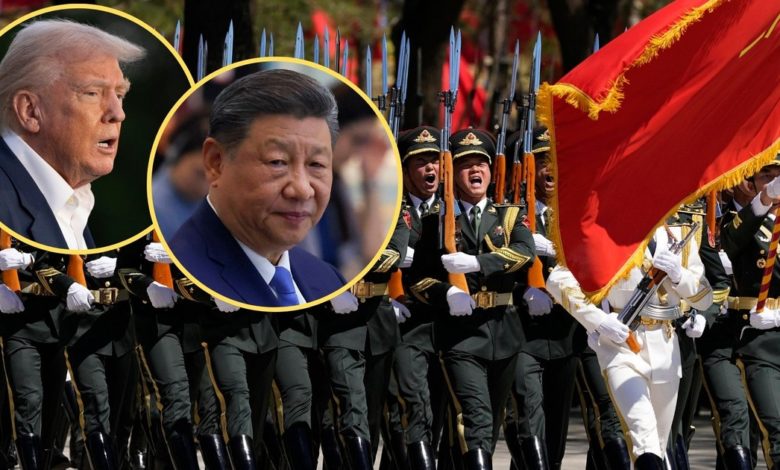
Relations between America and China are in the stagnation phase. Duties significantly exceeding 100 percent Trade broke on both sides. Each party strives for dominance in the field of 21st century technology, such as artificial intelligence. A huge expansion of military potential is underway. In the previous Cold War, this competition reached the climax at such inflammatory points as the Air Bridge over Berlin and the Cuban crisis. Today, America's determination will probably be put to the Taiwan trial – and faster than many expect.
China claims the rights to Taiwan and claim that they are ready for invasion, especially if Taiwan announces independence. Taiwan, however, wants to remain self -governing democracy. America agrees this contradiction with risky ambiguity. It works to prevent the formal disconnection of Taiwan, even if he opposes the use of force to solve the dispute and sells a weapon to Taiwan without a security guarantee.
In recent years, this deadlock has become even more tight. The last three presidential elections in Taiwan were won by the Democratic Progressive Party (DPP), which is in favor of independence. Since 2010, the economic importance of the island has increased rapidly, because the local company TSMC dominated the production of advanced semiconductors, including semiconductors for artificial intelligence.
China expenditure on defense increased three times per dollars, weakening the decisive military advantage of America in Asia. American strategists stick to the hope that as long as their country is able to reliably signal the readiness to fight, the President of China XI Jinping will postpone the realization of its life goal, which is the unification of China. The war about Taiwan would be a disaster: why would XI risk his legacy and the future of the communist China party, an invasion that may end terribly?
Currently, three factors question this hope.
Firstly, Under Trump's rule, America loses its deterrent. The president and his hawks support the room through strength. They present a trade war and a departure from Europe as evidence that Trump is fighting with China at the center of his foreign policy.
Unfortunately, the trade war brings the opposite effect. In 2024, Trump said that if China tried to invade Taiwan, he would put on the duties: “I will apply duties on you from 150 to 200 percent.” Currently, duties are 145 percent America fired its last cartridge. The trade war is about who will withstand greater pain and China think they can win it.
Protectionism also harms America's allies. Taiwan threatens a tax of 32 percent, and Trump presses on TSMC to move the factories to America. Australia, Japan and South Korea are in the face of duties and demands to separate from China, which are their large trading partner. No Asian state intends to break the security alliance with America: none has an alternative. However, states will be even more reluctant to get involved in the fight for Taiwan.
Continuation of the material under the video
Chinese Tactics of the Gray Zone
Secondly, New Chinese plans for Taiwan bypass a risky plant about everything or nothing that an open invasion would be. China is still working on taking over the island by force. The recent “Strait Thunder” exercises consisted of its 38 Navy ships. However, China is also testing innovative, more brutal tactics of “gray zone” that do not lead to an open war. The list is headed by temporary quarantine and customs controls of ships in Taiwanese waters, using significantly developed Chinese coasting guard forces.
China's goal would be to challenge the sovereignty of Taiwan and sit in doubt among his citizens, whether America will be able or wants to help them in the event of an invasion. Many private shipping companies can be subordinated to quarantine. The international criticism of one of them may be less sharp after a Chinese diplomatic campaign conducted since 2023, as a result of which 70 countries supported “all” efforts to union, creating a cover for any actions, from control to invasion.
The Chinese tactic of the gray zone aims to use the third factor, which is the chronic dysfunction of Taiwan's policy. Although few Taiwanese want to be part of communist China, their policy suffers from a toxic polarization mixture and complacency. Since the election last year, President Lai Ching-Te has been sharing power with the parliament led by KMT, which gives way to continental China, and a new third party supported by young Taiwanese disappointed DPP.
Ritchie B. Tongo / PAP
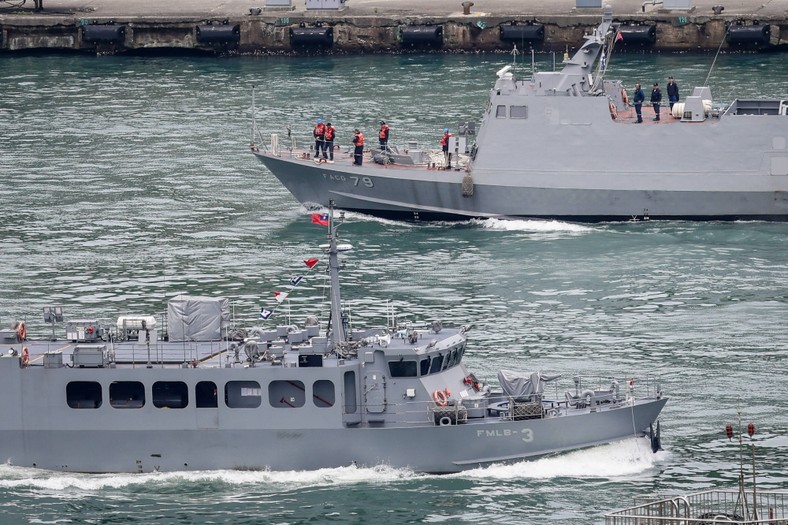
Kuang Hua VI class rocket boat (at the top) and Mine Mine Mine Jiang patrols the port during Chinese and armed and armed exercises near Taiwan, Keelung, Taiwan, April 2, 2025.
The disastrous spiral of events in Taiwan
The resulting impasse prevents Taiwan from taking decisive actions to increase defense expenditure, reduce dependence on imported energy or prepare for the crisis. The president's efforts to fight Chinese infiltration have the opposite effect, deepening polarization.
What would it mean? It would be a disaster for the Taiwanese democracy. Over time, Taiwan could even choose a government favorable to China. It would also cause panic related to the supply of chips from the West. This would not necessarily mean the end of America's domination in the Pacific. But the renewal of this dominance would require a lot of effort.
The Chinese folk and browning army could free resources, gaining a larger range. The US armed forces would have to move from the current defense position of the first chain of the islands, located near China, to the second chain of the island connecting Japan and Guam. Allies in Asia would need new economic and military treaties to feel safe. They could get nuclear weapons without it.
Trump wants to show his strength. His protectionism and a hard attitude towards allies are to make America great, but they weaken its ability to protect Taiwan. This contradiction will not be unnoticed in Beijing. Until recently, XI had reasons to think that he should wait with taking control of Taiwan. Now it may come to the conclusion that an opportunity has come to use before it is too late.
I’m Ashley Davis as an editor, I’m committed to upholding the highest standards of integrity and accuracy in every piece we publish. My work is driven by curiosity, a passion for truth, and a belief that journalism plays a crucial role in shaping public discourse. I strive to tell stories that not only inform but also inspire action and conversation.