“Putin crossed the border.” Economy in crisis. He left one way left

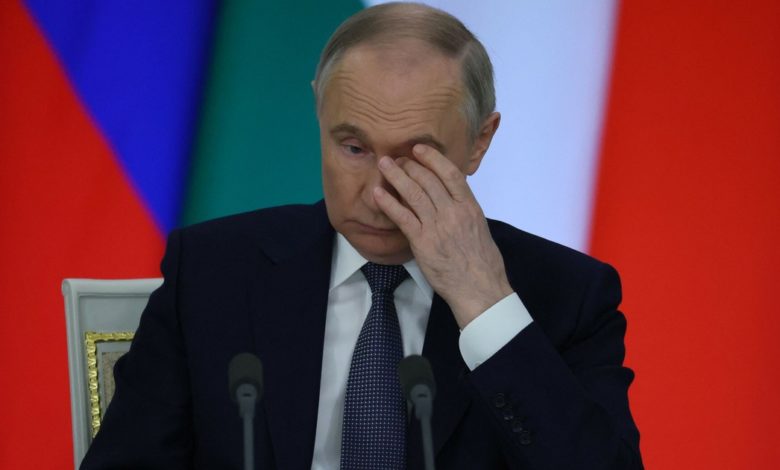
From 2022, the Russian authorities claimed that the “special military operation” could not be considered a real war and that it did not expose Russia to high costs. On the contrary – it can only bring them prosperity.
These words were reflected in official data-according to them in 2022-2024, GDP value increased by an average of 6.9 percent. Even faster, according to the Kremlin's promises, the wealth of “ordinary” citizens was to grow. To confirm these words, the authorities presented research conducted by the Russian Central Bank – in one of them 65 percent. The surveyed Russians stated that during the three years of war their real income increased.
These voices were finally reflected in economic analyzes. Some experts even began to claim that the Russian economy lacked only war and international boycott to really flourish. The authorities activated hidden reserves, introduced an import substitution and increased the army expenditure, which officially corresponded to raising the standard of living of most citizens. Everything was fine. Skillfully used “Military Keynesism” did a miracle.
However, the Russians will pay a lot for this miracle. The transition period is over and they are just beginning to feel what account Putin has issued to them.
All these assurances were not a fantasy of the Russian authorities, a rather exaggeration. The Russian economy had large reserves – both financial and those regarding the trust of citizens in the competence of the financial authorities.
Apparently production has actually increased in three years, though not as noticeably as Rosstat claims. This increase occurred thanks to the intensification of work in the military economy. In the production of civil rights, half or even by the end of 2024, stagnation could be observed. The production of ammunition and weapons increased, but the prices of food products were particularly suffering from it. The Russians could live as before.
Who will weaken faster
Russian war expenses are growing continuously. According to Stockholm SIPRI Analytical Center estimates, in 2024 they reached $ 149 billion. (approx. PLN 564 billion, 7.1 percent of Russia's GDP) – by $ 83 billion (PLN 314 billion) more than in the pre -war 2021 in 2025, if the war continues to continue, they will probably increase by another four or even a third, reaching the level of $ 200 billion. (PLN 757 billion) and reaching 8 percent Russian GDP.
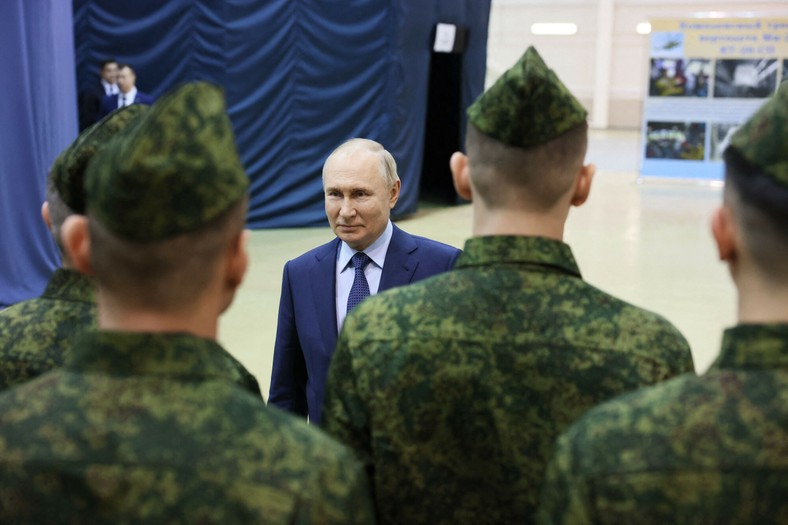
Vladimir Putin visiting the Training Center of the Russian Army Torżoku in the Twerski District, March 27, 2024.
And even if there is a suspension of hostilities, this is unlikely to reduce the militarization of the country to which the regime leads. He needs arms race not only to maintain an advantage over Ukraine, but also to exert pressure both on “new” NATO members (from Bulgaria to Estonia) and the “latest” (Finland and Sweden). The ultimatum that Putin erected in December 2021 – that NATO must withdraw from Eastern Europe – he still remains valid for him. Putin officials and agitators repeat them many times.
Do not treat these threats as a metaphor. Russia is already building railway lines at the border with Estonia and Finland, expands the military bases located there, prepares new military units with the intention of sending them to that area. In the years 2022-2024, after Russian aggression to Ukraine, “new” and “newest” NATO members-according to SIPRI calculations-increased their expenses on the army by $ 37 billion. (approx. PLN 140 billion). Putin apparently believes that he can and should gain an advantage over them too.
Does the growth of Russian expenses on the army translate into a real increase in the military power of this country? This is not obvious to everyone. “In recent months, Putin skillfully masks the terrible situation in Russia, presenting impressive reports about the power of his army and economic successes. Russia does not win war, we are at the stage of its weakening” – this is a fragment of the opinion of pro -Ukrainian experts. However, not only Russia weakens.
Apparently Russian production of armored equipment does not really compensate for the losses suffered by the Kremlin army on the front. However, the supplies of armored equipment from the West to Ukraine have also decreased. Deficiency of ammunition in the Russians, because of which the Russian Federation is so dependent on North Korea, is one side of the coin. The second is that American and European production capacity in the field of ammunition turned out to be much smaller than Russian.
Therefore, in Putin's eyes, economic and military competition with the West does not look hopeless. However, it consumes more and more resources, a The Russian economy has already reached the peak of its abilities and overheated.
How to maintain the economy
Trying to raise it and protect the country from inflation, the Central Bank raised a key interest rate to a record level of 21 percent. Initially, this caused confusion, but the last months have shown that the new rules are starting to work.
From the beginning of 2025, the Russian index of industrial production (including seasonality) decreases from month to month. Under the pressure of very high interest rates, the civil sector limits the production of goods and services. The military sector credited under special programs, however, does not reduce.
“If we consider the dynamics of industrial production without sectors with the dominant presence of the military-industrial complex, we can talk about the transition to the recession. In the first quarter the production of civil rights fell by 0.8 percent per month (after eliminating seasonality). As a result, the level of production reached the lowest values from April 2023” – informs the Government Analytical Center CMAKP.
According to the calculations of this center, in March 2025, the general industrial index (corrected by a difference in the number of working days) amounted to 100.3 percent, and the index in civil sectors – 97.9 percent. This means that the civil industries recorded a decrease during the year, and the others (i.e. military) continued growth. And this is because the authorities redirect resources from food products to ammunition and weapons.
The MMI channel on the telegram writes about the same: “The data from February showed that thanks to military production, the industry achieved maximum; in the civil industries the decline was already beginning. In March we can see further restrictions …”.
There are fewer goods and services from imports to the Russian market of goods and services. From January to March 2025, the value of the import of goods dropped to $ 64.9 billion. (PLN 246 billion) – from PLN 67.1 billion (PLN 254 billion) in the same period last year. In fact, this decrease is much higher due to the inflation of the dollar. The import of goods from Europe also decreased by 9 percent during the year, and its share in Russian imports dropped to 24 percent.
The inheritance can be seen in almost all sectors
Only in a few civil sectors, thanks to the effective replacement of imports, you can still observe growth. This is, for example, in the production of drugs or textiles. However, most of the non -war sectors are affected by a decline. This applies to almost all industries – from the production of building materials to the food industry, which after many years of growth began to fall.
As for building materials-the state statistics have not yet learned to cheat and, recognizing the decrease in their production, contrary to logic, it announced a rapid increase in housing construction during January-Marzec (by the entire 8.9 percent compared to the first quarter of 2024).
This “growth” resulted from a sharp decline in multi -family buildings (by 17 %) and a decorated increase in construction of single -family houses (by 20 %). Registration of long -standing summer houses as newly built is at its best. In fact, only the increase in single -family housing in Tuwa and the Ryazan region – in regions providing mercenaries to the army, looks reliable.
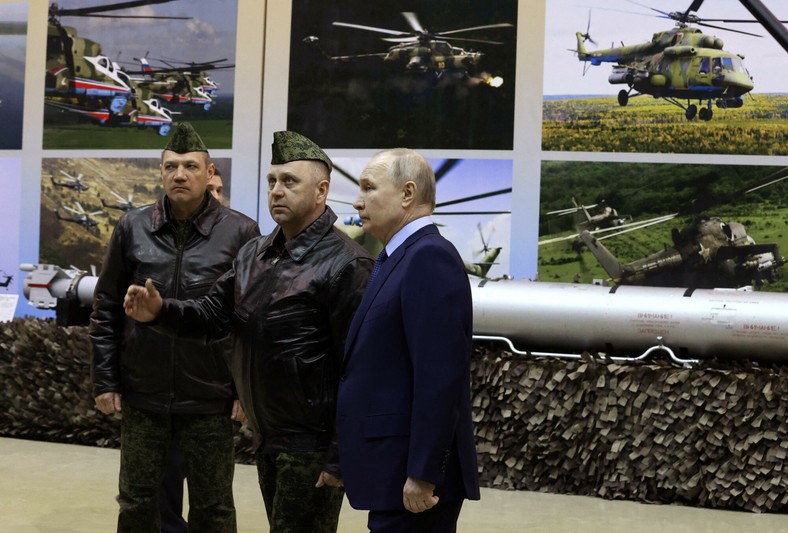
Vladimir Putin in Torżok, 27 March 2024
In the first quarter of 2025, Russian banks granted 43.7 percent less mortgage loans and launched by 25 percent less new construction projects than a year ago. The decrease in housing construction is just beginning.
The crisis has also returned to the automotive market. Thanks to the mass import of Chinese cars and partial restoration of its own production in 2024, the sale of new cars returned to the level before the war, from 2021 in the first quarter of 2025. In Russia, however, was sold by 25 percent. less cars than a year ago, and in March by up to 45.5 percent less.
In addition, the purchases of other expensive and less expensive durable goods, such as smartphones, have also dropped. Their sales in the first quarter decreased by 26 percent.
Everything before the Russians
The causes of the general decline in demand for non -food goods are the subject of stormy expert discussions. Apparently, however, they do not lie in the absence of money in Russian wallets, in temptingly high interest on deposits and deterrently high interest on loans, in the expectations of the abolition of sanctions and the return of “real” – that is, Western – brands and in some other, maybe even more naive social hopes.
Regardless of the cause of the decline in demand, it was he, along with the temporary strengthening of the ruble, slowed down the increase in prices of “non -food” goods in March. If the Russians try to buy the same number of goods and services as last year, they will immediately feel a sharp increase in inflation. The Russian market is no longer able to provide citizens as many products as before.
The regime chose weapons and ammunition and quietly withdraws from his own narrative about the alleged love for the people. Not all large -scale projects cancel, suspend or freeze a lot. An example of this is worth $ 2 trillion. (approx. 7.6 trillion) Moscow-Sankt Petersburg connection. 13 months ago Putin personally and with a great pump “began building a fast railway” (such a wording ordered to use all Russian publications).
Despite such a loud inauguration of the “Started” project, the construction did not even start. – In mid -2025 we will start construction works – one of the officials recently repeated. Bureaucrats will probably still be waiting for the end of the war and the emergence of money that is not there now.
Russia, though not immediately, crossed the borderfor which the expansion of military force can only be achieved by receiving resources from the inhabitants of the state. The way of confiscation of property may change, but the regime has already exhausted the other reserves.
So it's time to ask another question: how much are they ready to give his subjects to Putin? Do they resemble Stalin subjects with their selflessness? One would like to think that this is not the case at this stage.