The enigmas of a treasure of solid gold. How were the bizarre 3000 -year -old witch cones found on the territory of Europe

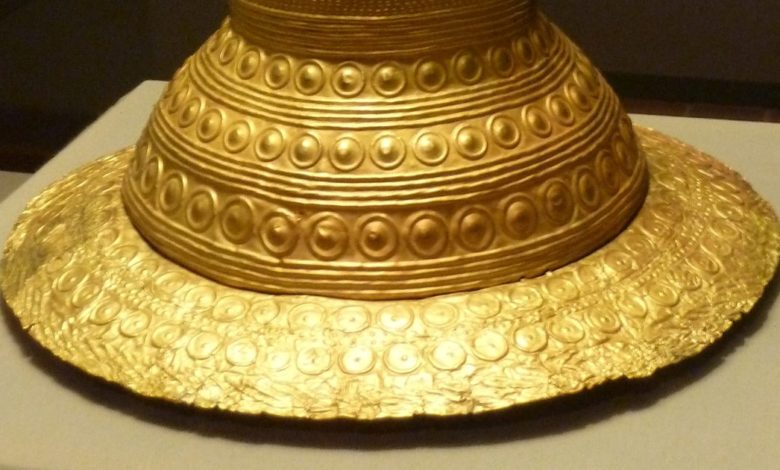
One of the largest mysteries in the world is a collection of gold “hats”, over 3000 years old, discovered in Central Europe. They are full of strange symbols and were found on a large area. Not until today the specialists have found an explanation about their role.
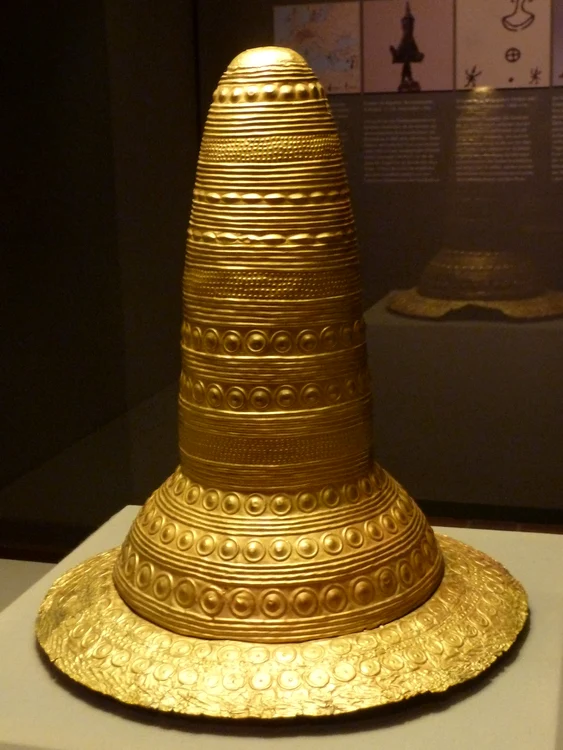
The golden “hat” discovered at Schifferstadt Photo Wikipedia
The story of human civilizations in the territory of Europe hides many mysteries. One of the most tangled puzzles is a series of massive gold objects discovered over time on a large area, comprising today's territory, Switzerland and France. Some archaeologists have told them “hats” others “cones”, it is certain that no one knows what they used and whether they were worn or not. These objects are large and their surface is covered with numerous mysterious symbols. Some specialists believe that they were “hats” worn by shamans, wizards of time, people who own all the science and magical power of the tribe.
Bizarre artifacts from Central Europe
According to specialists but also archaeological evidence, these are four such massive, conical gold objects, with a surface, at the base, large enough in diameter to be placed on a man's head. Their height varies between 29 and 88 centimeters. It is estimated that they are about 3000 years old and belonged to populations from the Bronze Age that lived in Central and Western Europe. It is not excluded that such objects will be discovered in other areas, such as the Eastern European area. All four gold “hats” were made, according to the dates made by specialists, between 1400-800 BC, which indicates a tradition of their production and use for about six hundred years. The first golden “hat” was discovered in 1835 in Schifferstadt in Germany. It is named in the specialized works “Golden hat from Schifferstadt” and was found by a farmer. The specialists believe that this conical-shaped object was made between 1400-1300 BC and was intentionally buried, in the form of an offer. This is proven by the fact that the “hat” was accompanied by three bronze axes, deposited symmetrically, on an burnt fire. The object has a height of 29 centimeters and a diameter, at the base, 18 centimeters.
The second “hat” was discovered in France, Avanton, in 1844. Dating indicates that the object was achieved between 1000-900 ÎHR. This time, the height of the cone reaches 55 centimeters and weighs over 285 grams. And this object was accompanied by an inventory of gold pieces.
The third “hat” was accidentally discovered, in 1953, by a handful of farmers who removed the roots of cut trees. The discovery took place between the villages of Ezelsdorf and Buch from southern Germany. It is the highest cone, with 88 centimeters. It is assumed that it was deposited, like the others, along with an inventory, but unfortunately, the place of discovery was disturbed by the works.
Finally, the fourth “hat” bears the name of “Berlin's Golden Hat” and was found by German specialists, in the 90's, at an antiquity fair. The artifact came from a private collection in Switzerland. In fact, in Switzerland, it was discovered in the 60s, but it was not declared to the authorities. It bears the name of the “golden hat from Berlin” because it was immediately purchased by the Berlin Museum. Experts say it was made between 1000 and 800 BC and has a height of 75 centimeters. All these objects, although found on a large area, resembles strikingly. All, they were ritually deposited by suggesting a special magic-religious importance.
The mysterious symbols of a missing world
These “hats” impress mainly through the beauty of the work but also of the symbolism. The “Berlin gold hat”, for example, weighs 490 grams and is made of about 90% of gold. As the specialized studies show, including “von Hüten, Kegeln und Kalendern Oder Das Blendend Licht des Orients” by Mark Schmidt, the cone was made of a single piece of material and was beaten to a thickness of 0.66 millimeters. The cone is decorated with 21 lanes that divide the piece into sectors full of symbols, such as wheels, circles, stamps. At the base, the cone was reinforced with a bronze ring. It also has a gold “boron” at the base, which led to the shape of a hat.
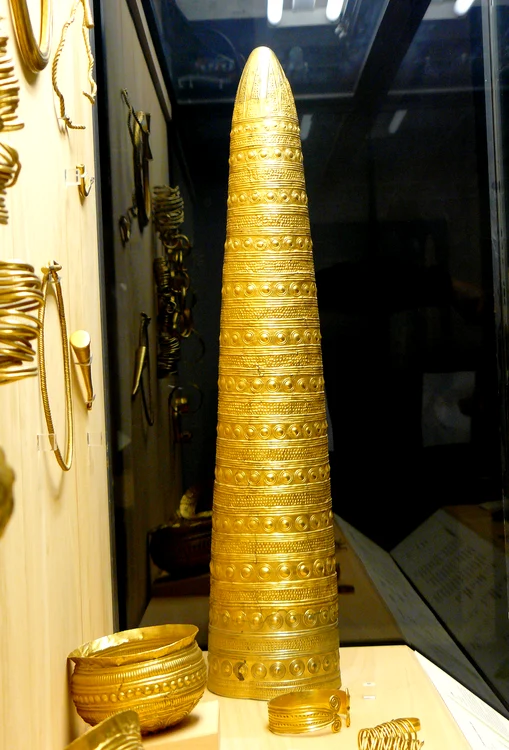
Cone from Avo Avo PHOTO Wikipedia
In the case of the golden “hat” from Schifferstadt, the object is also decorated with ornamental strips that divide the cone into sectors decorated with similar symbols. The rod is short, with a distinct widening and a wide boron at the bottom. At the base, the gold sheet was wrapped around a copper wire for additional stability. All “hats” have a band with a special symbolism: two wide open eyes. Also Mark Schmidt, in addition to other specialists, believes that the symbols on these cones are a real calendar. That is, it indicates the movement of the sun on the heavenly vault but also the phases of the moon. Basically, these “hats” were true astronomical encyclopedias of the Bronze Age, keeper of vital knowledge for the entire community. Based on this calendar, most likely, the agricultural works were executed, but also the rituals necessary for the tribe. Obviously, it's just a hypothesis. In reality, no one knows what those symbols represented. It is shocking that all this symbolism was common to the four “hats” made at an interval of several hundred years, one compared to the other and discovered in areas separated by hundreds or even thousands of kilometers.
The enigmatic “wizards” of the Bronze Age and the symbols of power
Although the specialists do not know exactly what these objects are and what they were used, a number of opinions have been issued. Initially it was believed that they were symbols of fertility and fertility, due to their phallic form. Subsequently, especially because of the bores but also the diameter at the base, which matched a human head, came to the conclusion that they were the marks of power, carried by the potent members of the community. It's about shamans or priests. Wilfried Menghin in “Acta praehistorica et archaeological”, states that these cones were sacred calendars carried by these shamans who kept the whole wisdom of the community. Based on their astronomical predictions but also of the accumulated wisdom, certain rituals took place.
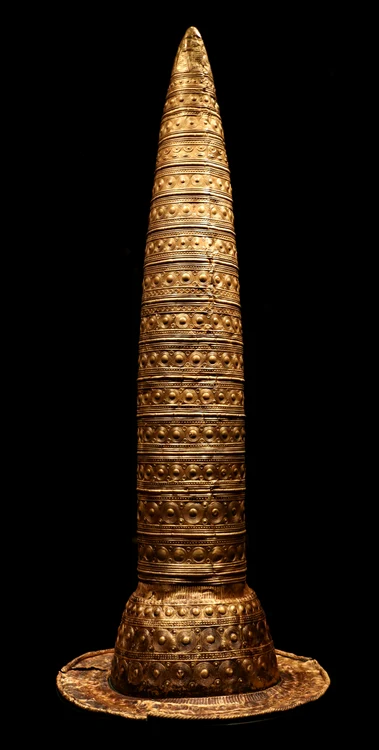
Berlin cone Photo Wikipedia
In addition, Wilfried Menghin believes that those who wore them could also be “reg-preot”, spiritual leaders of the community, strong wizards whom the community believed to have paranormal powers. “They could be considered true” lords of the time “, who had access to the divine science, a science that helps them predict the future.”says Wilfried Menghin, director of the Museum in Berlin for “Ancient Origns”.
It seems that these wizards belonged to the tribes of the civilization “fields with ballot box” that dominated the central-European area during the period 1300-750 ÎHR. After the death of shamans, these prestigious objects were deposited in the ground, as a kind of symbol of power that could no longer be transmitted. Interestingly, in Wales, a variety of cape, short, gold, with symbols similar to Germany and France was discovered. This leads to a special ritual outfit, which transfers a divine power to the shamans of the European Bronze Age.