Google “Przegląd from AI” can be the giant's biggest mistake. Destroys businesses and trust in the search engine


Research from April this year. Implemented by Ahrefs, a company offering marketing and analytical tools, based on 300 thousand. queries, proves that When the “review from AI” appears on the results page, the average click coefficient (CTR) for the top position drops by as much as 34.5 percent. compared to twin phrases without this AI function. This is a blow to the traditional business model of the Internet, in which advertising and subscriptions finance free access to content.
The Ahrefs methodology was rigorous. The authors juxtaposed 150 thousand key phrases triggering AI overviews with an analogous attempt in information inquiries that did not run the module. A year after the introduction of the average CTR function for item number one on queries AI it melted from 0.073 to 0.026, and for traditional – from 0.056 to 0.031.
Independent analysis of another company, Amsive, covering 700,000 keywords, confirms the trend, Pointing to declines from 15 to 37 percent, when “Review from AI” connects with other elements of the function in the search engine. According to Emarketer, the effects can be seen in the entire ecosystem: fewer clicks mean less demand for advertising and lower programatic value, which in effect may limit the variety of sources of information on the network (smaller services will not be able to maintain).
Check also: There was supposed to be AI, there were people from the Philippines. Investors must watch out for fraudulent start-ups
The authors of the content and e-stores have a problem
The consequences are not abstract. World History Encyclopedia, the second most frequently visited historical site in the world, recorded in November 2024 25 % A decrease in traffic from Google and had to be introduced by a member program to compensate for the loss of income.
Similar The implementation of the module for the American educational platform of Chegg ended with the blow to the revenueswhich in February this year appealed against Google, the first antitrust lawsuit related only to the AI Overviews function. The company accuses the giant that without remuneration, it condenses foreign content and distributes it by taking Movement and Sales.
Even larger players react nervously. Bloomberg described a wave of bitterness among independent publishers who talk about Google's “betrayal” and predatory capture of values on which a search engine partnership with content creators has been built for years. Pressure is also felt on the e-commerce market: the more organic movement decreases, the greater the weight falls on paid performance campaigns, which They lift the costs of acquiring traffic for online stores.
“If you put a link in the review from AI, he will note a higher CTR than outside of it,” argued Google's head, Sundar Pichai, in 2024 in the Podcieście Decoder. A similar argument was repeated by Elizabeth Reid, head of the Search section at Google, in a recent interview with the Financial Times. She claimed that the new feature brings “clicks of higher quality” and greater diversification of sources.
The empirical data collected in 2025 put these claims in question. Suggest that Google either looks at other records or tries to gain time before the industry realizes the full scale of the problem. Search positioning specialists (SEO) point out that earlier formats zero-click (e.g. weather forecast or calculation of the currency exchange rate visible directly in the search engine) also amputated part of the movement, but never on such a scale and without such deep interference the whole way of search results.
Read also: AI agents allow you to save and earn. It could be your strong competitive advantage
Crisis of credibility. Google invents us idioms
The decrease in clicks, causing the justified frustration of websites and authors of the content, on which the giant “feeds” is only half of Google's troubles. The second problem is reputation.
Numerous users' experiments have shown that it is enough to wash the expression and add the word “meaning” (that is: “Review from AI” to create a definition with full conviction, sometimes even with false references. According to Wired, phrases such as “Loose Dog Won't Surf” or “You Can't Lick a Badger Twice” have a detailed, allegedly idiomatic explanation, although such sayings simply do not exist.
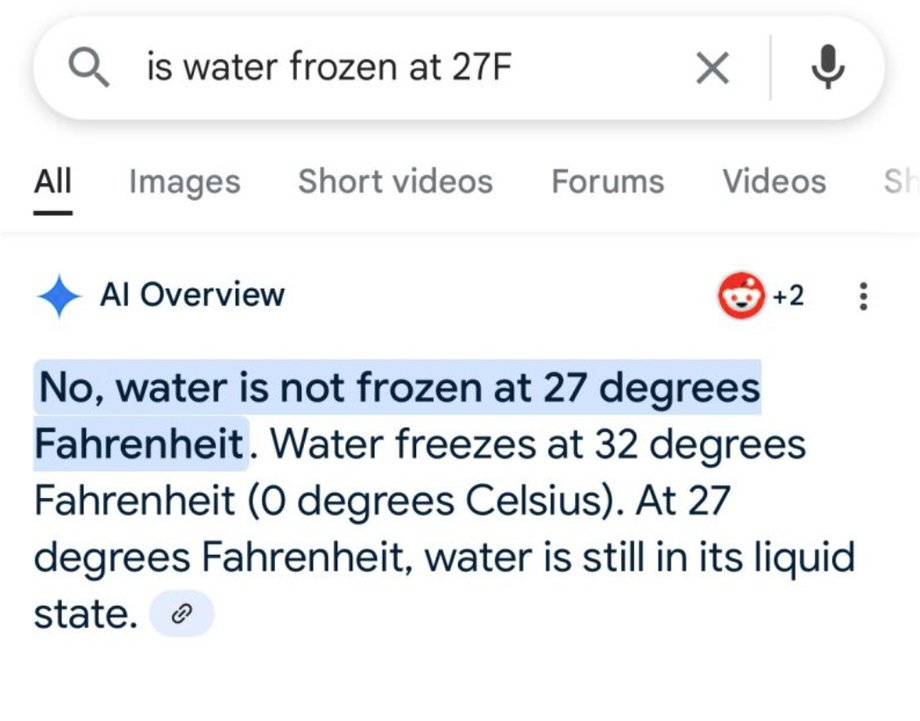
AI Overview/Review from AI very often mislead users. Example on a screen screenshot: The user asks if the water freezes at 27F (-2.7 degrees Celsius). AI Google explains that water freezes at 32 degrees Fahrenheit (0 degrees Celsius), while at 27F it is still in liquid state.
|
LinkedIn
Foreign services already warned in 2024 that similar Hallucinations undermine Google's many years of reputation as tools that serve the correct information. In a country where the search engine has over 90 percent. market share and serves as a basic internet gate, loss of trust may prove more expensive than the decreases of CTR.
See also: Google recognized as a monopolist. “He deliberately undertook a number of anti -competitive actions”
Christensen's theory trap
The situation is well explained by the dilemma of Clayton Christensen's innovator. The market leader, focused on the needs of the main clients and shareholders' claims, often ignores at first less profitable, but groundbreaking technologies. When they mature, they try to adopt them in the main product – with the risk of cannibalization of traditional revenues.
Google observes the outflow of complex queries for chatgPT, Perplexity or Microsoft Copilot Searchwhich debuted in Bing with a declaration that “supports a healthy network ecosystem” by fully quoting sources. By integrating generative AI directly in the search engine results, Google tries to protect position, but at the same time He cuts its own advertising and publishing foundations.
The late Christensen He suggested that those threatening innovations develop in separate units, not giving in a flagship product until maturity was reached. Similarly, Google could introduce a separate Gemini Search agent or a paid version of the assistant Workspace package, leaving a classic search engine specialized in linking to answers, not answering questions.
In April, the American Department of Justice began a great antitrust process, in which it explicitly indicates that the dominance of the search engine and AI propel each other, cementing the monopoly on the distribution of information.
Although “Przegląd from AI” is not formally the subject of the lawsuit, these are subsequent initiatives such as the Chegg case or News/Media Alliance complaints They can open the way to new regulations ordering sharing with publishers revenues from advertising displayed in the AI module. There is also a risk that the European Union, as part of an act on digital markets (DMA), will force Google to disable functions or pay compensation.
Check also: Wikipedia on the edge of overload. AI bots can take away free access to us
Scenarios for the next quarters
If Google maintains the current course, we can expect further erosion of the CTR coefficient, especially when the effect of new products has passed. Ryan Law from Ahrefs warned that in time users get used to the format, and the conversion will fall – which means that drops of 34.5 percent. This is just the beginning. Publishers will move resources to direct channels – newsletters, subscriptions, applications – limiting Google visibility in key segments of expert knowledge.
There is also the likelihood that some companies will implement the Gemini Cravlers blockades, as well as significant portals have closed to OpenAI tools.
Second scenario It assumes the creation of something that could be called, for example, Google Answers as a parallel product. A separate domain or application would allow to test generative answers without cannibalization of movement in a classic search engine, and at the same time open Google space for new monetization – e.g. premium subscription for an interactive research assistant. Microsoft tried this path, rebranding Bing Chat on Copilot, leaving traditional results intact. This model limits the conflict of interest with publishers and reduces the regulatory risk.
What are the conclusions for business? For companies involving traffic with Google, 2025 is a call. It becomes necessary to build direct relationships with the recipient, invest in the brand (building trust and attachment) and formats First-Party Data (communication mechanisms that allow you to collect and organize data about the recipient without the intermediary of external platforms), which do not depend on the whims of Big Techu. At the same time, you need to understand when to appear in “Review from AI” as a quoted source – this can reduce the number of visits, but increase recognition and authority.
For Google, it is a moment of truth. Either I will transform a risky experiment into a separate, profitable product, or will repair the search engine so as not to undermine the trust that has been building the giant's advantage over the years. The longer the status quo, the more likely the innovation will remain in the company's history not as a milestone, but as its biggest mistake.
Author: Grzegorz Kubera, Business Insider Polska journalist