“There are more traitors in Russia.” The secret of Ukrainian strokes with drones on Russia's territory

The air war between Russia and Ukraine is explosive on its own and figuratively. But beyond the concrete dimension, there is also a psychological and informational battle. Both parties are engaged in a continuous flow of public statements and dramatic videos, claiming to hit some targets and the challenge of damage to the other party, reports Kyiv Independent.
There is also the problem of keeping the critical targets hidden by the enemy.
Last week, images showed a fleet of drone, probably Ukrainian, threw in the middle of the night before hitting an industrial installation between Moscow and Kazan. The video, initially distributed by the local press, was already deleted-another collateral victim in a battle for the information that defines the proportions and the nature of an attack.
The information about the deep blows – the targeting, the blows and the drones and the rockets – are the subject of a constant fight for information. One of the military who leads this battle for the main information direction is the Iuri Șcihol brigadier general.
Russia's censure machine is much more aggressive than Ukraine, he told Kyiv Independent in an interview, explaining that this makes Ukraine's victories easier.
“They hide any successful shot. While practically all their strokes are known, we should gather our known blows and multiply this number by two. And then, if we compare between the number of drones and the number of successful blows, our drones are used with much greater efficiency.”
The great advantage of Russia, he explains, is the massive arsenal of air defense. Instead, the great disadvantage is the size of Russia.
“There is no amount of equipment that can protect the whole of Russia”
“They have a big plus – they have a lot of defenses. But they also have a great minus – a huge territory. There is no amount of equipment that can protect all Russia”says Șcihol. “We certainly overcome them in accuracy.”
Due to the secret and information war around the air attacks, it is impossible to confirm independently the total number of successful strokes on both sides, let alone the degree of damages. But Ukraine gathers visible victories lately.
Recent notable Ukrainian successes have included targets such as “Fiber Optic Systems”, the largest fiber optical producer, and a massive explosives factory east of Moscow. Ukrainian President Volodimir Zelenski has recently announced that the “Neptun” rocket, a cruise missile of internal manufacture, flew 3,000 kilometers on the territory of Russia.
Ukrainians receive information from Russia
Beyond the improvements to Ukrainian drones since 2022, the Ukrainian officer explains that drones intended for deep blows, in particular, are better, and this is largely due to information. Specifically, Hur finds several Russians willing to help Ukraine, to the point where Ukraine has access to coordinates located deeper inside Russia, according to Șcihol.
“The first aspect is the quality of the guide systems that are located on their territory, from which it can be deduced that there are many more traitors on their land than they can recruit in Ukraine.”he explains.
“In Ukraine, they are isolated incidents and we see, according to SBU (state security service), that there are not so many. But judging by the effectiveness of our drones, it can be deduced that they have many more traitors because they worry, as the number of those who install our drones increase.”
He refused to provide details on the equipment that guides these deep blows on the territory of Russia.
On the other hand, Ukrainian production is constantly facing limits in terms of state -of -the -art components, such as inertial guidance systems and CRPA antennas, which can guide a drone or rocket even through electronic war saturated areas.
Russia has several local producers, including Kometa, whose CPRA guides Russian bombs through the Ukrainian territory. Russia's allies, especially China, sell state -of -the -art electronic moscow, such as advanced guidance systems, often by redirecting western components.
However, the Ukrainian officer says that when it comes to deep blows, Russia's game has largely stagnated.
“If in 2022 Shahed was considered the peak of unanswered aviation, today, the drone is practically unchanged, especially related to navigation and guidance.”
Russian factories now produce large -scale drone shahed drones, with at least a few tens that are launched in Ukraine almost every night.
Although he argues that the current progress of Ukrainian attacks up to 3,000 kilometers is more victory for information services than for engineering, Șcihol said that the technical progress in the production of Ukrainian drones are huge compared to 2022.
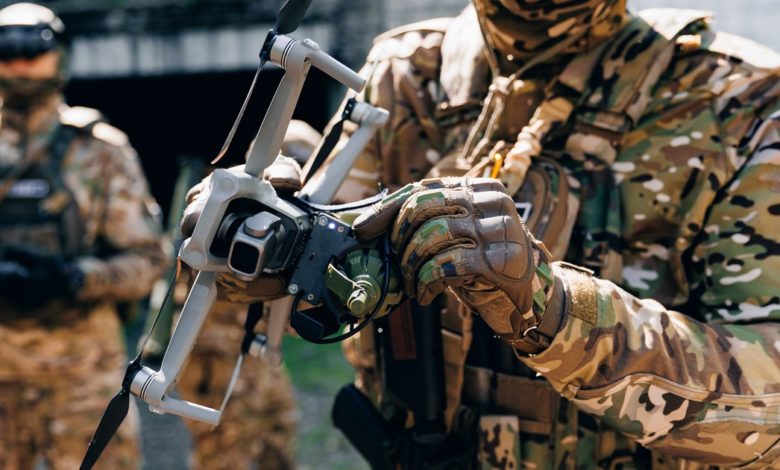
“The soldiers began to contact us, saying that we needed Mavics, only Mavics. No one at that time said anything about FPV drones, about long -range drones, about surveillance equipment,” Șcihol said, referring to the ubiquitous commercial quadopters on the battlefield.
Today, it indicates a much longer list of locone products. “The effectiveness of Ukrainian drones Vampir, Nemesis and Kashans – there is no comparison, because no one else on Earth does such drones.”referring to the type of heavy attack drones, many of them equipped with thermal vision for night raids.
At the beginning of the large -scale invasion of Russia, Stecihol was at the helm of the Special State Communications Service (SSCS), a branch of the State Security Service, which became independent and reconfigured for modern cyber defense in 2006.
Analogous to the Cyber Security and Security Agency of the US infrastructure, SSCS was responsible for the purchase of drones in 2022. The Minister of Digital Transform, Mihailo Fedorov, has carried out an international campaign of media and successful donations.
One of the first high-ranking officials who recognized the value of the cheap drones on the Ukrainian front, Fedorov directed the military part of those fundraising campaigns to the “drone army” a fund managed by the Ministry of Defense, but by SSCS, which Fedorov had semi-effect.
The arrangement was not without controversy. In December, the Ukraine's ministers' office was deprived without the ceremonies on Fedorov by his semi-formal authority on SSCS-a movement that observers at that time claimed to have been the result of a power struggle with Andri Iermak, the head of the Ukraine Presidential Bureau.