Narrator: Here is the rarest pasta in the world.
The key to making SU Filindeu, or “God's thread” is stretching and folding the dough over and over until it turns into 256 equal strands.
For a hundred years, this technique was practiced in the Sardinian city of Nuoro by one family who prepared this dish only for religious ceremonies.
Now Luca Floris is one of only seven locals who make this pasta.
Luca Floris, pasta producer: Until recently, knowledge about Filindeu was unavailable, even for the inhabitants of Nuoro.
Narrator: This mystery almost led to the disappearance of pasta, but now it finds new producers and customers abroad.
This new audience can save rare pasta from extinction.
Will this expansion not deprive the cultural and religious importance of this dish?
We went to Italy to see how the tradition of making “God's thread” survived.
SU Filindeu production is complicated, but the ingredients are simple.
It's semolina flour, water and salt.
Luca mixes them together, creating a cake.
Luca: When I was small, I always watched my mother kneading the cake.
To calm me down, she gave me a piece of cake I had fun.
I slowly started to make pasta myself.
Narrator: Obtaining a completely smooth dough can take up to 20 minutes.
Luca: This pasta may vary depending on factors such as climate, humidity and temperature.
You need to know how to add and how much water to add.
Narrator: Luca alternately adds drops of brine and fresh water, depending on the needs.
Luca: It sounds clichéd, but the truth is that you can feel how the dough changes.
Almost as if it appealed to me and reported when it is ready.
It must be smooth to the touch like a velvet.
Narrator: Stretching is the key to obtaining thin threads SU Filindeu.
With one fast move, Luca folds the dough in half, creating two fragments, then four and then eight.
He continues this action until he forms 256 perfectly even pasta threads.
Each of them is as thin as a strand of hair.
Luca: There is no Filindeu making machine.
It can only be done with your own hands.
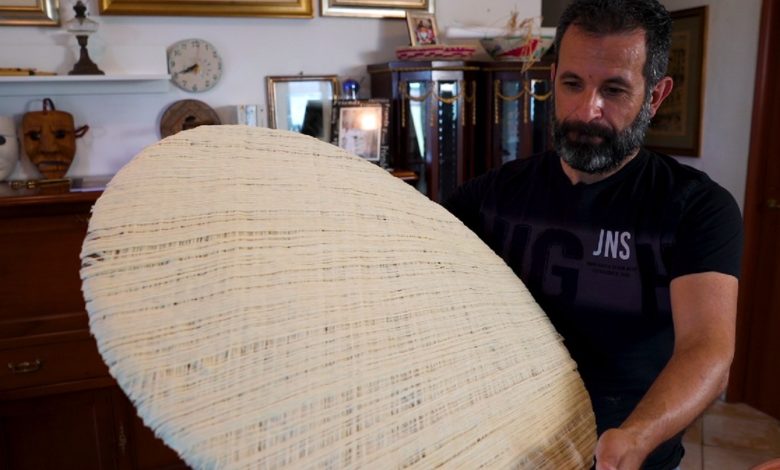
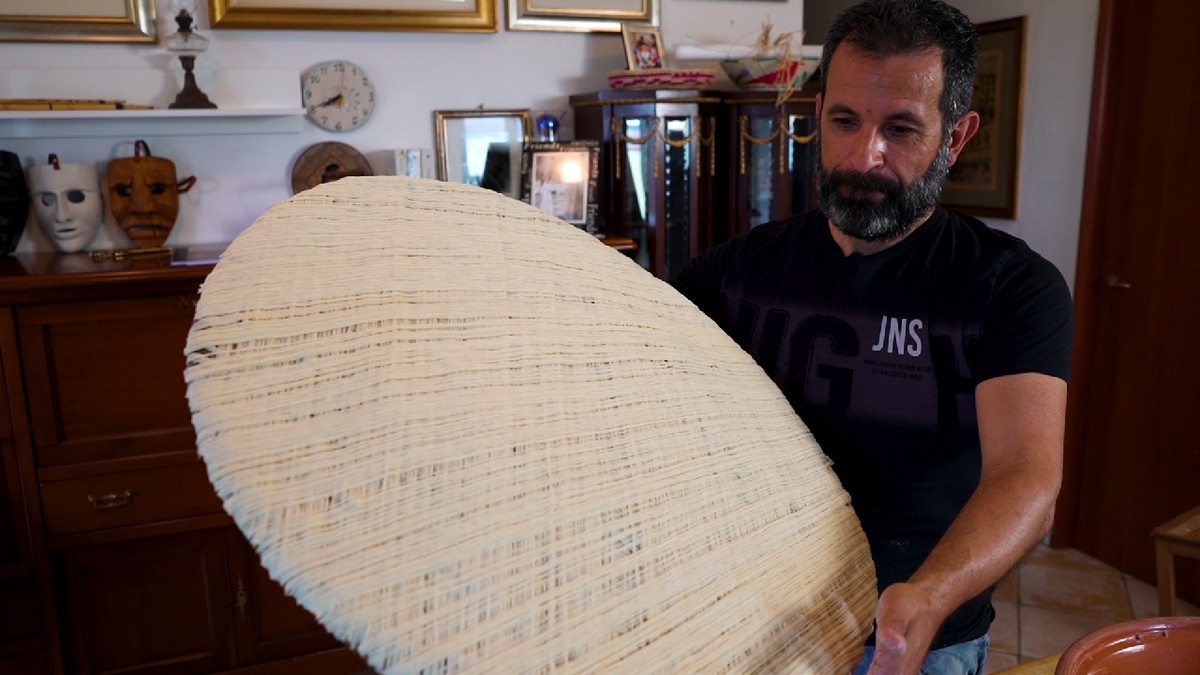
Narrator: Luca must be careful not to break any of the bands when he places them on a traditional wicker base called the fund.
It is made of gold -shaped – a plant growing throughout the region.
Luca: The golden -headed is great because it helps to dry the pasta, and also gives it a special taste after cooking.
Narrator: Application of layers is the key to the SU FILNDEU -like mesh.
It is also the most difficult stage of the process.
The threads cannot be moved when they are already on the fund, so Luca must be precise.
Removes excess dough from the edge before starting to work on subsequent threads.
Luca: You have to work as soon as possible, because the lower layer can stick with the upper.
If the lower layer is dry, it does not adhere to the others.
Narrator: Luca has only 20 minutes to finish all three layers.
Luca: Here is the end result.
Narrator: For the inhabitants of Nuoro SU Filindeu is a holiness.
Traditionally, this dish was prepared only twice a year during the ceremony in honor of St. Francis of Assisi.
Pilgrims from Nuoro traveled 32 km to his chapel.
Women from local families gathered and prepared SU Filindeu for those who finished the journey.
Luca: A typical recipe is cooking in lamb broth seasoned with local fermented Pecorino.
Narrator: This has not changed since at least the 19th century.
Luca: Traditionally, women did SU SU Filindeu.
Narrator: The secret was kept for generations, so only a handful of people in Nuoro has the right knowledge and wants to do this dish.
In 2021, the producer SU Filindeu revealed the recipe to other women in the community, trying to prevent the disappearance of the dish.
Other residents of Nuoro, such as Luca, decided to maintain tradition.
It was impossible to find a teacher.
Luca: I asked various people to study, but I did not receive positive answers.
Narrator: Luca decided to take matters into his own hands.
Luca: Why would only women deal with it?
Narrator: Slowly Luca began to receive queries from chefs from Canada, England, China, Germany and more.
Luca: This proves that this pasta is very known and desirable, even abroad.
Not only on our island.
Narrator: Over 9600 km from Nuoro on the outskirts of Los Angeles, one of the students of Luka breathed a new life in SU Filindeu.
The chef Rob Gentile spent over 20 years, introducing the flavors of Italian origin to exquisite restaurants in Canada and the USA.
Rob Gentile, chef, Stella West Hollywood: It was always a holy grail of pasta and I wanted to learn to do it.
It's just one of these unique things.
I wanted to know how to make SU Filindeu before I die.
Narrator: Over the years Rob tried to find a teacher.
When professionals from Nuoro finally began to share their knowledge, he took the opportunity.
Rob: I began to wonder how to keep this tradition alive.
How to encourage interested people to develop this amazing product?
In this way I met Luca.
Narrator: Rob spent many hours at the Luka house, watching and learning how to knead and stretch the dough.
Rob: I thought I could do it.
It is not that difficult.
Luca made it look so easy.
It was a very memorable moment in my life.
I couldn't believe it.
Narrator: Currently, Rob serves SU SU Filindeu in the menu of his restaurant Stella West Hollywood.
Rob: I just felt it was something special.
Something that people must try.
Every time I serve this dish, magic happens.
Narrator: Increasingly, SU Filindeu is given in restaurants outside Sardinia, which means that the awareness of the cultural and religious importance of this dish may disappear over time.
Luca and Rob, however, believe that this should not stop people from sharing how to do them.
Luca: Unfortunately, not everyone agrees to teach this person outside the country.
However, I always thought that sharing this pasta does not cause that his origin was losing its importance.
Rob: I think you can appreciate the technique of making pasta itself.
We can do dishes such as Zuppa di Pesce with him and have fun.
It can also be celebrated as a religious tradition.
This is an exciting time for SU Filindeu, because he has never been anywhere else outside Sardinia before, and now it is.
Narrator: Pasta finds new houses, but the tradition of making it is threatened in the place from which it comes.
This is because to make pasta in an authentic way, you need a fund, and there are not so many people who make it.
Luca: We go to Olzai to meet one of the last funds of the funding.
Hello?
Giovanna polar, weaver: Come in.
Luca: I can?
Giovanna: Hi.
Narrator: Giovanna Porchi has been weaving since childhood.
Giovanna: I learned this by watching my mother.
When she left the house, I secretly stuck small fragments.
Of course, she noticed it right away, and because I wasn't very good in it, she had to improve me.
Narrator: Giovanna begins by cutting the golden -shell into thin stripes.
This tool is made of cow bones.
Giovanna uses it to braid the plant to a round base.
In Sardinia, women have passed this skill for generations.
It was a source of income for people like Giovanna's mother.
Giovanna: She went to neighboring cities where she sold her baskets.
Exactly what they hang on the wall.
She did this work to earn and feed children.
Narrator: Currently, this trade has practically disappeared and there are only a few weavers left.
Luca: I don't understand why such a beautiful tradition is slowly dying out.
Narrator: Giovanna says that young people do not show interest in science of craft.
She tried to teach women in her community, but the craft did not become very popular.
Giovanna: Products still sold on the markets, but virtually no one has left who would do them.
I am proud that I can do it, and I like it.
However, I am tired.
Narrator: Like weaving, the art of making SU Filindeu in Nuoro is not common.
Luca: Few people do it, so it's hard to produce large -scale production.
Narrator: The pasta is expensive due to limited production.
A kilo can cost from 26 to 30 euros, which is about 15 times more than the average price of pasta in Italy.
Luca does not believe, however, that sales are the key to maintaining this tradition alive.
Luca: This is a holy pasta, which is combined with Francis of Assisi, who swore to live in poverty.
Therefore, earning on this pasta is morally doubtful.
Narrator: Instead, Luca focuses on teaching others.
He believes that people like Rob will spread this dish all over the world.
Rob: This is part of culture and kitchen.
It's just something that you should teach.
Making pasta should be continued and developed.
Luca: Sardinia is a region rich in tradition.
It would be great to wake up tomorrow and see that someone decided to teach these traditions in schools.
Narrator: Luca does not know what the future will bring, but he is proud of the work he does to keep “God's thread” alive.
Crowd: Piotr Nazek