The cash crisis forces Syrians to stand in line with the hours to get their salaries. Sometimes he has to take a day off to withdraw money

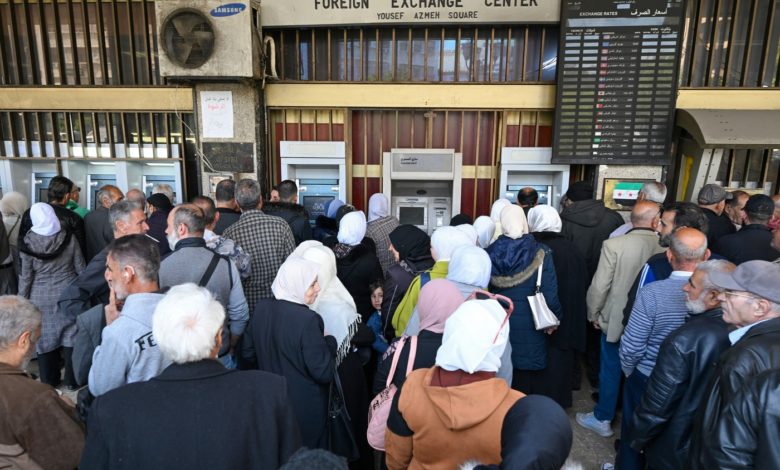
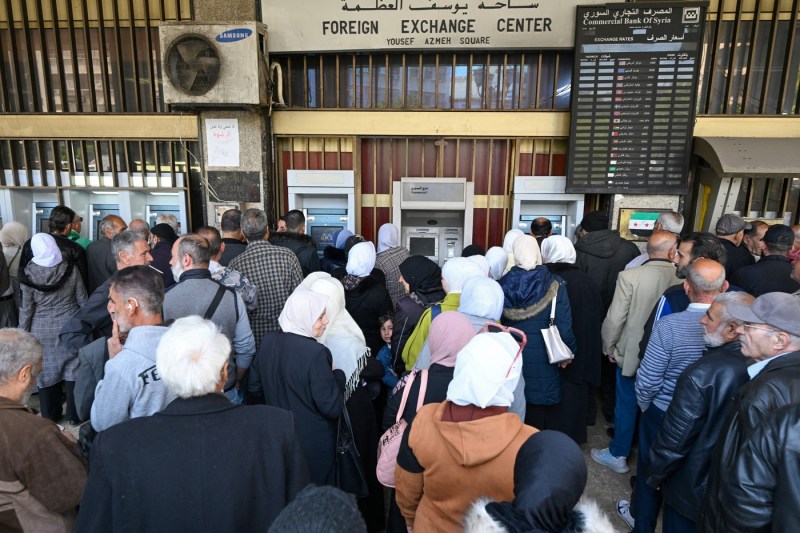
ATM in Damascus, on April 16, 2025 .Credit line: Louai Beshara / AFP / Profimedia
Sitting on the sidewalk in front of a bank in the center of Damascus, Abu Fares's face is worn out of exhaustion while waiting to collect a small part of the pension.
“I have been here for four hours and I didn't get to get my pension,” said the 77-year-old man, who did not want to give his full name, writes the Syrian press.
“The ATMs do not have enough money, and the tails are long,” he continued.
Since the overthrow of President Bashar al-Assad in December last year, Syria has struggled to come out of almost 14 years of civil war, and his banking sector is no exception.
Decades of punished sanctions imposed on the Assad Dynasty – which the new authorities are trying to raise – left about 90% of Syrians below the poverty, according to the United Nations.
The liquidity crisis forced the authorities to drastically limit cash withdrawals, and a large part of the population has great difficulty in withdrawing their money.
Before his removal, Assad's key ally, Russia, held the monopoly of printing banknotes. The new authorities have only announced that they received a transport of banknotes from Moscow from Assad's overthrow.
In a country with about 1.25 million employees in the public sector, civil servants must stand in line at one of two states of state or affiliated ATMs to make withdrawals, capped to about 200,000 Syrian pounds, the equivalent on the black market of $ 20.
In some cases, they have to take a day off to withdraw the money. “There are sick, old people … We can't continue that way,” said Abu Fares.
“We disable the ATMs at the end of the work day”
“There is a clear lack of cash, and for this reason we disable the ATMs at the end of the working day,” an employee of a private bank told AFP, preferring not to give him the name.
A tail of about 300 people extends outside the Syria's commercial bank. Some are directly on Earth.
Afraa half, a civil servant, said he spends the most money he withdraws on travel tickets to get to the bank and then, at home.
“The conditions are difficult and we have to withdraw our salaries as soon as possible,” said the 43 -year -old man.
“It is not normal to spend whole days to withdraw small amounts.”
Local currency has decreased in value since the civil war broke out in 2011, before the dollar was evaluated at 50 Syrian pounds
Economist Georges Khouzam explained that foreign currency sellers – whose activity was prohibited during Assad – “deliberately reduced cash flows in Syrian pounds to cause fast market fluctuations and make a profit.”
Muntaha Abbas, a 37-year-old public official, had to return three times to withdraw the entire salary of 500,000 Syrian pounds
“There are a lot of ATMs in Damascus, but very few works,” she said.
After five hours, she finally managed to withdraw 200,000 Syrian pounds.