Did Trump's rates kill economic populism? The inheritance of “Liberation Day” will persist for generations

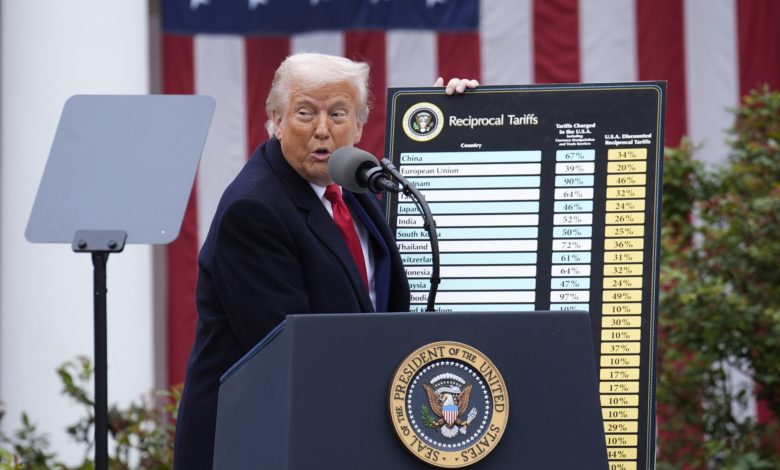
“The autopsy “of April 2, the so-called” release day “of America, when Donald Trump announced a drastic customs taxes for all trading partners, is still in progress, but the” victim “could be the economic populism, strangled by Wall Street, the Citadel of Globalization, the Guardian notes.
The effects of the chaos created by the tariff measures announced by Donlald Trump, even after he returned to them and decided a 90 -day break in their application, with the execution of those for China, produced significant long -term damage. The inheritance of the “Liberation Day” will persist for generations, writes the journalist The Guardian Patrick Wintour, in an analysis published on Saturday by the British daily.
“When the chosen man leads the country that invented globalization places the rejection of globalism in its ideological center, even if this means the alienation of the closest allies in the US, it triggers a fundamental reordination“he writes.
The objective of the white house through the announced rates was not to weaken globalism or protect the US economy, but to negotiate the reduction of tariffs throughout the world and to punish China, insist Trump's counselors.
But, according to The Guardian, these scenarios are hard to believe, mostly because Donald Trump has repeatedly praised his tariff intention, which he called a macroeconomic measure of income growth or a means of supporting American production.
The reality is that when they have faced an attempt to restore the world commercial system overnight, the markets have revolted. And, in the midst of chaos, not only Trump's poilitic credibility had to suffer, but also the ability to return the system that globalization represents.
“Donald Trump has set fire to everything”
British Prime Minister Keir Starmer was not the only one who claimed that Trump's release day and his consequences marked the end of an era.
In a warning that remains valid even after Trump's withdrawal, Mark Carry, Canadian Prime Minister and former Bank of England, said: “The global economy is fundamentally different from as it was yesterday. The global trade system anchored in the United States that Canada has been based on the end of World War. decades, it ended“.
“The 80 -year -old period in which the US embraced the world's economic leader, in which he created alliances rooted in trust and mutual respect and supported the free exchange of goods and services. Although it is a tragedy, this is also the new reality,” he said.
Thus, Mark Cariy stressed that, regardless of how the commercial war with China is resolved, the inheritance of April 2 will persist for generations.
Paul Krugman, the laureate economist of the Nobel Prize, has largely agreed that the US, through the announced rates, commit an act of abdication. “The rules that govern the tariffs and the negotiation process that led to the decrease of these rates over time have resulted from the mutual trade agreements act, designed by Roosevelt in 1934. It was, in fact, one of the greatest political achievements. Donald Trump has set out for everything,” he wrote.
“The aversion to commercial deficits never left it”
The Guardian journalist believes that a key difficulty in all this situation is that Trump, 78, has not given any sign that he would like to learn from the created disaster.
According to the British daily, since September 1987, Trump has spent $ 95,000 to publish an “open letter to the American people” in three newspapers.
“For years, Japan and other rich nations have taken advantage of the US. It is time to end our huge deficits, forcing Japan and other countries that can afford to pay,” he wrote then.
Although his target moved from Japan to China, Trump's resentments, along with the aversion to commercial deficits, never left him. His choice in 2016 only confirmed the resonance of his message.
In the first two years of his first term, in 2017-18, Trump's instincts were largely kept by his economic counselor Gary Cohn, former operating director at Goldman Sachs, who attenuated the Republican's decision to use the tariffs to put an end to commercial deficits.
Cohn has engaged in a dispute that lasted two years, compiling a lot of statistics meant to convince a skeptical Trump that the decline of the US processing industry and its replacement with a services economy was largely benign.
He presented how global rates are affected by American consumers and explained the connection between consumers' uncertainty and stock market. Challenged Trump to explain why he thinks the rates would not be counterproductive. Trump replied that he didn't know, but that he simply knew what he had believed for 30 years.
At one point, exasperated, Cohn accused Trump of dangerous nostalgia, saying, “You have a Norman Rockwell vision” – the artist mentioned for his idealized portrait of American workers.
Finally, Cohn found that Trump-who once scratched “Trade is bad” as a summary of his thinking for an opening speech-was so immune to evidence and so determined to impose steel and aluminum rates that he resigned, leaving Peter Navarro, a man that Cohn considered.
“Friend or Near-Shoring”
The path was free for Trump's frontal attack on tariffs, partly because, in the four years of mandate, the antiglobalist wave seemed to go in his direction. Many center-left people have believed in the argument that hyperglobalization does not match an era of geopolitical conflicts.
The Biden administration, for example, in the name of reindustrialization and national security, has kept many tariffs in the Trump Era, especially for China, a decision considered a mistake by a study published by Harvard Kennedy School.
Since the financial crisis of 2007-2008, there has been a constant increase in trade restriction measures-such as tariffs, non-tariff measures, export control and investment restrictions-which have contributed to the increase of trade fragmentation. In 2024, over 3,000 commercial restrictions were implemented worldwide. Some of these have arisen as a result of legitimate concerns about unfair competition, but many have been determined by the intensification of geopolitical competition.
Countries of all political orientations have resorted to increasing definitions of national security to filter foreign investments and trade. A new language has entered the vocabulary, such as “Friend or Near-Schoring”, a term meant to encourage companies to align their supply chains to the geopolitical interests of their countries.
The call for resistant supply chains was stimulated by the vulnerabilities exposed by Covid, including the dependence of the West by a small number of vaccine providers.
After the invasion of Ukraine, Russia further exposed the vulnerability of the Western supply chain by exploiting Europe's dependence on its gas pipelines. The interconnections meant to approach the countries, such as submarine data cables, have become targets – from the Baltic Sea, to the Taiwan Strait. The war also destroyed the myth that trade brought peace.
As a result, the West governments have introduced investment control measures, which allowed them to block the takeover and investments of foreign companies, mainly Chinese, in strategic industries.
Rachel Reeves supported this trend in a speech in Washington as a shadow chancellor of the United Kingdom, in May 2023: “Globalization as we know. The supply chains that prioritize only what is cheaper and faster when there is a crisis, whether it is the PPE during the Covid.”
In a diagnosis similar to Trump's, Reeves claimed that a globalized system “can be manipulated by countries such as China, which have underestimated and ignored international commercial norms and made our competition impossible.”
Rajan Raghuam, former chief economist of the International Monetary Fund and former governor of the Central Bank of India, argued that “Friend-Horing” is “a resurgent protectionism, masked and increased by new geopolitical rivalries.” He also criticized the initiative as “the concentration of production within the closed community of advanced communities”.
Even so, the proportion of trade in GDP – the best extent of economic opening – has not yet collapsed. In his report for 2023, entitled “Re-Globalization”, the World Trade Organization (WTO) said that there was a slowdown in world trade after financial collapse and Covid, but the change can be largely linked to the growth of services, as opposed to goods, in the world economy. Compensatory tendencies, such as digital trade, have maintained globalization in life.
The problem that arises now is what can be kept from the remains of last week and if it can be collected, if necessary, a new coalition of the will – this time of free traders. There is talk of a G6 – G7 less US – to go to China to see if an agreement can be reached to reduce commercial imbalances and subsidies distinguishing trade, The Guardian shows.