The Dacian columns come to life at Sarmizegetusa Regia. The ancient Andesit temple is restored to conquer tourists today

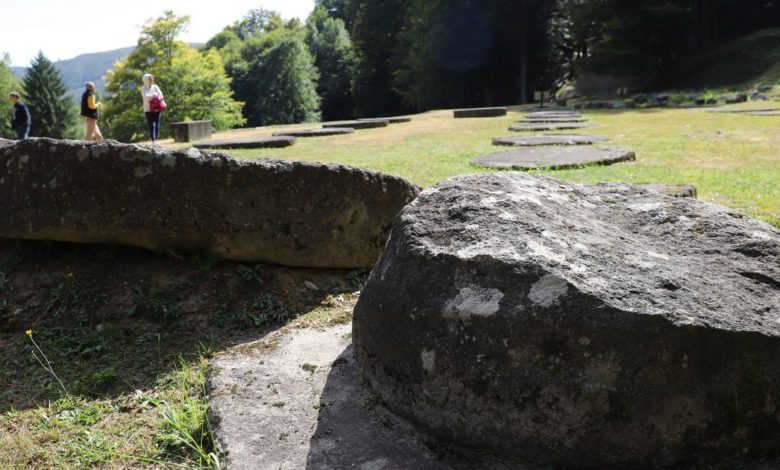
A temple of ancient Andesite over two millennia is reborn at Sarmizegetusa Regia. The authorities hope that, with the restoration of the ancient monuments in the former Dacian capital, some in the three -year -old site, the UNESCO site will regain its place in the attention of Romanians.
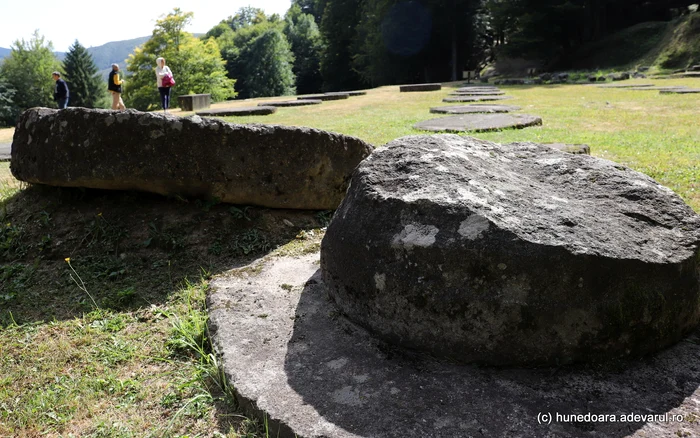
The Temple of Andesit. Photo: Daniel Guță. TRUTH
Sarmizegetusa Regia remained an epicenter of ancient history in Romania, but the number of Romanian visitors can be considered reduced to the popularity enjoyed by the Capital of the Dacians in the Orăștiei Mountains, on social networks.
The Dacian fortress passed into the administration of the Hunedoara County Council in 2013, and since then, the total number of its visitors has not yet exceeded 700,000 people.
However, this year, the authorities hope to bring it back to the public's attention, with the completion of the restoration works to the ancient fortification, an enclosure of the Dacian capital that includes ancient stone walls, with a length of almost one kilometer, and three monumental gates.
The works began in the autumn of 2022 and included archaeological researches, slopes and landscaping, the restoration of the military enclosure and the access gates, the introduction of a new route, the arrangement of a lapidary and a shelter for visitors, as well as the final arrangement of the site, by planting vegetation and finishing the land, financed by EEE grants 2014–2021.
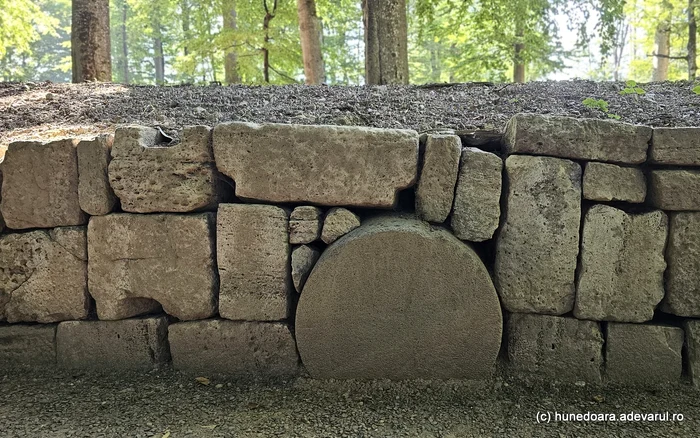
Ancient fortification. Photo: Daniel Guță. TRUTH
The investment of over 2.2 million euros in the restoration of the fortification from Sarmizegetusa Regia will be received this spring, announces the Hunedoara County Council.
The Dacian column reposed on the plinth
Meanwhile, another spectacular historical monument of the Dacian capital will enter the site.
“In the following days, the order to start the restoration works of the Andesite Temple on the XA Terrace will be issued.announces the Hunedoara County Council.
The project, financed with European funds, aims not only for the preservation, but also to play an image close to the original, in accordance with recent research, and at the end, tourists will see at Sarmizegetusa Regia, for the first time for Romania, a Dacian column in the way it looked in antiquity.

The Andesit temple on the XA terrace. TRUTH
The works are aimed at stopping the degradation of existing structures – bells, Andezit drums, limestone blocks and support walls – and include restoration of the terrace wall, repositioning the fallen blocks and strengthening the reinforced concrete wall.
The restoration will play the partial appearance of the temple: the columns of the columns will be completed up to four rows of ten and 15 columns will be recomposed, of which one whole, the rest of the fragmentation – a partial reconstruction of the original monumentality.
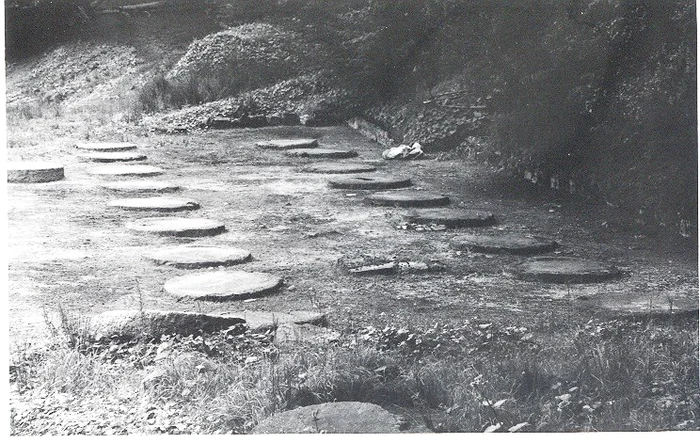
The Andesit temple on the XA terrace. Photo from the 1960s.
The great Andesit temple, built in the first century AD, replaced an older sacred construction. The Andesit used by the Dacians came from quarries over 50 kilometers away, on the Mureș Valley, and the material was considered particularly valuable. “The Andesite was given superior qualities, including monumental value,” the researcher Ioan Mârza said in a study.
The temple is made up of rows of columns, supported on Andezite slats with a diameter of over two meters, heavy of several tons, mounted on stone and clay foundations. The archaeological research indicates two phases of construction, and the exact configuration of the temple is still the object of interpretation: either four rows of ten columns or six rows with ten. The last intervention on the temple took place in the 1980s, but the works were abandoned in 1982.
The ancient city of temples
At least eight temples existed in antiquity in Sarmizegetusa Regia, according to archaeological discoveries. The latest structure was identified on the 9th terrace, where the research started in 2017 and continued in 2024.
Like terraces X and XI, this plateau also had a major religious role. Here, a Dacian temple was destroyed by a fire, and another building was built on its ruins.
On terraces X and XI, archaeologists have identified seven other temples, two circular and five quadrilaterals. The terraces included in the sacred premises were raised on support walls over 10 meters high, a remarkable architectural achievement in antiquity.
“From the structure of the temples there remained only a small part, but the elements kept speak by themselves about a monumental religious architecture, unique in the Dacian world.”inform the National Museum of History of Transylvania.
The strangest altar, the “Andezit Sun”, is on the 11th terrace. The disk with a diameter of over seven meters, with ten carved “rays” and a “tail”, was made from Andesite and would have been intended, according to historians, religious ceremonies or time measurement.
“Unique in Dacia so far, the altar impresses with its monumental dimensions, by the special attention paid to the processing and assembly of the pieces in its structure”, Mnir shows.
How many people visited Sarmizegetusa Regia
Most Romanians have never reached Sarmizegetusa Regia, it shows a simple calculation, based on the estimates of the number of visitors of the site, in the last decade.
Until 2016, when the access road was transformed into a modern road, the Dacian fortress was more difficult to access, and in winter, often closed to the public, so that the small number of visitors was considered normal.
Between 2013 and 2024, Sarmizegetusa Regia experienced a significant increase in tourist interest. In 2013, approximately 26,000 visitors were registered, and in 2014 – 34,000. The number decreased slightly in 2015, to 30,000, but increased spectacularly in 2016 to 60,000, with the modernization of the access road.
In 2017, 69,786 tourists were registered, and in 2018-55,803. The peak year was 2019, with 77,250 visitors, followed by a slight decrease in 2020 (70,185 visitors) and a maintenance in 2021 (70,000 visitors).
In 2022, the number went down to 55,000, then climbed again in 2023, to 67,000. In 2024, by the end of the year, the site was visited by 52,000 tourists, which takes the total of the last 12 years to over 667,000 visitors.