The decrease in oil prices hits the Russian budget. The Kremlin observes the situation with concern


A sharp decline in oil prices on global markets It pulls URAL Russian oil. This causes more and more fears in Moscow about this year's state budget, strongly dependent on the revenues of raw material exports.

The price of Russian Urals dropped rapidly at the beginning of April along with the prices of other species of raw material in global markets. It is true that on Wednesday on the raw materials exchanges prices temporarily reflected, but it was rather a rally of relief, because on Thursday the courses record declines again. The WTI barrel is listed around $ 60, Brent oil costs around $ 63.
Oil prices began to fall strongly when US President Donald Trump announced the introduction of duties on products from 185 countries. In addition, eight OPEC+ countries agreed to accelerate production growth in May by 411 thousand. Baryłek a day instead of planned 135,000 barrels. In addition, Saudi Aramco has reduced the oil price for May for Customers from Asia to the lowest level in several months, Reuters said.
Although Trump suspended, he did not do it to China, which are the largest oil importer in the world. In addition, concerns about the global economy and oil demand did not stop, because additional duties were only delayed by 3 months, maintaining a basic rate of 10 percent.
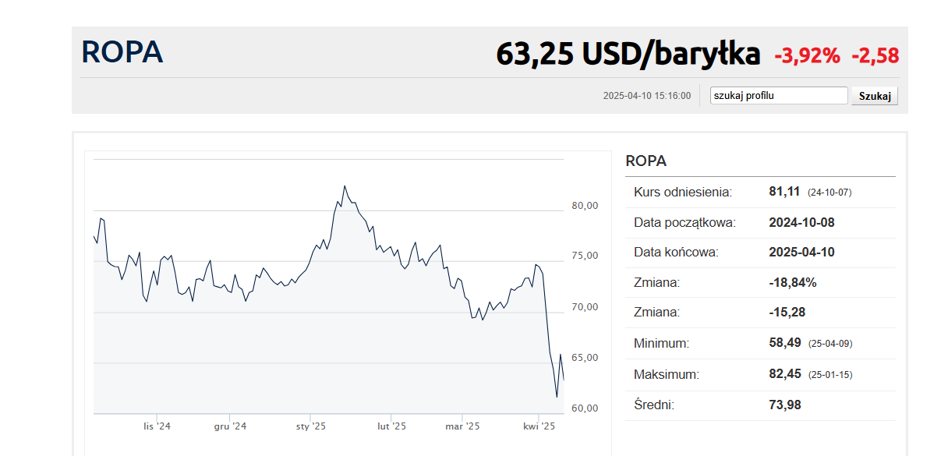
As for the current Ural oil prices, the matter is a bit more complicated by sanctions and the lack of quotation on the main raw materials exchanges. The courses are largely set on the non -magazine market. According to recent data, the reference price of Russian oil was about $ 50 per barrel, which meant a decrease of about 15 percent. compared to March and the lowest level from 2023. For comparison, on April 1, prices in the Baltic ports were 62 – 63 dollars per barrel. It is still below the level of $ 70 adopted when planning the Russian budget for 2025.
“We monitor the situation very carefully to minimize the effects of an economic storm,” said Kremlin spokesman Dmitry Pieskow. Trade wars “usually lead to a decrease in global trade and possible demand for our energy resources,” said the head of the Russian central bank Elvira Nabillin, adding that “they are always preparing for such a risk.”
The Ministry of Finance, according to the reports of The Moscow Times, announced that in comparison with March 2024, Russia's tax revenues were lower by about 230 billion rubles ($ 2.7 billion). Revenues from trade with oil and gas fell in March by 17 percent. RDR, due to a stronger ruble and drops in price before collapsing from the beginning of April.
The Reuters agency notes that a decrease in oil and gas income occurs during difficult negotiations between Russia and the United States regarding the suspension of weapons in Ukraine. In 2024, there was an increase in expenditure related to the war, which, however, forced the Kremlin to reduce other expenses, including social policy or financial support of the regions, notes the Eastern Studies Center in the economic assessment of Russia for 2024.
“In 2024, the total budget expenditure of Russia increased by more than 24 percent yard. The largest item was the funds allocated to the” national defense ” – for the first time they officially exceeded the expenditure on social policy. The financing of the war consumed at least 35 percent. budget ” – we read in OSW.
Expenses have increased extremely dynamically in recent months, which, as OSW assessed, it resulted from the fact that the Kremlin wanted to convince the West, especially the new US president about “his possibilities of continuing the war and the ineffectiveness of sanctions.” However, this meant a double increase in the deficit (in relation to the budget act) – up to around $ 35 billion. His financing came from issued bonds and reserves from the National Welfare Fund.
As reported by the AFP agency, the economist of Jewgieni Kogan, as at March 1, the fund had about USD 138 billion, of which around $ 39 billion. They were smooth assets that can be easily sold to obtain cash. This is still a very large liquidity pillow, which, however, can quickly melt along with less and smaller influences of oil trade.
In turn, Ukraine was satisfied with information on falling oil prices, counting on the weakening of the Russian war budget. “The lower oil prices are, the less money the Russians will have to finance their war” – wrote on the platform X Andrij Jermak, chief of staff of the President of Ukraine Volodymyr Zelnski.
Professor of economics Igor Lipstis in the commentary for “The Moscow Times” states that the financial resources of the Russian state are starting to run out. He reminded in his column that in practice over 60 percent. all budget revenues and about 67 percent Russia's GDP comes from the oil and gas industry.
“At such low oil prices – below $ 60 for a barrel in a situation where the state budget is based on about $ 70 – not only we are dealing with a decrease in tax revenues, but this means that the oil and gas sector descended from the path of generating profits and began to generate losses – which may even end with withdrawal.
Although the Russian authorities ensure monitoring of the situation and readiness to various scenarios, a sharp decline in oil prices undoubtedly puts into question stability of budget and strains the possibilities of financing further aggression on Ukraine. Professor Lipstis in his long argument about the Russian economy writes that she presents the situation from one of the fairy tales. “If you go right, you die; if you go left, you won't live; and if you go straight, you will lose your head,” he describes. “Problems are so tangled that no matter how you solve them, they become even more related. (…) It can only be cut, as in the USSR – he added.