Trump's trade war with China escalates. America has already done it once. And she had to pay extra

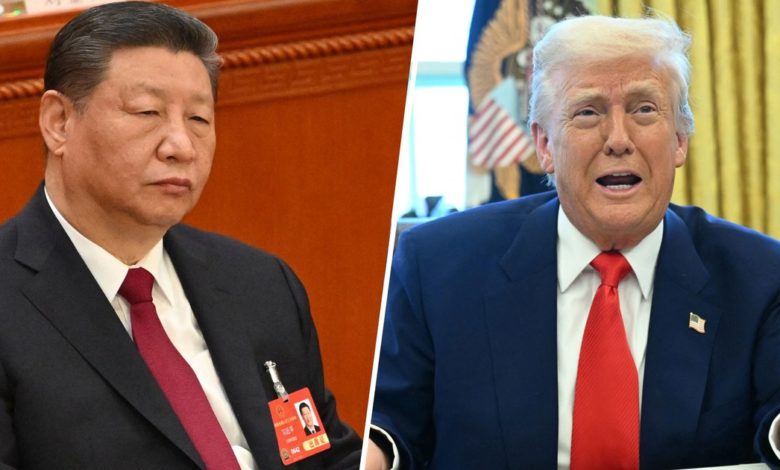
On Wednesday, April 9, Trump announced in a post on his Social Social Social Media platform that he would raise duties on Chinese goods to at least 125 percent, thus deepening the gap between the two largest economies in the world. Trump also returned to the basic customs tariff of 10 percent. For almost all imports to the USA, which last year amounted to around $ 3.2 billion. (PLN 12 billion 364 million), while suspending the higher tariffs, which he announced last week for the European Union and almost 60 other trading partners.
The 10 % Trump's base tariffs and the sky-high duties on China make up a huge increase in import tax for one of the US main trading partners, which will probably lead to the price of many consumer goods and semi-finished products used by producers. Beijing retaliation also threatens the export of American agricultural goods, which largely depends on China.
An additional 125 % duty, in addition to customs on Chinese imports, which have already introduced the United States, can be interpreted as the imposition of a “kind of embargo on China, as we did in the 1950s and 1960s”, when the leader of the MAO Zedong communist party was in power, he noticed Ed Gresser, a former American trade official who is currently working in democratic. Think tank progression Policy Institute.
Economists predicted on Wednesday that the increase in customs duties on China would eliminate any economic relief resulting from the suspension of other duties. The escalation of Trump's activities against China “is probably more inflationary” than his original “mutual” tariffs, despite the fact that he suspended high rates on the EU and other trading partners for 90 days, he wrote in the post on X Jason Furman, who was the head of the Council of Economic Advisors of the White House during the time of former US president Barack Obama.
Trump argued on Wednesday that his tariffs would eventually force the Chinese president XI Jinping to join the negotiating table. “I think President XI is a very intelligent guy and I think that we will finally conclude a very good contract for both sides,” Trump told reporters on Wednesday afternoon.
Beijing, however, did not give any signals that this gambit is working.
“The Chinese government's approach was to remain unmoved, accepting pressure and waiting for Trump to beholped,” said Daniel Russel, a former official of the State Department, who is currently the vice president of international security and diplomacy at Asia Society Policy Institute. – Beijing believes that Trump perceives concessions as a weakness, so succumbing to him only encourages him to be more pressure He added.
Anxiety surrounded by Trump
Even some members of the President's party remain concerned about the direction of his trade policy. – The tariff pause announced on Wednesday distributes part of the speculation, but does not eliminate uncertainty, unless in the next few days the US begins to sign the agreement with some main trade partners – said the Republican Senator Tom Tillis.
United States and China, which last year traded goods worth almost $ 582 billion. (approx. 2 trillion 249 billion, counting at the current exchange rate), were involved in a series of “wet wet” customs, which Trump started shortly after taking office to put be cotton beads on Beijing. The US president demanded that China make more to stop the influx of fentanyl to the United States.
It started with a 10 % duty to Chinese goods, which in March were doubled to 20 percent. Last week, Trump increased the rate to 54 percent, adding a 34 % duty to “balance the unfair commercial practices of Beijing.”
Mutuals were part of a wider tariff action against the whole world, which Trump partially suspended on Wednesday for 90 days, after how She caused concerns about the global recession and caused a sharp decline on the stock exchanges.
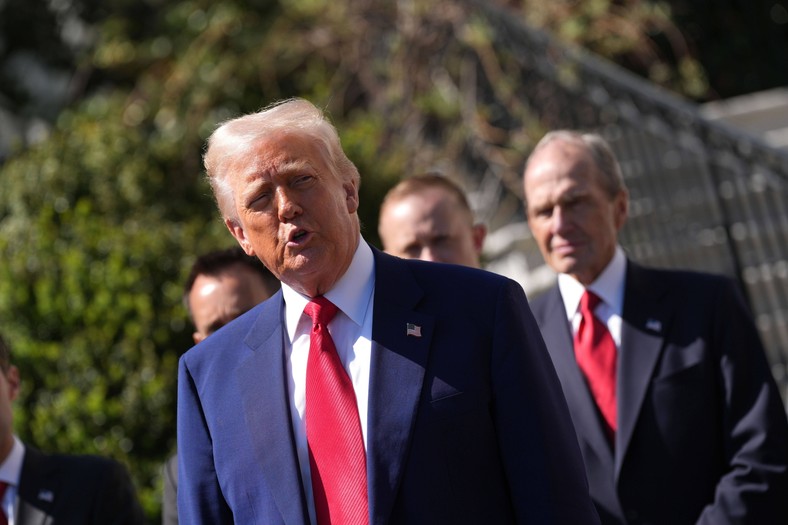
Donald Trump in front of the White House in Washington, USA, April 9, 2025.
When China responded by applying a 34 % duties to American goods, Trump announced the introduction of an additional 50 % tariff. On Wednesday, Beijing reacted to Trump's higher duties again, which prompted the US president to be announced on Truth Social that he raised the American duty to Chinese goods to 125 percent. with immediate effect. He emphasized that his decision results from “disrespect that China showed to world markets.”
The nature of Trump's tariff activities caused even greater criticism from the Democratswho accuse him of starting a trade war with the whole world without any consistent plan of negotiating with countries that are willing to conclude contracts. And even if many legislators expressed the relief that the president suspended some of the most aggressive duties' increases – raising the rates to those from the 30s and 40s. For allies, such as Japan and South Korea – many remains concerned about the duties that Trump has maintained.
Senator Rand Paul, one of the most die-hard opponents of customs duties on behalf of the Republican party, said bluntly: “10 % duties are bad, but better than 60 %”.
Paul added that he is concerned about the influence that the escalation of the trade war can have on Taiwan, a key US partner who has close economic connections with China.
– Raising the duties to China and starting a total trade war with Beijing is not good for our country, it is not good for Taiwan – said Paul. – I think that the moment when there is no longer trade with China will contribute to the deterioration of Taiwan's situation. So I think that trade with China is good for our foreign policy, but it is also good for consumers – said the Republican.
“Trump does not stop duties, but imposes a new 10 % tax on everything that Americans buy, and extends chaos for small businesses and pain for retirees and families,” said in a statement Senator Ron Promote, a leading democrat in the Senate finance committee.
“The lack of certainty and predictability will leave millions of Americans in a state of suspension as long as Trump will be the president,” he added.
“I am also afraid that a total trade war with China may limit their cooperation in the fight against the fatal epidemic of fentanyl harassing our community,” he emphasized.
Painful consequences
In 2024, the United States imported goods from China worth $ 438 billion. (1 trillion PLN 692 billion), including mobile phones, electronics, clothing, toys and all kinds of consumer goods, as well as equipment and parts used by factories and repair workshops. Trump's tariffs will take pressure on American companies to find other suppliers to replace Chinese goods, which accounted for over 13 percent. total imports to the USA last year.
An additional 84 % duty, which China has applied to American goods so far, threatens American exports to this country, which last year amounted to around $ 143 billion. (PLN 552 billion PLN 509 million). This accounted for about 7 percent. total US exports in 2024 or approx. 9 percent if you take into account exports to Hong Kong. The loss of this sale can particularly harm farmers, because China is one of the three largest export markets, next to Canada and Mexico.
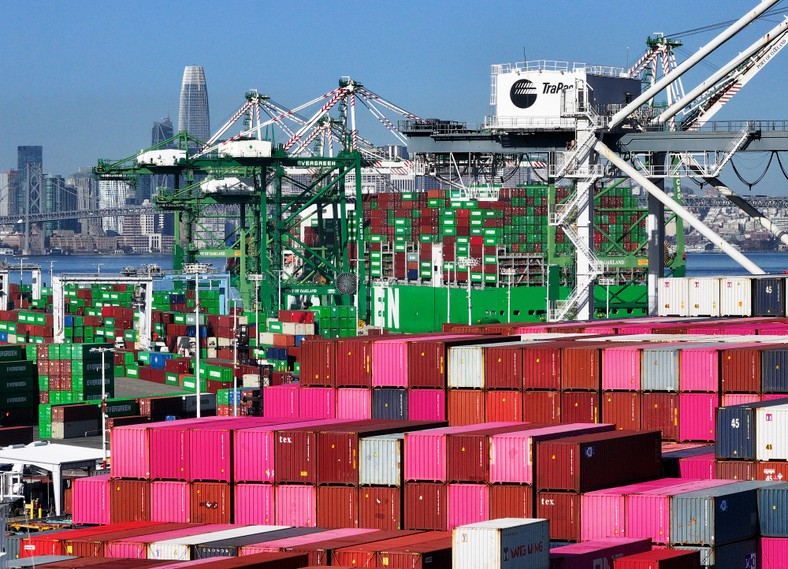
Oakland Sea Port in California, April 9, 2025.
Last year, the United States exported agricultural products worth over $ 24 billion to China. (approx. PLN 92 billion 729 million, counting at the current exchange rate), which accounted for about 13 percent. total export of agricultural products. A rapid decline in this sale can contribute to the growing trade deficit in the US agricultural sector, which according to the forecasts of the United States Agriculture Department will reach a record level of $ 49 billion. (approx. PLN 189 billion PLN 321 million, counting at the current exchange rate) in the fiscal year 2025.
The export of American agricultural products to China fell sharply during Trump's first term to the lowest level of $ 9.2 billion. (PLN 35 billion 546 million) in 2018, i.e. more than half less than before the office. This led to the administration of over $ 20 billion. (approx. 77 billion 274 million, counting at the current exchange rate) to save the agricultural sector.
Trump can try it again, as well as strive to conclude a trade agreement with Beijing, like the one he signed with President XI at the beginning of 2020, reminded Gresser.
Despite the hard rhetoric, his decision to invite the Chinese leader to his inauguration suggests that he is willing to conclude a contract with China, which he could then trumpet, noted the American official.