How two German producers are prepared for Trump's increased taxes / “We have important customers, to whom we cannot dictate prices”

The President of the United States took a step back on Wednesday in the chaos triggered on scholarships and markets, but the danger has not been outdated, and German companies are already sketching B for the future.
- The application of increased “mutual” tariffs has been suspended for 90 days (except for China), to allow negotiations. During this period, the new universal tariff of ten percent is applied.
If Trump does not give up taxes increased by 20%, the engines of the German manufacturer Deutz will initially be much more expensive in the US, Warned, Sebastian Schulte, the CEO of the company based in Koln, the day before Trump will turn back.
“The immediate effects of the tariffs will be transferred to customers,” he said, quoted by the Handelsblatt publication.
“We cannot build a local production, at any price ”
The application of increased tariffs, a currently suspended measure, will not immediately affect the business of the company listed, with a turnover of almost two billion euros, says the head of Deutz. Its competitors come from the UK and Japan, but they would also be affected by the increase of US customs duties.
Neither US customers could move to local offers in a short time. This would require the redesign of construction and agricultural machines, for which Deutz provides the engines. “That would take a few months,” Schulte said.
Deutz generates a quarter of his sales in the US. According to Schulte, about half of the activity will be affected by tariffs, the other half is the creation of local value, for example in services.
Deutz does not currently plan to relocate one's own production in the US. “We cannot build a local production, at any price. The quantities are too small for it,” explained Schulte.
Of the 160,000 engines that Deutz builds annually, about 30,000 go to the US.
Deutz starts business with weapons
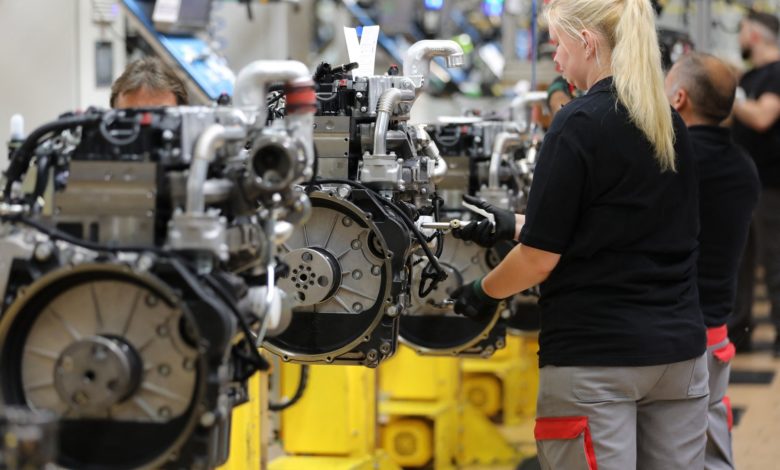
Deutz AG is a German producer listed on the stock exchange, diesel, gas, hydrogen and electrified engines. It is based in Köln and is the oldest engine factory in the world, being founded in 1864. The company is fully owned by shareholders (from December 2023).
The company's products can be found in construction cars, compressors, commercial vehicles, buses, agricultural cars, industrial vehicles and carriers and ships. In addition, the company offers complete services in the form of provision of spare parts, assistance for customers with repairs and maintenance services.
The Deutz CEO, Schulte, believes that many American customers will buy many goods now, before prices are raising due to tariffs. In the third and fourth quarter, the demand could decrease, due to this “anticipation effect”.
Deutz is currently building a large network of services in America. If a car fails, the company aims to help each customer within three hours. The problem is the lack of workers, that “we cannot find people”, Schulte complained.
If sales in the US fall due to increased customs tariffs, a new opportunity will appear on the German domestic market: the defense industry. “We want to continue to grow there,” Schulte said. So far, Deutz has provided small series for military applications, but now applies to larger auctions for wheels protected, such as staff armored carriers.
“Basically, our engines meet military requirements,” says Schulte. After all, Deutz engines are also used for construction machines or mining vehicles and can withstand heavy loads and extreme temperatures.
However, the company will generate only about 50 million euros in sales in this segment this year, with a forecast turnover of 2.1 to 2.3 billion euros.
“Recipe for success? Innovation”
Like Deutz AG, many German companies must currently find a way to deal with high US tariffs if they are applied.
The head of the singing producer, BizoBa, Andreas Wilhelm Kraut, told Handelsblatt: “One third of the products we make in the US. The rest we supply in Germany and Serbia. This puts pressure on our costs.”
There are existing supply contracts with customers, but the negotiation space is limited. “We have important customers, to whom we cannot dictate prices,” explained Kraut.
The Bizo Bizo-headquarters manufacturer, based in Balingen, in the Baden-Württemberg, has imposed it as a family business on the American market and has been operating in the US for over 40 years. Trump's possible rates will be a problem. Owner Andreas Kraut explains how he is going to save the business.
“The recipe for success? Innovation,” says Andreas Wilhelm Kraut, in an interview for Handelsblatt. The medium-sized company was the first producer to integrated its precision scales into the Retailers' IT systems, winning large customers of supermarket chains.
“We could relocate production in the US in a few months ”
Kraut, which is the fifth generation of his family that runs the company founded in 1866, developed the US business itself. Today, this represents a quarter of the total turnover of 800 million euros.
The world commercial war brings the company absolutely new problems. It will hardly be possible to compensate for the additional load of tariffs, with price increases. “This raises challenges for our calculations,” says Kraut, saying that he already has a B plan, to secure his business in the US.
It is already the second time that Trump's punitive tariffs have affected his US business-first hit the China production location, now Serbia. In Germany, in the meantime, only high quality scales are practically manual products: “Standard products with large volumes can no longer be made economically in Germany,” says Kraut.
“During his first term, I was still sending equipment from China to the US,” he said, regarding Trump and his previous measures. “When rates were imposed on China, I relocated this production in Serbia.” Andreas Kraut was surprised by the level of the rates to be applied to Serbia, before the breath break decided yesterday by the American administration.
“We cannot understand how this high rate is calculated, for such a small country in Eastern Europe,” he explained. Now, Bizoba is again afraid of the tariff policy of the White House and considers the relocation of production in the US, which could take place in a few months. But Andreas Kraut wants to wait and see what happens, with the punitive rates proposed by Donald Trump.