Exhibition with accusations of anti -Semitism: “The works are discussed various historical horrors,” says the curator. A researcher contradicts him: “Why does the artist wear swastika?”

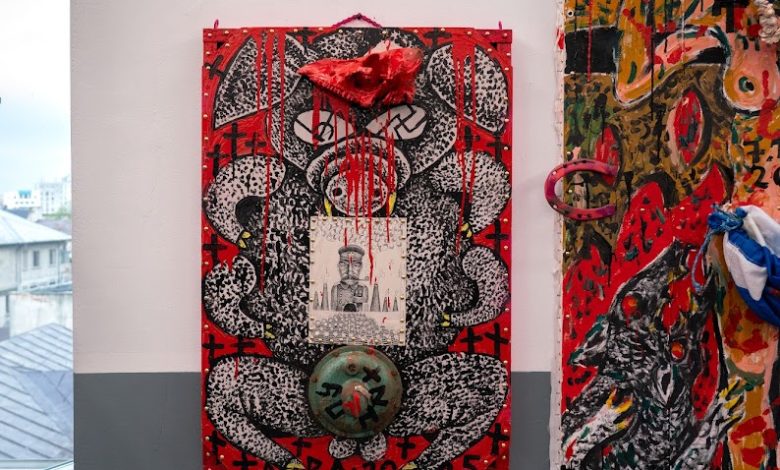
An exhibition signed by artist Sorin Tara and curated by Dan Popescu sparked heated reactions on social networks, being accused of anti -Semitism and glorification of Nazism. In an interview with HotNews.ro, the curator claims that the works have been misinterpreted and that “the exhibition is an alarm signal, a form of demitization and a direct criticism of all bloody ideologies that have marked history, including Nazism.” In reply, Adina Marincea, researcher specialized in extremism, states that by these answers the curator “delights the most thorny questions”.
- Critical comments have in particular aimed at the presence of symbols such as swastika, considered by some as “urging, violence and extermination”.
- The curator of the exhibition, Dan Popescu argues that Sorin Tara's works do not glorify the totalitarian ideologies, but ironize and demitize them. “What we see here is a total lack of understanding of the language of contemporary art and the stakes of this exhibition,” he said, for Hotnews.
- Following the explanations offered, the researcher Adina Marincea stated that if the artist “wants to criticize the ideology represented by swastika, she still signs with a turned swastika or wears such symbols around her neck? (…) Then not only the use of this symbol is criticized, but also the anti -Semitic messages of her works.”
“What is the border between a controversial artist and a Nazi supporter”, was the question about the exhibition called “History at the empty p **”, organized in Malmison, submitted by Iulia Bădilaș, a young woman who saw the works of the artist Sorin Tara. Then more critics followed and voices appeared that demanded the prohibition of the exhibition. At the same time, the community of artists and artists from Malmaison is delimited by the content of the exhibition, specifying that it is not responsible for the selection of projects hosted in the individual galleries.
The accusations were rejected by the curator of the exhibition, Dan Popescu, who stated that the exhibition “is not a glorification of the dark past, but a provocative mirror put in front of contemporary society.” He argues that these criticisms come largely from people who did not visit the gallery, and he explained, in his curatorial speech, “that it is not, in no case an anti -Semitic approach.”
“On the contrary – the exhibition is an alarm signal, a form of demitization and a criticism of all bloody ideologies that have marked history, including Nazism,” explains Popescu.
He argues that “the works ironicizes, criticizes and discuss various historical horrors – from the policy of the state of Israel to Gaza, to the crimes committed by Hamas against the Israelis on October 7, to the atrocities of the Russians in Ukraine, the crimes of the Milosevici regime, the First World War, the Battle of the Romanian Turn.”
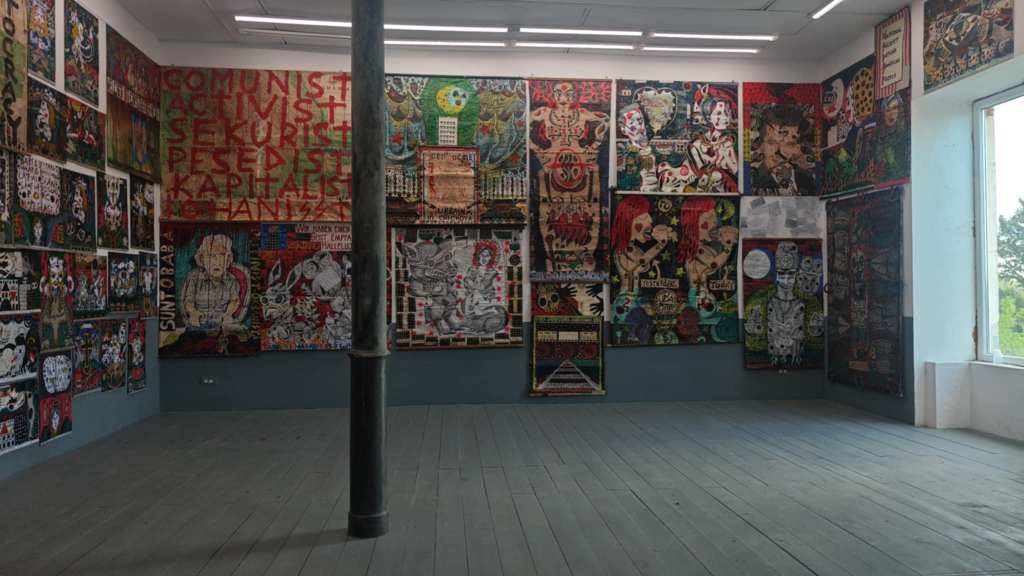
“Symbols can be used in art”
Dan Popescu believes that negative reactions to the exhibition come “from a deep misunderstanding of the language of contemporary art and the context in which the controversial symbols are used.” According to him, part of the public believes that certain signs-such as the swastika or star of David-can never be used, not even in an artistic framework meant to problematize or demitize them.
“They consider them sacrosancts, forbidden, ignoring the fact that, in art, the context is essential. They did not have the patience or the availability to listen to the curatorial explanations.”
Popescu also invokes the legal framework that allows the use of extremist symbols for artistic purposes. “The law is clearer than the chaos triggered by their reactions,” he says, referring to Article 4, paragraph 3 of the Emergency Ordinance 31/2002, which allows the use of such symbols in educational, scientific or artistic contexts.
At the same time, he rejects the idea that the moment chosen for such a theme would be inopportun, given that the non -elegious and anti -Semitic discourse has climbed into the public space. “In a possible future dominated by far-right authoritarianism, such exhibitions will not be able to exist. If we want to defend artistic freedom, we must do it now,” he says.
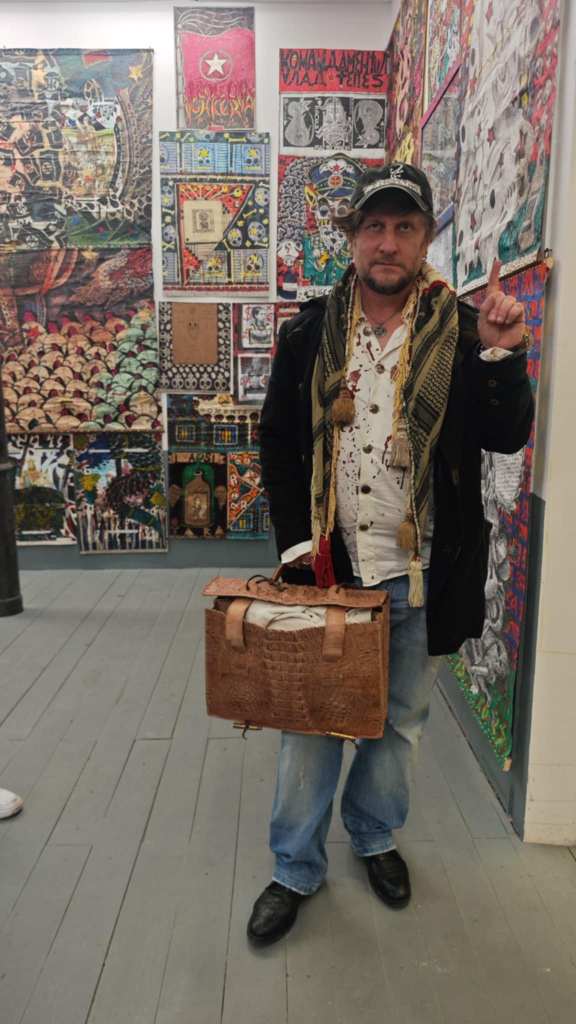
Dan Popescu says he was expecting critical reactions, but not from the direction they came from. “I thought that the dissatisfaction would rather appear in the area of the gold supporters, given that the exhibition directly ironizes the candidate Călin Georgescu,” says the curator.
As for the symbols, he believes that the presence of swastika is “minimal” and does not aim to glorify Nazism or deny the Holocaust – “God forbid,” he adds. “It is a serious misunderstanding of the language of contemporary art to reduce everything to symbols, ignoring the intention and the context.”
Artist Sorin Tara, involved in another scandal in 2015. The curator defends him
Popescu also refers to an older scandal, in 2015, in which the artist Sorin Tara had been accused of extremist sympathies, after a work that portrayed Klaus Iohannis in controversial hypostases.
“I worked with both the country and Vlad Nancă, and the latter reaction was a superficial one. He concluded that the country would be a Nazi, a mistake similar to the one we see now.”
The curator claims that, although the Goethe Institute subsequently gave up collaboration, following public pressures, “there was no evidence that the country would be anti -Semitic or promote extremist ideologies.” In his opinion, it was a case of “Culture Culture” before the deadline was fashionable.
Researchers: “The truly uncomfortable questions are bypassed”
In a response to Hotnews, Adina Marincea, researcher at the National Institute for Holocaust Study “Elie Wiesel”, criticizes the public position of the curator Dan Popescu, who says that “it will delight the most thorny questions” related to the content and symbolism of the works signed by Sorin Tara.
In her opinion, not only the use of swastika is problematic, but also the way the artist personally relates to that symbol.
“If Mr. Country wants to criticize Nazi ideology, why signs with a turned swastika or wears such symbols around the neck?”, Asks the researcher rhetorically. She believes that such gestures transmit ambiguous messages, difficult to interpret otherwise than as forms of visual glorification or, at least, of symbolic assumption.
Old anti -Semitism packaged in new forms
Marincea also draws attention to the presence of classic themes and tropes of anti -Semitism in the exhibited works. “In the paintings of the country, classic anti -Semitic narratives appear, such as the deicide – the painting with Jesus crucified by the beasts, wearing the yellow star with which the Nazi Jews were marked. It is an image that resumes a centuries -old trop, specific to religious anti -Semitism.”
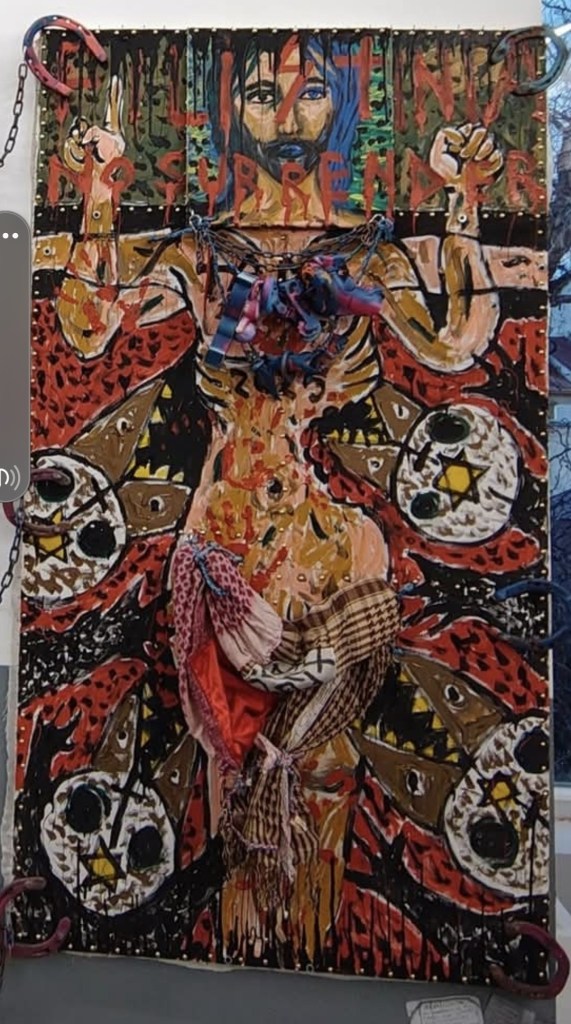
The yellow star appears, according to the researcher, in several works in the current exhibition, but also in others presented in 2023, “just one month after the attack on October 7”. The Jewish symbols are placed on bombs, tanks or in texts like “Terrorism”, a formulation that, she argues, resume the myths related to Jewish financial domination – another well -documented anti -Semitic trop.
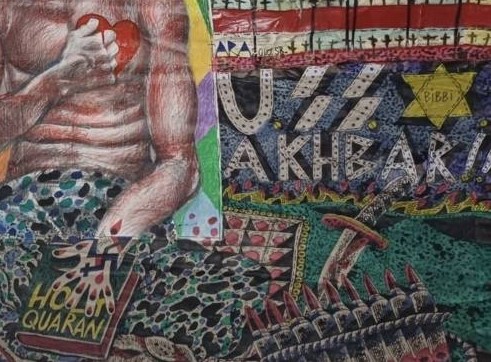
“The criticism of Israel is not anti -Semitism. Generalization, yes.”
“There is absolutely no problem in criticizing the state of Israel or his politics, but it becomes anti -Semitism when overpassing Israel with all Jews, Judaism or with its religious symbols. This means generalization, and generalization leads to hatred,” warns Marincea.
It invokes all three major international definitions of anti -Semitism – IHRA, Nexus and JDA – which explicitly mentions that such overlap is anti -Semitism, regardless of intent.
In this context, the researcher draws attention to the increasingly tense climate in Europe, after the attacks on October 7, and says that hostility has increased significantly. In Romania, she adds, Jewish synagogues and cemeteries were vandalized with swastika or “free palestine” messages, in an unfair and deeply dangerous association.
“This hostility creates a sense of insecurity and fear among the Jewish community. It is completely irresponsible to bring, through art, anti -Semitic messages – either intentionally or out of ignorance. The effect is the same: the spread of hatred under the cover of artistic freedom.”
Marinca also states that the problem is not limited to artistic works. She claims that there are also testimonies about Sorin Tara's anti -Semitic verbal behaviors, addressed to women, including Jewish origin. “One of his paintings is called himself Jewish Bitch – The Jewish bitch. There is, therefore, a coherence between messages in his art and personal behavior, ”she says.
The exhibition continues. Discussing with the public, open
While the exhibition has aroused heated debates, the curator announces that it will continue to be open, and on Thursday, April 10, he will talk to the public. “My participation was not questioned by the organizers, which shows that the artistic approach is still accepted and supported,” says Popescu.