Why don't we sleep well? Answers and solutions from Dr. Maria Dede, pneumologist with specialization in sleepy


Do you wake up tired even after many hours of sleep? Do you have difficulty falling asleep or waking up frequently during the night? Dr. Maria Dede, a pneumologist with specialization in sleepy, comes to the conference to explain how sleep influences every aspect of our lives – from energy and productivity to physical and emotional health.
Sleep does not mean only rest, but an active process by which the body is restored and protected. During deep sleep, the body repairs damaged cells, regulates metabolism and improves memory. Therefore, long -term sleep deprivation not only makes us irritable and tired, but can lead to hormonal imbalances and risks to cardiovascular health
📅 Come on April 12 at the Reference Conference and find out how to improve your sleep! More details and tickets here
HotNews: Why is sleep so important to our physical and mental health?
Dr. Maria Dede, pneumologist: Sleep is a physiological process that is part of our lives and is necessary to restore the body. There is a bed-waters' circadian rhythm, after which we operate over 24 hours. In a waking state, when we are active, we consume energy through all the activities in which we are involved (physical, intellectual, stress, etc.), ie we are in a process of catabolism (energy expense), being under the action of the sympathetic vegetative nervous system. At the end of the day, when we have the “unloaded batteries”, sleep is installed, when we recover all the energy consumed. We are in an anabolism process (energy gain), being under the action of the parasympathetic vegetative nervous system.
During sleep, the brain rests, with a much slower electrical activity, the muscles relax, and the breathing and cardiac activity are much reduced. At the same time, the process of anabolism forms proteins that help in the synthesis of essential antibodies for immunity, contributes to the consolidation of memory and to the formation of various hormones in the body, such as thyroid hormones and cortisol, which are discharged into the blood at the first hour of the morning to prepare us for a new day.
Sleep is considered restful if the duration and quality required. The proper sleep duration is about 8 hours in adults (about a third of life we should spend it sleeping). The duration is longer in children, because during sleep the growth hormone is secreted, and in the elderly it is smaller due to the “aging” of neurological centers that control the sleep-wake rhythm.
As for the quality of sleep, there is a sleep architecture that involves 4 sleep cycles of about 90-120 minutes each. In the first two cycles, superficial sleep predominates, and in the last two Rem Sleep (Rapid Eye Movement), the sleep in which we dream and which is the most restaurant.
If we do not sleep the 8 hours or if the sleep is fragmented and we do not reach enough sleep, we will not be rested on the following day and various manifestations, especially neurovegetatives, may occur: lack of attention and concentration, mood disorders (irritability, anxiety), decreased efficiency in performing daily tasks. If the duration of sleep is insufficient in the long term and insomnia is installed, the balance between sleep and wake is lost, and the body, being longer awake under the influence of the sympathetic nervous system, becomes prone to various conditions, such as high blood pressure (HTA), weight disorders, diabetes, but also the lack of concentration.
HotNews: What are the most common mistakes we make in the sleep routine and how can we correct them?
Dr. Maria Dede, pneumologist: The most common mistake is not to look at sleep as a real necessity, and from here many other mistakes derive:
- Lying late and waking up at irregular hours
- Sleeping during the day
- Eating at night
- Sleeping with bright light
- Sleep in a noisy environment (television, strong music)
How can we correct these mistakes?
- Let's lie down and wake up at the same time, even on the weekend
- Let's sleep about 7-8 hours a night, preferably starting at 10:00 pm
- Let's practice exercise during the day but not before bedtime
- To avoid excessive liquid consumption before sleep
- Last meal to be 3 hours before bedtime to avoid gastroesophageal reflux
- Aerry of the camera and maintaining a temperature of 18-20 ° C
- The bed, mattress and pillow be comfortable
- To remove the sources of bright light and noise
- To avoid using the phone, tablet or television before sleep
HotNews: What can we do if we wake up frequently during the night and we can't rest well?
Dr. Maria Dede, pneumologist: First of all, we must identify the factors that cause the awakening: stress, sleep hygiene problems or medical conditions (osteo-articular pain, gastric reflux, sleep apnea, restless leg syndrome, etc.). If the symptoms persist, a medical consultation is indicated.
If we wake up at night, it is important:
- Let's avoid the TV and the phone
- Let's not check the consistent clock
- Let's find relaxation methods (prayer, meditation, soothing music, read)
- Let's take melatonin, especially in the elderly, where its production decreases as you get older
HotNews: How does it influence stress and anxiety sleep and what strategies can we adopt to sleep better?
Dr. Maria Dede, pneumologist: stress and anxiety cause adrenaline and cortisol release, which prevents sleep installation and favors nocturnal awakening. The lack of adequate rest aggravates and maintains stress and anxiety.
Tips to reduce stress before sleep:
- Organizing activities to avoid persistent thoughts at night
- Practicing relaxation techniques (hot bath, massage, sports)
- Psychological therapy or psychiatric consultation if stress is chronic
HotNews: Is it true that certain foods or drinks can influence sleep?
Dr. Maria Dede, pneumologist: foods with heavy digestion, such as pork and other meat derivatives, fatty foods, mayonnaise, butter and dietary fats, if consumed at the evening meal, even before bedtime, will make it difficult for sleep or will generate gastro-oesophageal reflux overnight. Also, eating at night is completely erroneous, because it disrupts metabolism and can lead to obesity.
Therefore, dinner should be a light meal, served about 3 hours before sleep, for effective digestion.
As for liquids, it is preferred to be consumed throughout the day, not before bedtime, to avoid going to the bathroom during the night. Coffee, green or black tea, energizing or caffeine drinks should be used in moderation, especially in the first part of the day, to avoid insomnia. It is preferable to avoid the consumption of alcoholic beverages at the evening meal, especially without moderation, because the alcohol has miorelaxing effect, and the muscles inside the neck relax and join, leading to the closing of the pharynx and the appearance of sleep apnea, which fragments the sleep. Instead, a small amount of lime or milk tea can be served, with a soothing effect.
HotNews: For someone who sleeps a little because of the busy schedule, what tips could help to maximize rest?
Dr. Maria Dede, pneumologist: The best solution is the reorganization of activities to allow a longer sleep. If this is not possible:
- Not to sleep during the day in order not to fragment even more sleep;
- To try at least a few nights a week a longer sleep;
- To optimize the quality of sleep by adequate hygiene;
Conference References, 3rd edition
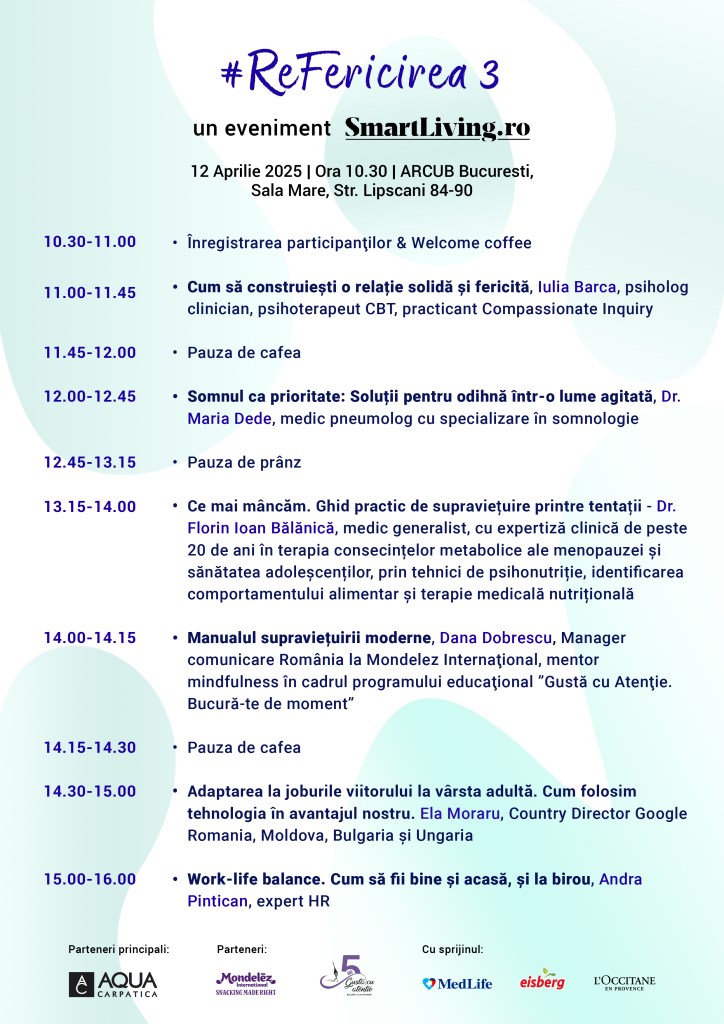
📅 At the reference 2025, we invite you to take a break. A break that does not mean “stop”, but “restart”. It is not a moft, but a necessity. A day when we offer you new prospects, concrete solutions and inspiration To live more consciously, more balanced and closer to you.
It's about to make room for your own lifeabout learning to take care of yourself without guilt, about building healthier relationships, understanding better what you do well and what your energy uses uselessly.
It's not about perfection but about To live more authentic, more present and more reconciled with you. More details and tickets here – https://shorturl.at/ia0qy
Inspirational speakers:
Iulia Barca – CBT psychotherapist, compassate inquiry
Dr. Maria Dede – Pneumologist with specialization in sleepiness
Dr. Florin Ioan Bălănică – specialist in psychonutrition
Dana Dobrescu – Mindfleness character
Ela Moraru – Country Director of Google Romania, Republic of Moldova, Hungary and Bulgaria
Andra Pintican – Expert HR
… and other guests surprise!
💫 What is waiting for you at the referral 2025?
✔️ Interactive panels and practical tips
✔️ Moments of inspiration and introspection
✔️ Surprise activations from sponsors
✔️ A warm, relaxed atmosphere, where you can be you
📍 Places are limited! Book your ticket now and give yourself a day just for you. 🎟️
Main partner: Aqua Carpatica, partners: Mondelez International, carefully taste with the support: MedLife, Eisberg, Lʼoccitane