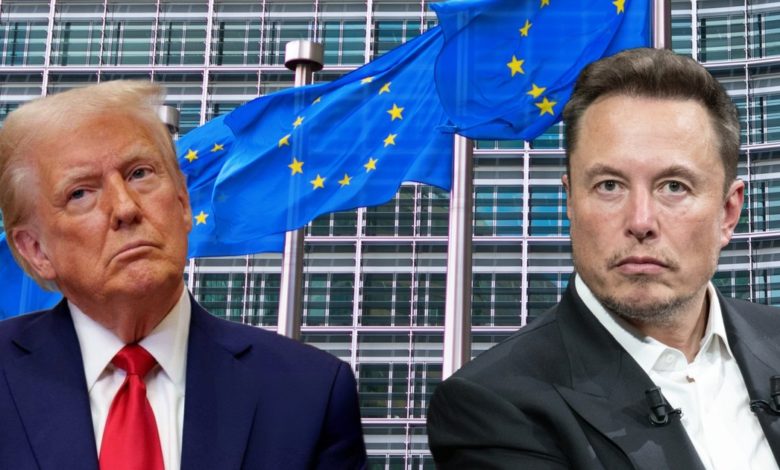
When the President of the United States Donald Trump presented on Wednesday a list of customs duties on a number of countries, European officials and legislators immediately thought about the Washington Achilles heel – in the form of Big Techów.
The European Union has a commercial surplus of EUR 157 billion (PLN 671 billion) in goods, which means that it exports more than imports. At the same time, however, it has a deficit of EUR 109 billion (PLN 466 billion) in services, including digital ones. In all parts of the market in Europe, great technological giants, such as Apple, Microsoft, Amazon, Google and Meta dominate.
During the Tuesday session of the European Parliament, even before Donald Trump announced, the chairwoman of the European Commission Ursula von der Leyen mentioned that technology is one of the “cards” that Brussels can play in negotiations with the US President. And it is really strong. The problem is that the EU is divided as to whether it should use it – such serious consequences can entail.
The EU tool and the anger of the rich
The flagship EU technological provisions, such as the Act on digital markets (DMA) and the Act on Digital Services (DSA), were not created as retaliation. Attempts to impose higher taxes on technological giants have failed.
European governments could reduce their expenses on Big Tech by changing the public procurement policy, but in many cases they do not have other companies to which it could turn to. What's more, some capitals, such as Dublin, are already warning that hitting American technology will seriously harm the block economy.
It is almost certain that A direct attack on large technology companies will cause the anger of the presidents of technology companies, Such as Elon Musk, Jeff Bezos and Mark Zuckerberg, who established close relationships with Trump.
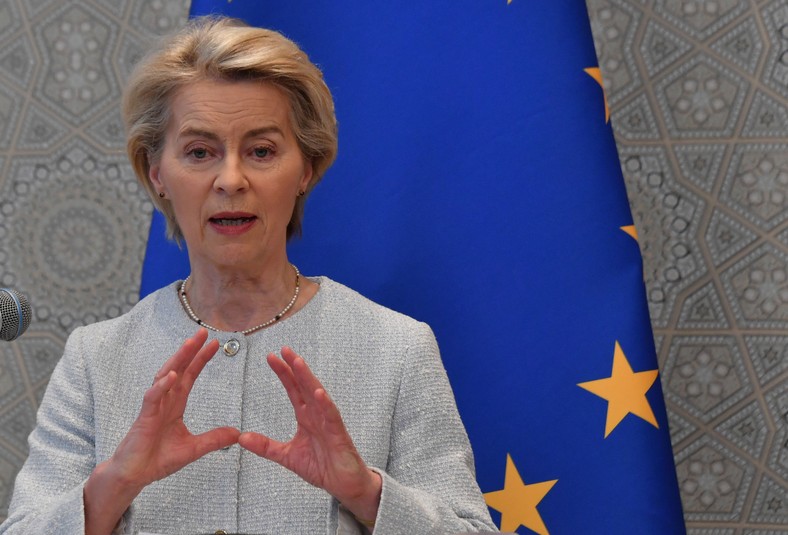
Vyacheslav Oseledko / AFP
Chairwoman of the European Commission Ursula von der Leyen during a press conference during the EU-Azja Central Summit in Samarkand, April 4, 2025.
Europe could also use its strongest trading weapon so far-Anti-CoERCION Instrument [Rozporządzenia w sprawie ochrony Unii i jej państw członkowskich przed stosowaniem wymuszenia ekonomicznego przez państwa trzecie; daje ono UE możliwość nakładania sankcji odwetowych na państwa trzecie w odpowiedzi na naruszenie jej interesów]. With its help, Brussels could hit American technology companies.
However, this tool is not proven. It was designed as “commercial bazooka” after the first term of Trump's rule in 2017-2021, but it has never been used in practice.
Law versus trade wars
The EU has not yet carried out any of the groundbreaking investigations she initiated as part of the DMA (regarding digital competition) and DSA (regarding content moderation). At the end of this or at the beginning of next week, the European Commission intends to impose a fine on Apple and Meta for violating the rules of digital competition – these will be the first such fines imposed under DMA.
Brussels also decided that Elona Muska's website violated the EU rules for moderating content. This may result in financial penalties of 6 percent. annual global turnover of the company. The same investigation is also covered by the finish. EU officials are trying to emphasize that the enforcement of these provisions should not be considered part of the trade war.
– DMA is not a tender card. This regulation is to establish honest rules of the game in Europe, and not to be used in the trade agreement with the United States-said French law renew Stephanie Yon-Courtin.
Continuation of the material under the video
Andreas Schwab from the center -right European People's Party (EPP), which is involved in DMA work, stated that the European Commission should issue decisions on Apple and Meta faster – just to show that “there is nothing political in them”.
His main argument is that EU technological provisions exist in order to support European values, not discriminate or attack a given country. Any suggestions that it is different may harm the European Commission – Big Tech will inevitably be processed in the case of bangs and penalties resulting from violation of the regulations.
Washington, however, suggested the opposite. In February, Trump's administration threatened the retaliation targeted at the EU technological regime – it justified this alleged threats to American companies and freedom of speech. The Wednesday's statement of the White House regarding customs renewed appeals to Brussels to accelerate investigations against American technology companies.
– Because Trump said he was open to negotiations, I'm afraid he would try to use digital services as a negotiating tool. However, I hope that the European Commission will be firm – said Danish MEP Christel Schaldemose. The lawyer of the green Alexander Geese spoke in a similar way. “Let's definitely enforce DSA and DMA,” she said.
Taxes and fees
Proponents of answers to Trump's duties see several other forms of retaliation – such as the imposition of higher taxes on digital services and the exclusion of American technology companies from applying for government contracts.
Brando Benifei, who chaired the parliament delegation to the USA the need to take “wide remedies that will hit where it really hurts” And which will be “focusing on services, such as large technology companies”. In a written commentary, as one of the possible solutions, he suggested excluding them from public procurement.
Digital services “will inevitably be in the center of attention,” said Aura Salla, a Finnish MP from the European People's Party (EPL), which is also a former leading lobbyist in Brussels. The chairman of this group Manfred Weber said on Tuesday that “digital giants pay little for our digital infrastructure, from which they benefit so many benefits.”
Some EU countries are already joining these votes. On Thursday, a spokeswoman for the French government Sophie Primas said that Another wave of retaliation EU may be aimed at “digital services that are currently not taxed”. Also the French MEP Sandro Gozi noted that “taxation of American digital giants” may be one of the options for answering Trump's customs.
The issue of tax on digital services has been raised in the EU for some time. 27 Block Member States, however, may not agree on this matter, and the EU tax policy requires unanimity.
Therefore, some member countries have taken independent actions. Recently, the ruling coalition in Belgium has developed a contract on the introduction of digital tax by 2027, if there is no agreement at international or EU level. Ireland, the European “capital” of several American Big Tech companies, immediately responded to this move. The Irish Trade Minister Simon Harris assured that this is not the entire EU position, adding that this move can be very harmful to Ireland.
I’m Ashley Davis as an editor, I’m committed to upholding the highest standards of integrity and accuracy in every piece we publish. My work is driven by curiosity, a passion for truth, and a belief that journalism plays a crucial role in shaping public discourse. I strive to tell stories that not only inform but also inspire action and conversation.