“Putin will not let us wait for 10 years.” Baltic countries build a defensive line against Russia, but officials are afraid they have no time

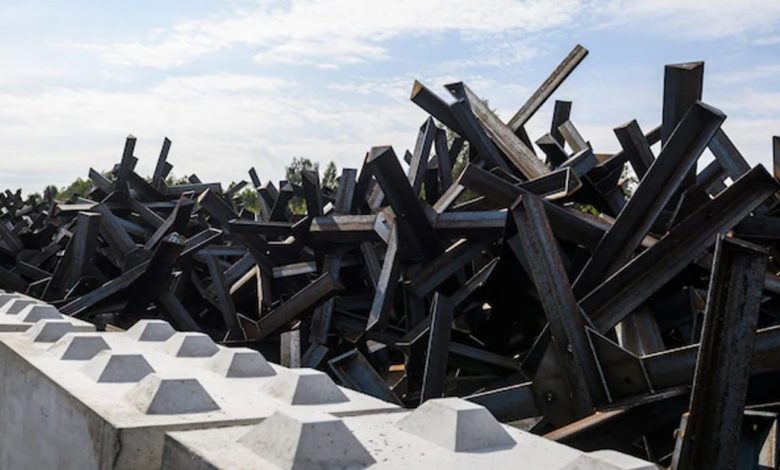
Estonia, Latvia and Lithuania are in a hurry to build 1,000 concrete bunkers with anti -tank ditches. The construction progresses quickly, but the Baltic officials are afraid that they do not have time.
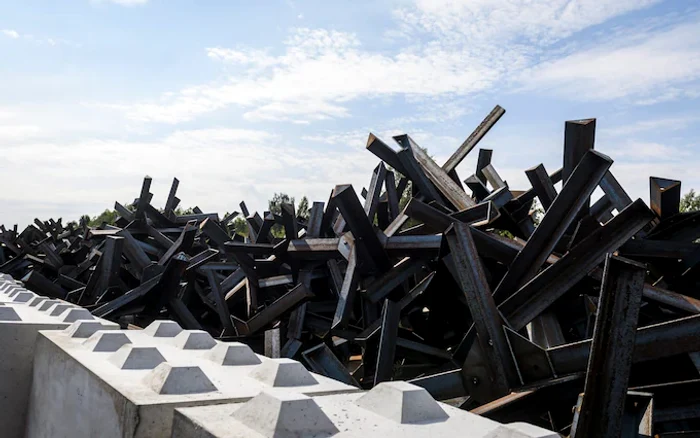
Anti -tank hedgehogs and concrete blocks near the Latvian border with Russia Photo: Getty Images
“From the first meter”, It is the way NATO intends to fight a Russian invasion in the Baltic states.
In the center of this plan is “Baltic defense line ”, The common project of Estonia, Latvia and Lithuania to strengthen a portion of about 970 km from their borders with Russia and Belarus, the most exposed part of the Eastern NATO flank, according to The Telegraph.
The main elements, announced for the first time in January 2024, include 1,000 concrete bunkers – 600 in Estonia – together with trenches, anti -tank ditches, ammunition deposits and supply shelters.
The construction progresses quickly, but estimates suggest that it could take a decade until completion. Baltic officials are afraid they have no time.
“We need ten years to prepare to deal with the Russian threat. Putin will not let us wait for these 10 years. The most dangerous time for the Baltic countries will be immediately after a cessation of fire in Ukraine,” Gabrielius Landsbergis warned, who was Lithuania Foreign Minister until November.
The small ex-Soviet states are aware that Russia, with its economy already on the war, has developed plans to increase military production and to send additional troops to their borders in the event of a break in the Ukraine war.
As security concerns grow, these countries announced last month that they will withdraw from an international antipersonal mines prohibition treaty.
Poland and Finland joined them. Lithuania also gave up a treaty on bombs with dispersion in March. All these countries say they want to have the freedom to choose to use new armament systems to counteract the threat from their eastern borders.
“Strategic message”, According to Dovilė Šakalienė, the Lithuanian Minister of Defense, is that “We are ready to use absolutely anything ” to defend us against an invasion.
A recent report of Danish Intelligence Services said that once the war will stop or freeze in Ukraine, Russia will be able to re -enter, regroup and start a war against NATO.
The report estimates that, in six months, Moscow could “He was wearing a local war in a surrounding country. ”. In two years, it will be “prepared for a regional war against several countries in the Baltic Sea region. “ In five years, will be able to carry “A large war” in Europe (without the involvement of the US).
NATO signed a defense plan in 2023 “Each centimeter” From the Baltic countries, with reinforcement lines in Finland, Poland and Germany.
Currently, the Alliance carries out multinational forces the size of a battalion, by rotation, in each Baltic State, to act as a defense strategy “thread”, To discourage Russia.
How could the Baltic Defense line look like?
Latvia is defended by an international force led by Canadians, a German brigade protects Lithuania and about 1,000 British soldiers protect Estonia.
“We lack the strategic depth. The Russians could move throughout the country in a few hours, if not even days, which is why we defend ourselves from the first centimeter.”said Landsbergis.
“Look at Ukraine and their recaptured cities, what they took back was a desert,” he added.
More simply, the goal of the new defensive line is to prevent the Baltic cities and localities from having the same fate as the races on the face of the earth in Ukraine.
Estonia, Latvia and Lithuania will spend every 60 million pounds for this, a huge part of their defense budgets, which, in relation to GDP, are the largest in Europe after Poland.
Gabrielius Landsbergis said the message received from NATO was “How much do you handle yourself before asking for help-when you start digging trenches and picking up your border?”
Estonia intends to build 600 bunkers along her border with Russia.
Raimond Kaljulaid, the head of Estonia delegation to NATO, said they are doing “Good progress” on the defensive line.
“The Baltic states do this together, there is no alternative, we have to build a strong regional cooperation,” he said.
Referring to the decision of the Baltic states to leave the 1997 Ottawa Treaty on Land Mines, the head of Estonia delegation to NATO said: “We cannot fight against Russia with a hand related to the back. ”
“We must be able to keep the line, make sure that Russia does not penetrate, but we must also be able to fight the enemy,” he added.
As part of the first stage, Latvia and Lithuania have already installed concrete pyramids known as dragon teeth to obstruct armored vehicles along their borders. In Estonia, her consolidated bunkers – which should withstand artillery strokes – were tested and the positions were chosen.
Lithuania has installed anti -tank systems
Lithuania has installed anti -tank obstacles on the bridge over the Neman river at the border with Russia. Till autumn the first section of what his army calls “Defensive strengths” It will be completed, the Estonian Center for Investments in Defense said.
Potrovit to the quoted source, the country also purchased large quantities of different barrier wires, 1.5 ton large dragon teeth and “LEGO blocks ” made of two -ton concrete, as well as road barriers with walls in T.
“In this way, the defense forces, together with the allies, can stop the opponent from the first meters”, said the spokesman of the Ministry of Defense.
A major lesson in the war with many losses in Ukraine was the importance of defense in depth and counteract the mobility of the enemy.
“The great advantage in the modern war is the defense ”said Michael Dicianna, a researcher at Institute for World Politics.
“The new drones and satellite images have allowed Ukraine's permanent supervision. You always know the positions of the enemy”, he said.
Last year, Poland also started the construction “to the eastern shield ” worth 1.9 billion pounds – a vast line of stratified defense infrastructure and peak surveillance systems along its border with Russia and Belarus. This month, his army stated that plans are underway to start the mining of his eastern border.
Despite the concerns, Karolis Aleksa, the Lithuanian Deputy Minister of Defense, believes that the Baltic region is ready to withstand a Russian attack.
“We are prepared right now to defend ourselves until the first centimeter, we have no choice”, he said, describing the Baltic Defense line as a “Integral part” a the country's defense system
Lithuania has additional vulnerability compared to the other Baltic states, because its hostile border includes the Russian military bastion Kaliningrad to the southwest, adding 171 miles to its defensive problem.
This country with 2.8 million inhabitants is also the main defender of Suwałki Gap, a narrow corridor between Lithuania and Poland, which forms the shortest terrestrial bridge between Belarus and Kaliningrad.
Both Kaliningrad and the Swałki goal are considered a major liability that Russia could use to isolate the Baltic states on the rest of Europe and then to block them at sea.
“It is a race against the stopwatch”
However, the Lithuanian Deputy Prime Minister of Defense claims that the accession of Finland and Sweden to NATO has brought a “Better strategic image” in the region.
“Our goal is to discourage first, the more we build now, the stronger the signal we will send to Russia. But we should be more prepared. We need to strengthen the defense strategy throughout Europe and NATO,” Harolis Aleksa stressed.
The key fields on which Lithuania is concentrated and, indeed, the region, are the purchase of air defense systems – which are not available throughout Europe – and the increase of remote attack capabilities.
However, beyond the threat of a Russian invasion, the Baltic countries are facing the intensification of hybrid attacks from Russia.
“Against the background of the Ukraine war, one of the most attractive playgrounds for Russia is in the shadow, in the gray area.”Aleksa said, citing acts of sabotage on the submarine cables in the Baltic Sea, cyber attacks and misinformation. “We must be resilient, we have to be better prepared.”
“It is a race against the stopwatch. A big question that the Kremlin could ask is why to give Europe time to re-enter, to supply again, to organize its defense? We cannot exclude the possibility that Russia will make a catastrophic calculation error,” Kaljulaid said from Estonia delegation to NATO.