“Problem for the whole planet”. The French oil giant expands its activities on the ocean


The ecoactive of the Tobechukwu Diol from Nigeria saw with his own eyes how the oil industry destroyed nature, fauna and living conditions of the local population in the Delta of Niger in the south of Nigeria – a region rich in oil deposits. So when he heard that the French oil giant Totalenergies recently received permission for new deep -sea oil wells in Nigeria and the Republic of Congo, he was shocked and disappointed.
– he said.
The area in Nigeria, where Totalenergies received permission to search for oil, covers an area of approx. 2,000 sq km. Permission for wells off the coast of the Congo Republic concerns an area of 1000 km.
New permits for Totalenergies have been criticized by five non -governmental organizations and many organic activists. They believe that NAFT giants, such as Totalenergies, should stop implementing new projects related to mine fuels on the continent, because they are afraid that the environmental contamination and violations of human rights may occur.
– It is disturbing that it is at this point that Totalenenergies is to be expanded at the sea – in the deep blocks off the coast of the Republic of Congo and Nigeria – says Zaki Mamdoo from the international organization 350.org, which has just participated in a general -hon -confinned campaign under the slogan “Kick Total Out of Africa” (Polish throw away from Africa).
Even the Nigerian doctor and ecoactive Bieye Renner Briggs criticize new oil extraction permits.
– It is very depressing and disappointing that Totalenergies did not clean oil leaks after decades. Oil companies run away from responsibility. They only want new projects on which they can earn. The only fair solution is to restore our land, rivers and sources of income – says.
A group of UN experts also drew attention to this problem. They accuse Totalenergies and a number of other oil giants of violating international human rights law because they sell their oil in Nigeria, without covering the costs of huge cleaning work related to environmental pollution or paying compensation to local communities that lost their income and homes.
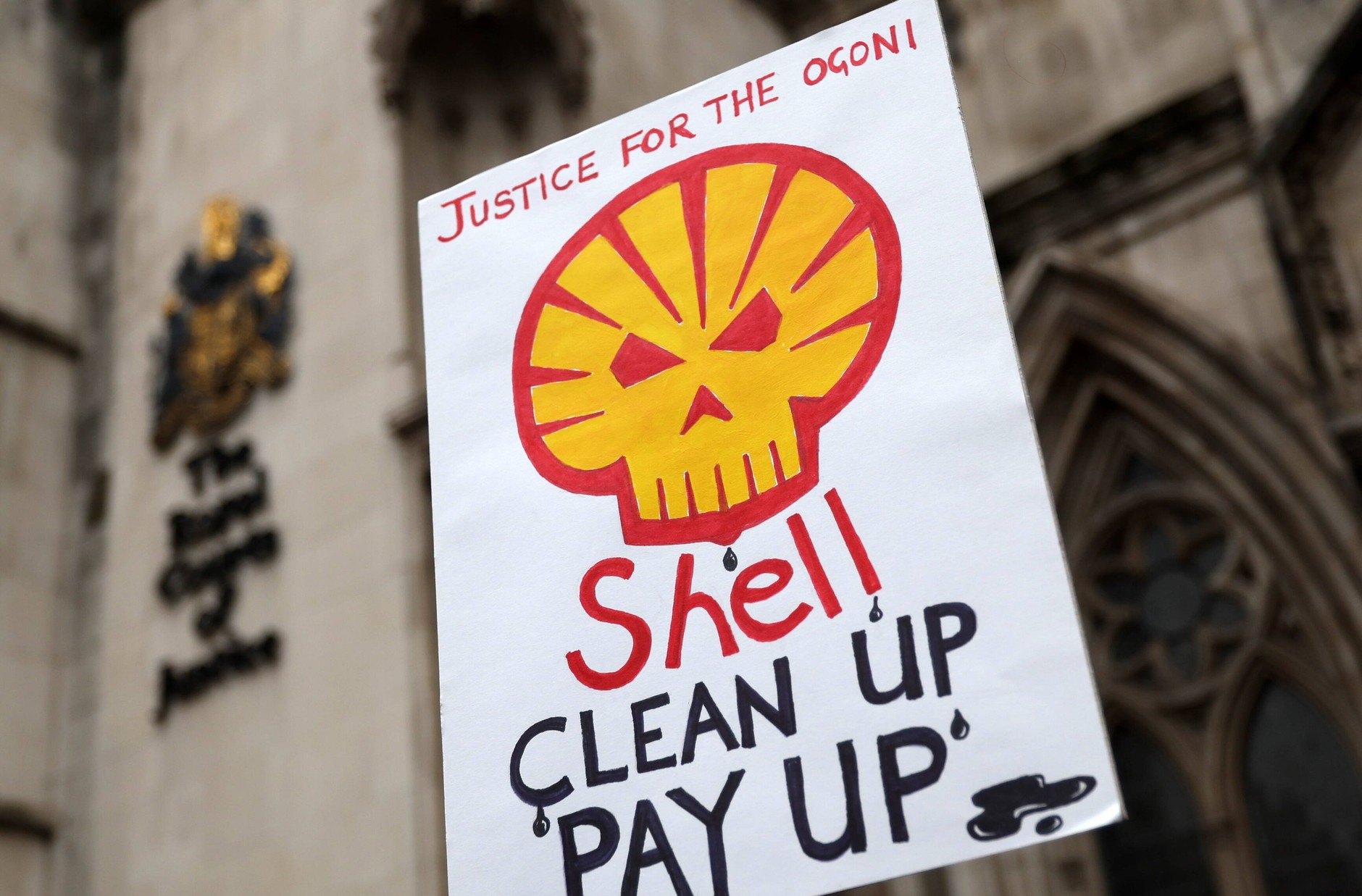
Picture of the poster with the inscription “Shell, Clean, settle” made during the protest “Justice 4 Nigeria”, February 13, 2025.Andy Rain / PAP
Totalenergies is silent
Danwatch has tried to contact Totalenergies to find out how new oil projects are to the company's ambition in the field of carbon dioxide reduction, and how the company helped Delta Niga regions after oil contamination. He did not receive an answer.
A total of approx. 2 billion 200 million crowns (approx. PLN 1 billion PLN 250 million) have invested five Danish pension funds in Totalenenergies. The Danwatch portal asked for a comment to everyone, but only PFA, Paedagogernes Pensionskasse and Industriens Pension have answers. These three claim that they still support the oil giant, but actively act through dialogue and voting at general meetings to keep Totalenergies at the obligations: reduction of carbon dioxide emissions, achievement of carbon neutrality by 2050 and taking into account the environment and human rights in their projects.
Rasmus juhl Pedersen, director of ESG (Polish natural environment, society and corporate order) at Paedagogernes Pensionskasse, believes that having shares gives you the opportunity to introduce changes that would not be possible in the case of selling shares and withdraw from dialogue.
We fully understand the frustration and fears of local communities that live in a contaminated environment on a daily basis. This is an important perspective that we take into account in our dialogue with the company
– states in a written answer.
PFA, the largest commercial pension fund in Denmark, which has shares of a French company worth almost 1 billion 400 million crowns (approx. PLN 798 million), informs in a written answer that it expects Totalenergies to fulfill its duties and take the necessary precautions to protect both the environment and local communities in places where he operates.
“In PFA, we do not agree with everything that Totalenenergies does, and we would like the company to switch its activity faster to renewable energy sources” – states Rasmus Bessing, director of responsible investments, in a written answer.
“Dead lands”
To understand why many organizations and ecoactivists are afraid of expansion of projects related to mine fuels, especially in a country like Nigeria, one should look at the long -term history of the oil industry, including the West African state. It all began in 1956, when the first oil deposits were discovered by Shell, which continues to operate in this country. These discoveries made Nigeria become the largest oil producer in Africa, and thus one of the countries with the largest resources on the continent. However, its extraction was associated with contaminated areas and rivers as well as air pollution due to gas burning.

A resident of Delta Niger, where oil leaks ruin the communities of fishermen and farmersSadak Souici / East News
A number of reports published over the years indicate that oil companies, such as Totalenergies, are responsible for catastrophic oil leaks over the past 50 years, which caused huge ecological damage and influenced the lives of millions of people in local communities.
As Amnesty International said, Delta Niger is one of the most polluted places on Earth. As the diol's toychuk says, Delta Niger is already “dead lands”. In recent years, he has visited 73 rural communities to document how great consequences for nature and people have coexistence with the polluting of the Oil Industry. The living conditions and damage caused to the natural environment are described as poignant. He calculates problems: pollution, loss of livelihood (fisheries and agriculture), disease, lack of clean drinking water, limited access to hospitals and schools.
I see a lot of injustice and very harsh living conditions
– says.
The Nigerian doctor and activist for environmental protection Bieye Renner Briggs has been visiting local communities in the Niger Delta since 2023 to examine how pollution affects the health of residents. He took many samples of soil, water and blood and noticed problems such as kidney failure, heart disease, infertility and children with birth defects.
– It was shocking how many hydrocarbons are in the blood, water, air and even in the crops of local communities. This has many health consequences – he says.
In the event that oil concerns move to the sea and the wells are carried out further from the mainland and coastal communities, the risk of pollution does not decrease.
This is how the researcher Amarachi Paschaline Onhena from Nigeria Maritime University Okerenkoko and Tyson Miller, general director of the Earth Insight organization, dealing with monitoring critical threats to people, areas, nature and climate around the world. According to them, deep wells are associated with great danger and can affect sea ecosystems, threaten fishing, as well as the health of the local people consuming fish and seafood. In addition, underwater noise caused by wells can scare away whales, dolphins and fish.
Oil leaks that can happen will be difficult to master and can have serious, long -lasting consequences
– says Tyson Miller.
Scientist Amarachi Paschaline Onaena studied what effects oil leaks from deep naval wells have for the sea environment and for mangrove forests in Nigeria. According to her, the influence on mansions is a serious global problem, because they absorb four times more carbon dioxide than tropical rainforests and are crucial in the fight against climate change. In the study of 2024, the International Organization of Nature Conservation IUCN found that the mangrove forests were at risk, and by 2050 more than half of them could be destroyed.
Amarachi Paschaline Onena is not convinced that the rule of Nigeria and the Republic of Congo and oil corporations such as Totalenergies have prepared a real plan that will guarantee that oil extraction will not have negative effects on the environment, biodiversity and health of people in the future.
– It is a serious problem that the next oil projects are allowed, since you have not been able to deal with the consequences of the existing ones – says.