The commander of Ukrainian drones, Major Robert “Madiar” Browdi, informed about the attack from Thursday to Friday. “Ruszkik Haza! (Ruthenian home)” – he wrote in Hungarian, publishing a recording from a hit on the Telegram messenger. Like the interfax-Ukraina Browdi agency, it is of Hungary.
The attacked bus resumed work only on Tuesday after prior destruction, when Ukrainian drones hit the “Nikolskoje” pumping station in the Tambian region. The fire that broke out there caused the transmission to be completely suspended. The Hungarian Minister of Foreign Affairs Peter Szijjarto sharply criticized Kiev's actions, calling them “scandalous and unacceptable”. According to him, the attack was aimed at drawing Budapest into the war.
However, Ukrainian diplomacy responded equally firmly. The head of the Ministry of Foreign Affairs Andriy Sybiha said that if Budapest has grown up on oil supply, he should direct them to “Friends in Moscow”, not to Kiev.
“Trouble at your own request”
According to Wojciech Jakóbik, the energy market analyst, the current crisis is a consequence of the wrong policy of Budapest and Bratislava.
– Slovakia and Hungary have trouble at their own request, because despite the appeals of the European Commission, Poland and other participants of the debate, they not only did not reduce, but even increased their dependence on Russian oil – comments Jakóbik. – This has become against the EU REPERREU program, which assumes the abandonment of all raw materials from Russia until the end of 2027.
The expert emphasizes that both countries ignored a strategic threat to short -term economic benefits. – Hungarians and Slovaks deliberately maintain this dependence, counting on lower prices, and in effect they expose themselves to the risk. This threat is just materializing.
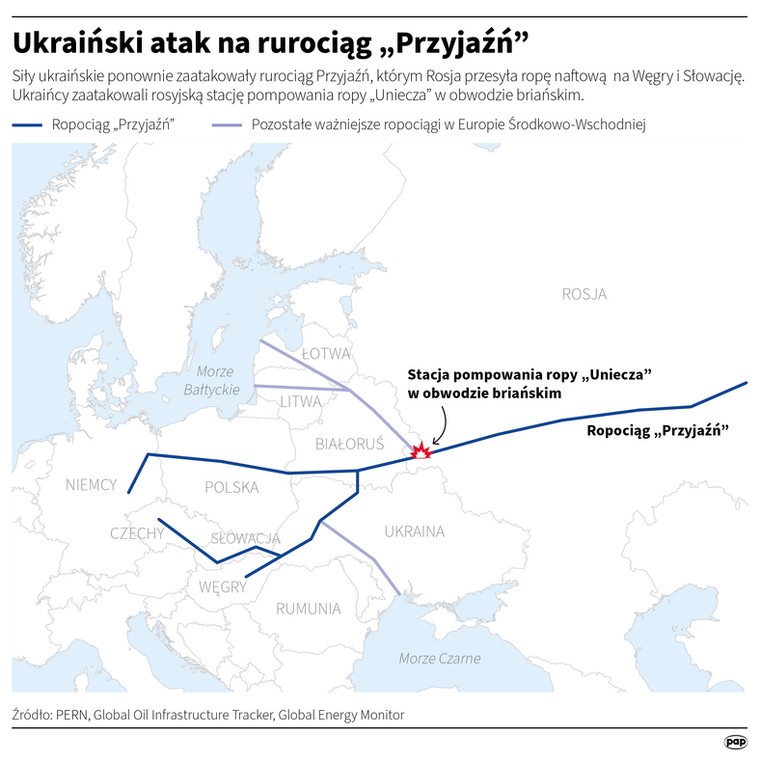
Ukrainian attack on the “Friendship” pipeline
Hitting pro -Russian interests
Jakóbik notes that current attacks do not cause a real threat to energy security, because Budapest and Bratislava have alternative sources of supplies, which, however, have not wanted to use so far.
– The last clients receiving oil from Russia under long -term contracts are the Hungarian mol and Slovak Slovnaft – explains the analyst. – That is why these strikes are a blow primarily in pro -Russian circles at the interface between business and politics in Hungary and indirectly in Slovakia.
According to the expert, from the security perspective of the region's states, the situation is stable. – There is no risk of supplies even to these countries. They have an alternative at their disposal, which they have not wanted to use so far – he emphasizes.
Ukrainian attacks on Russia's energy infrastructure also have a purely military dimension. Transmission pipelines do not only serve to export raw materials, but also in the internal logistics of the Russian Federation.
– It looks like the West gave green light on such actions. And secondly, all damage in Russia is her responsibility as an aggressor's country, who, according to international law, is responsible for all the consequences of the invasion he unleashed – adds our interlocutor.