In the East, through the 7th century BC. H. begins the spiritual revolution, out of barbarism. The purification of pagan cults (through Zarathustra's reform) will become a constant concern in the following centuries.
Now the Greek culture begins its ascension. Currently, the poet Hesiod is located at the beginning of this century and remains in the general consciousness through two poems: Work and days and theogonic. The second one presents the conception of the Greeks about the birth of the universe (theogonic – The goddess of the gods). Hesiod says that the chaos was initially, then, Glia (Gaia or Ge), the tartar and eros, appeared, the latter being the first born of the gods. From chaos were born light and darkness, and glia thought, Without lovethe sky, the mountains and the sea. From glie and heaven the monstrous abnormalities are born: Titans, cyclops and multicephalous giants. The vision is not much different from that of Rig-Vedafor Hesiod also puts at the beginning of life – love (on Eros), but here the world does not occur by ascetic (hatch), but by meeting the opposite (heaven and earth, for example), that is, from the antinomies, which reminds of the Babylonian poem Enuma Elișpresented above.
Another important name of this century is that of Thales in Milet (624-546 BC), illuminated mind, with concerns in several fields (mathematics, physics, astronomy, philosophy). Traditionally considered the last one in the string to the seven mythical wise and called philosopher By Aristotle, Thales believes in the immortality of the soul, puts the water at the beginning of the world, as well as Homer, and found his thinking system. In his conception, the perpetual becoming is determined by a principle he calls Arkhe.
Towards the end of the century, Greek lyrical poetry appears. Alceu and Safo make the transition from this century to the next. Poetsa Safo (612-580 BC) is considered the founder of love poetry and, at the same time, the first feminist school, founded on the island of Lesbos. His poems are love.
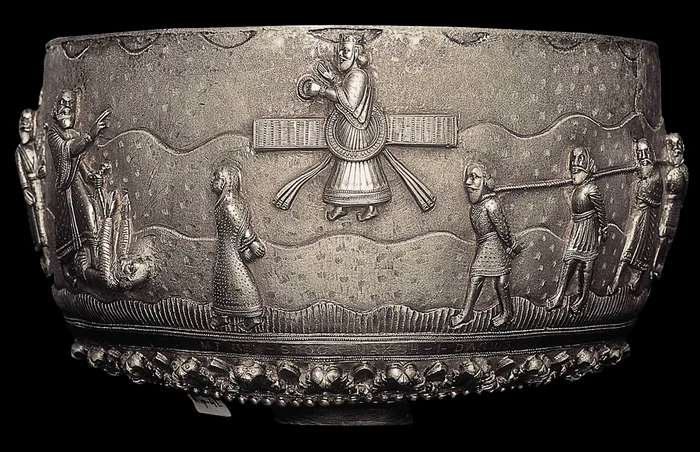
In the East, the most important event is triggered by Zarathustra (Zoroastru, on his behalf), who lived between 660-583 BC. H., and after other sources even earlier, around 1000 BC. H. Prophet, religious reformer of Iranian antiquity, places at the origin of the world both good and evil, bringing a dualistic vision, in contrast with the polytheism of his time. Thus, in his conception, there is a supreme master of the world, the god Ahura Mazdā, who has two sons: the beneficial spirit (Mainyu Spant) and the denial spirit (Angra Mainyu). They are in permanent contradiction, suggesting that man has a choice, and existence is made up of alternatives. It is also known that Zarathustra has put an end to bloody sacrifices and instituted a cultural code that has contributed to the progress of the Iranian world. Zarathustra's teaching transmitted orally through some hymns, which are part of Avestathe sacred book of zoroastrism and other related religions, such as Mazdeism. In addition to the moral principles, the hymns, complemented over time, also contain a vision of the end of the world, related to REVELATION biblical. Respectively, the end of the world will occur through a purifying fire, which will separate the right people from others. He will then make a Messiah, incarnated from Zarathustra's seed, which In a lake from the eastand through its sacrifice, people will raise and become immortal.
He remained in the general consciousness especially for the fascination he exercised on the Greek world (Herodotus, Pythagoras, Plato), the orphan rituals originating in the zoroastrist doctrine. Also the philosophical poem of Nietzsche, entitled That's how Zarathustra spokecontributed (at the end of the 19th century) to the popularization of the name of this prophet.
To us, Eminescu makes Zoroastru a literary character (in the novel Poor Dionis).
Two things seem particularly valuable to this century: the conception of Greeks about the birth of the world (in Theogonia of Hesiod) and the beginning of a religious obsession: dualism (through the teaching of Zoroastru).
bibliographic
– Hesiod – PoemsMinerva Ed., 1987 (p.7 et seq.); trad. Ion Acsan
– Maria Marinescu-Himu and Adelina Piatkovsky – History of Eline Literature, Scientific Ed., 1972 (for Alceu, Safo, VP 216, 221)
– Diogenes Laertios – About the lives and doctrines of philosophersMinerva Ed., 1997, vol. I (about Thales – p. 18); trad. But Balmuș.
– Fr. Nietzsche – That's how Zarathustra spokeEd. Humanitas, 1994, (Stefan Aug. Doinaș trad)
– Mircea Eliade, Ioan Petru Culianu – Dictionary of religionsHumanitas Ed., 1993 (Trad. Cezar Baltag); v. Zoroastrianism.
After:
Doina Ruști, Encyclopedia of humanistic culture for hasty people, 2004.