
Expert: These seven key straits decide about the fate of the world [ANALIZA]

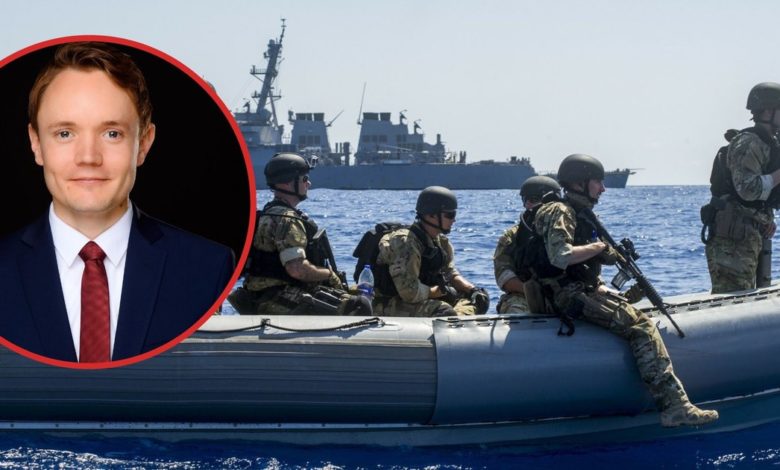
There are places that in the case of escalation of the conflict or even an accident may become the proverbial bottleneck of the whole world economy.
As much as approx. 80 percent all goods in the world are transported by ships. Sea trade is therefore the spine of the world economy. The fact that most of the goods transported by sea is carried out by very few trails – and these are areas very risky for navigation from a geopolitical perspective.
Here are seven, absolutely key places where the fate of the Earth decides.
Corner of Africa
The geopolitical importance of the Horn of Africa is particularly felt since the beginning of 2024.
A significant part flows through the 27 km Strait of Bab Al-Mandab between the Coast of Yemenu and Djibuti, namely 9 percent. world oil transported by sea and 10 percent all goods sold all over the world.
This trail runs through numerous regions overwhelmed by conflicts. North of the Bab Al-Mandab bottleneck in Sudan, a bloody civil war broke out again. At the same time, the EU Atalanta Operation off the coast of Somalia tries to protect the freedom of navigation and fight piracy.
The potential for escalation of conflicts in the region was high – and now these clashes have gained new power. This has a significant impact on the global economy.
From November 2023, Huti carried out many attacks on international trading ships. A military initiative commanded by the USA called the “Prosperity Guardian operation” tried to protect the free sailing on this trail. In response to Huti attacks, allied countries carried out raids on this Yemenian armed movement – it is estimated that it has nearly 250,000. members.
Suez channel
The risk of almost complete blockade of global trade was realized in March 2021. At that time, the Suez channel was de facto blocked for six days due to an accident involving Ever Given container. Ships with goods got stuck in a place, every hour cost a global economy around $ 400 million. (over PLN 1 billion 400 million, counting at the current exchange rate).
15 percent flow through the channel. world trade, 4.5 percent world oil, 9 percent refined products and 8 percent tankers carrying liquefied natural gas.
Parallel to the Suez Canal, the Sumed pipeline runs, which flows about 80 percent. crude oil transported from the Middle East to Europe.
An alternative route around the corner of Africa is associated with greater distances and significant costs.
Malakka Strait
The Malakka Strait is even more important for global trade, which separates the Malay Peninsula and Sumatra. It connects the South China Sea with the Indian Ocean.
In the narrowest place of the Malakka Strait measures only 2.7 km, but every year about 100,000 flows through it. ships, which is 40 percent world trade.
In addition to terrorist attacks and piracy, this transition is exposed to various geopolitical threats. For example, political instability in Malaysia or the regional dynamics of disputes between India, China and the USA may lead to blocking this trail.
There is already a geostrategical fight around this waterway. This is indicated by the presence near the army of different states as well as exercises and maneuvers of regional and global powers.
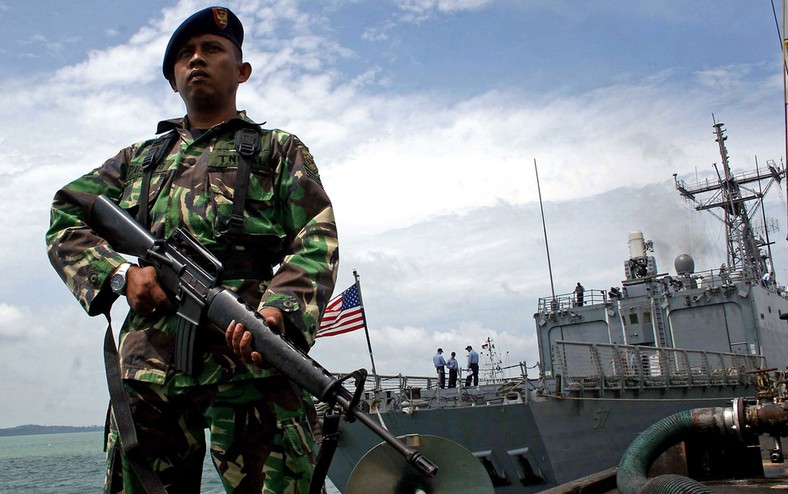
A soldier of the Indonesian Navy next to the American USS Reuben James ship in the Malakka Strait
Strait of Ormuz
Nowhere is the influence of geopolitics on the economy is not more visible than in the case of the Strait of the Ormuz.
It is located between Oman and Iran and connects the Persian Gulf in the north with the Bay of the Oman in the south and then with the Arabian Sea. In the narrowest place it measures only 38 km. The shipping channel, followed by ships, measures only 3 km.
The importance of the Strait of the Ormuz is huge, because every day it transports about one fifth oil used all over the world.
In the period from January to September 2023, an average of around 20.5 million barrels of oil and petroleum products were transported through the Strait of Ormuz. It is also the most important transport trail for liquefied LNG natural gas from Qatar.
In the past, Iran repeatedly threatened to block the strait.
As a result of the war of Israel with Hamas, the conflict of the West with Iran became inflamed again, which increases the risk of destabilization of trade in this area.
South China Sea and Taiwan Strait
The South China Sea and Taiwan Strait also play a key role. These are another bottleneck of the world economy.
About 30 percent pass through the South China Sea. global maritime trade. In turn, about half of all container containers in the world moves with the Taiwanese strait – including almost 90 percent. the largest ships.
China's war claims in that part of the world may initiate China's territorial claims. In the South China Sek, Beijing makes demands to the areas belonging to Malaysia, Brunei, Vietnam, Taiwan and the Philippines. In the case of Taiwan, the People's Republic of China refuses the island the right to self -determination.
China can potentially implement the Taiwan sea blockade. This would disturb the key sea trade routes leading from Asia to Europe. This situation would have serious consequences for the entire world economy, in particular for companies operating on the international arena.
Arctic
In the Far North, the impact of trade routes exert on international relations.
The route leading through the Arctic (when it is not frozen, i.e. in the summer) is an alternative to transporting goods by Hamburg-Szanghai. The transport of goods through the Arctic then only takes 15 instead of 22 days.
The number of non -Russian ships on the Arctic Trail, however, fell by one third in 2022 (from 116 to 36). The main cause of tensions in the Arctic is the collapse of cooperation between North European countries and the Russian Federation as a result of Russia's invasion of Ukraine.
Scientists believe that the arctic can be completely free from ice in 39 years (in summer), which will allow navigation to ordinary ships.
This fact, combined with the assumption that in this area there are probably huge deposits of oil, natural gas and rare lands, already leads to geostrategic competition for territorial rights in the region.
China is trying to gain shares in ports in Finland and Russia. The Russian Federation, Iceland, the USA and Canada are already claiming the rights to certain areas, which can drive future conflicts in this region.


