The pride of being American descends to minimal levels shows the data of the latest Gallup survey

The pride among the Democrats decreases, while the independents also reach a new minimal, consistently surpassing the growth among the Republicans, shows the data of a poll published on Tuesday, before a few days of July 4 (the National Day of the US) by Gallup, a multinational company based in Washington, DC, known for the world.
A record percentage of 58% of American adults declare that they are “extreme” (41%) or “very” (17%) proud to be Americans, decreasing with nine percentage compared to last year and five points below 2020. The 41% percentage that are “extremely proud” is not different from the data in the previous surveys, which is the most of this year. the percentage of those who are “very proud”.
These conclusions come from a Gallup survey conducted on June 2-19 before the American military action on June 21. It is not clear how the feeling of national pride of Americans has been affected by this action.
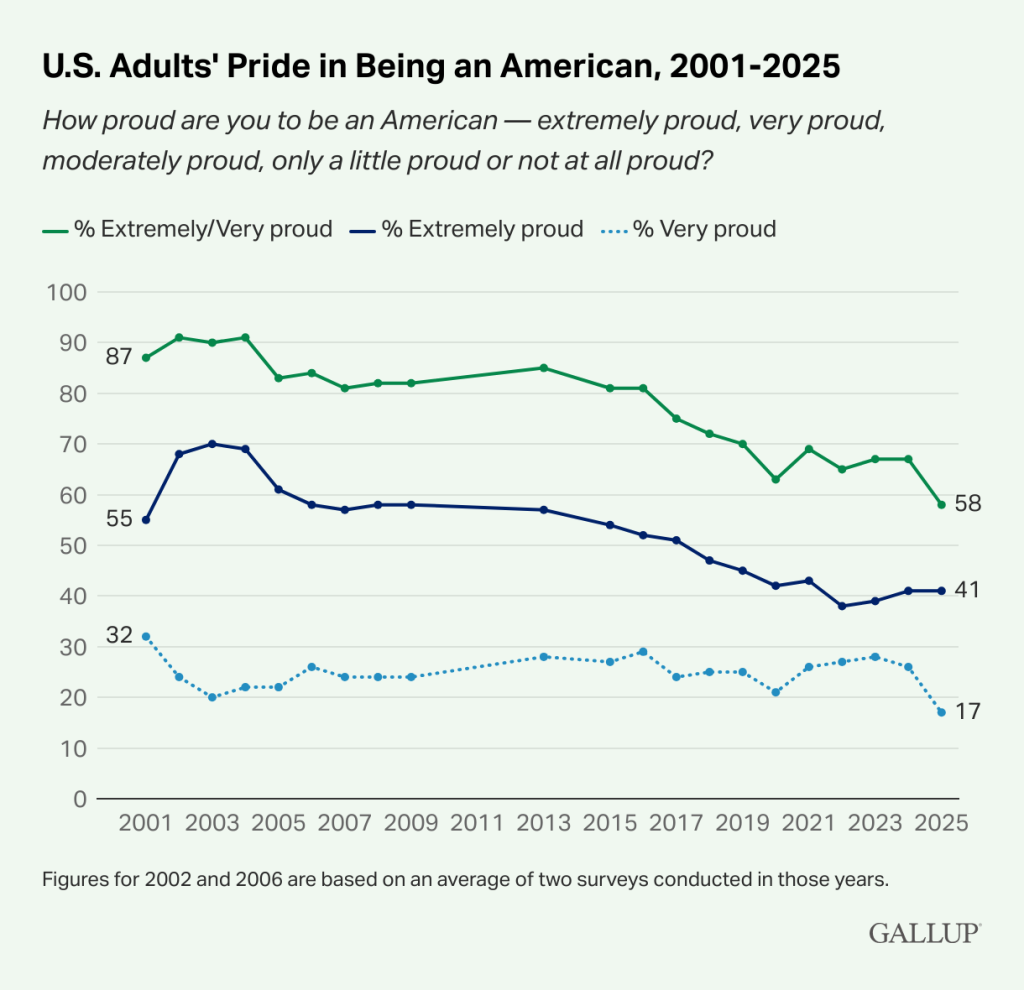
In addition to the 58% of American adults who are extremely or very proud, 19% say they are “moderate” proud, 11% “only” proud and 9% “not” proud. The combined percentage of 20% from the lower end of the pride scale is double compared to that of 2018, when only 10% of Miccans said they feel “little or no national pride.
In January 2001, when Gallup first asked Americans how proud they are, 87% said they were extremely or very proud. After the terrorist attacks on September 11, the figure increased to 90% and maintained at this level or even higher between 2002 and 2004.
Pride decreases among democrats; Independents have also reached a minimum new
Democrats are the most responsible for lowering the degree of pride in the US, 36% declaring that they are extremely or very proud, compared to 62% a year ago. This is only the second time that the pride of the Democrats falls below the majority level, along with a value of 42% in 2020, the last year of the first Trump administration. The survey was conducted in the first stages of the Covid-19 Pandemic and shortly after the killing of George Floyd by Minneapolis police officers.
The pride of the political independents also reached a low level, 53% expressing a high degree of pride, decreasing with seven percentage points compared to last year, which had been the previous minimum for this group. The pride of the independents is declining since the early 2000s, lowering below 80% for the first time in 2005, then below 70% in 2019 and below 60% this year.
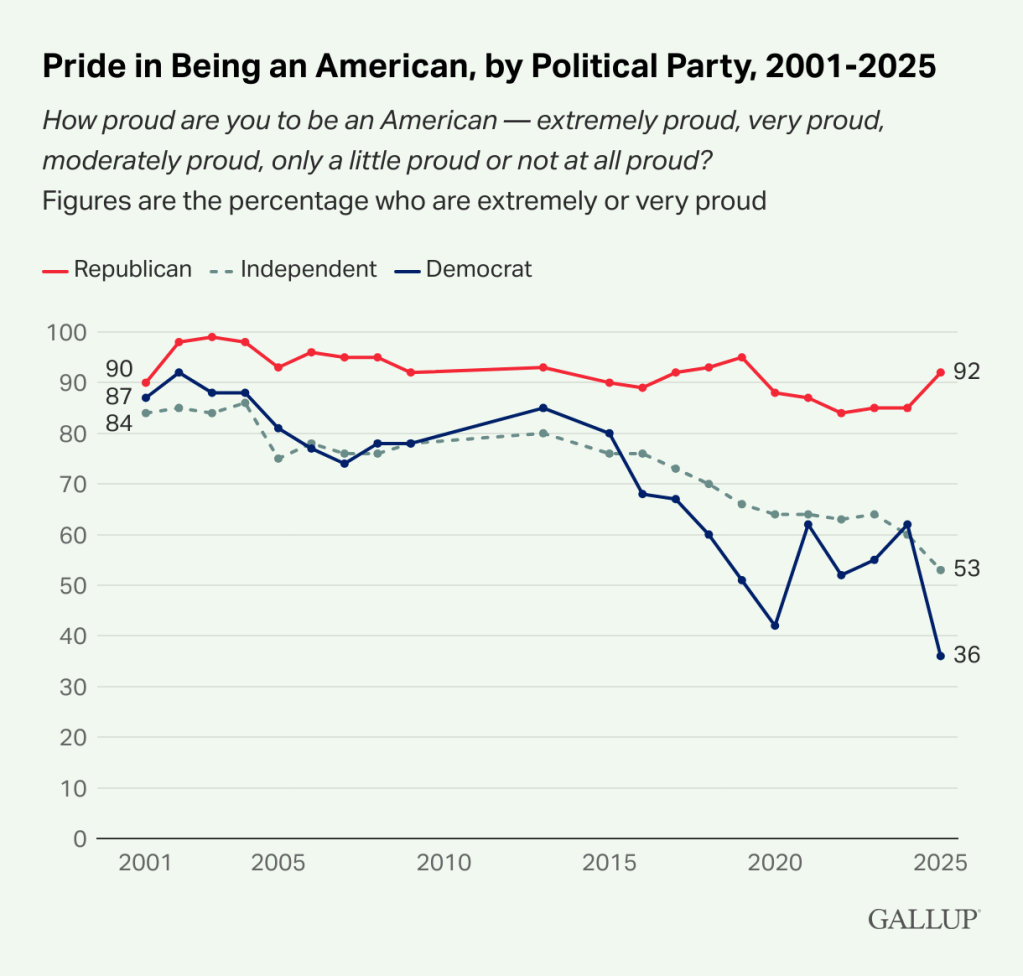
The level of national pride of the Republicans was much more constant, usually registering over 90%, including 92% this year, increasing from 85% in 2024. The only years in which less than nine out of ten Republicans were proud and 2020 until 2024. All years except 2020, there was a democrat.
Younger generations are less proud than older Americans
There are clear differences between generations in terms of American pride, each new generation being significantly less probable than the previous one to say that it is extremely or very proud to be American.
This finding is based on the average level of pride expressed by the different generational groups during five periods of 5 years since 2001. The dimensions of the resulting samples allow robust comparisons in each period, as well as the evaluation of changes in time.
The youngest two generations, millennials (born 1980 and 1996) and generation Z (born after 1996), are the most distinct. Between 2021 and 2025, less than half (41%) of the adults belonging to the Z generation were extremely or very proud to be Americans, compared to 58% of millennials. The rate increases to 71% in generation X, 75% in the Baby Boom generation and 83% in the silent generation.
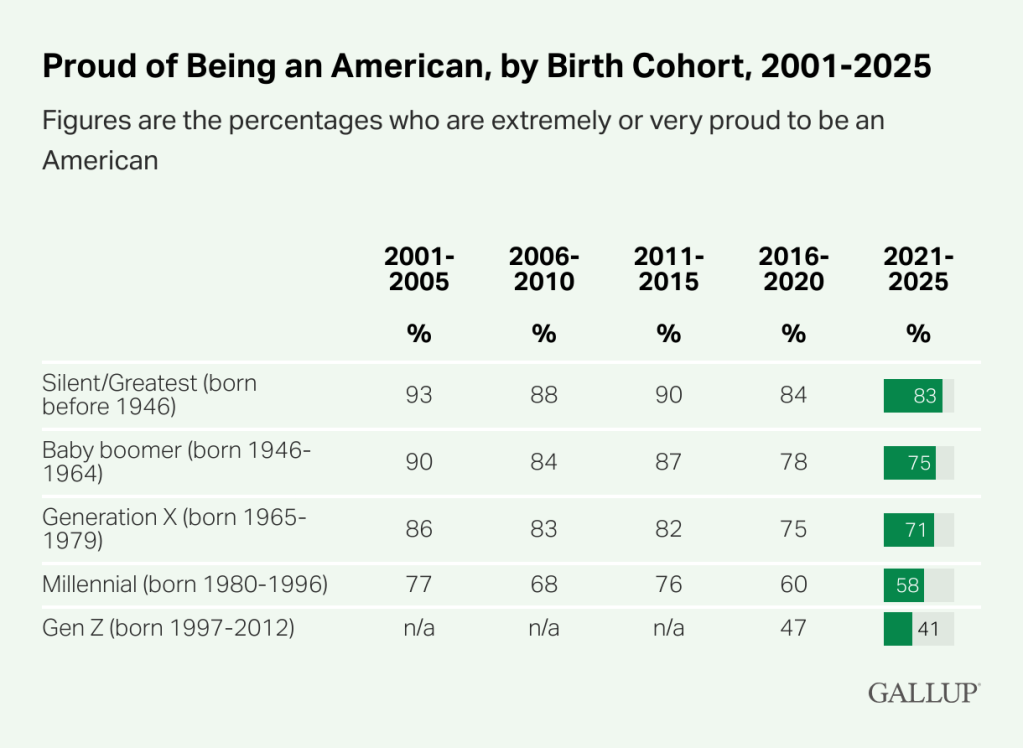
Despite the fact that it shows a more proud pride, all generations, from millennials to the silent generation, have registered decreases of 10 or more percentage points of extreme or very proud people between 2001 and 2005. Most of this change has taken place since 2016.
As expected, given the partisan tendencies, democrats are largely responsible for lowering pride in the US within each generation. Comparing the data of the last 10 years with those of the last 15 years, the pride among the democrats of each generation has decreased by at least 10 points, with higher decreases, of 21 points for Democrats of the X generation and 32 points for democrats of the millenial generation.
During the more recent period, an average of 44% of Democrats in generation Y and 56% of Democrats of the X generation are extremely or very proud to be Americans. But these figures are still much over the 24% of the Democrats in the Z generation that are proud.
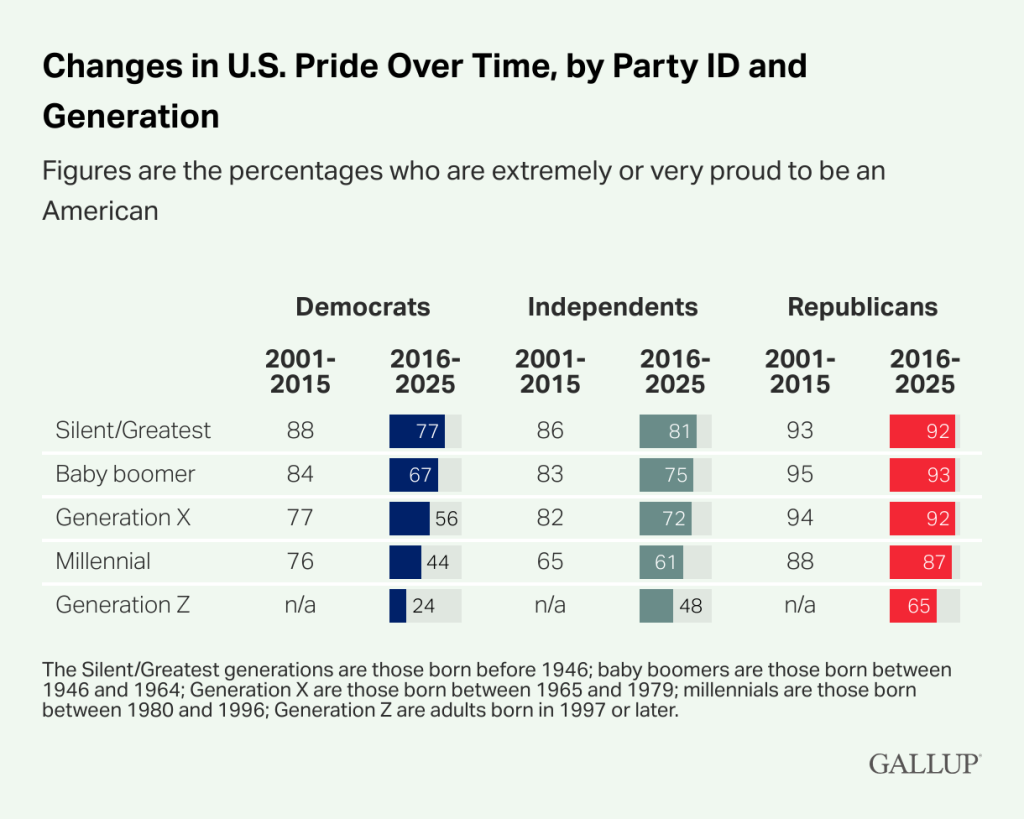
Notably, more Democrats of the Z generation say that they are little or not proud of the fact that they are Americans (32%) than they say they are extremely or very proud.
The political independents of each generation have registered modest decreases in national pride over time, ranging from four to ten percentage points.
Republicans from older generations have, in essence, the same high degree of pride today as at the beginning of this century. Republicans in generation Z are much less proud than their older Republican colleagues; However, it is still more likely to be proud than Democrats and Independents of the Z generation.
Implications
At the beginning of the 21st century, American adults were almost unanimous in saying that they are extremely or very proud to be Americans. But this national unity has eroded over the last 25 years due to a combination of political and generative changes. Today's democrats are much less predisposed than in the past to express their pride towards their country; In fact, their national pride has reached a new minimum. In addition, the Z generation and millennials are much less proud of their country than they are the oldest.
These changes have taken place in the last decade and have occurred against the backdrop of pessimism regarding the economic prospects of young people, of a widespread dissatisfaction with the state of the nation, of greater ideological divisions between adverse parties, images of both parties and an intense partisan resentment during Trump and Biden.