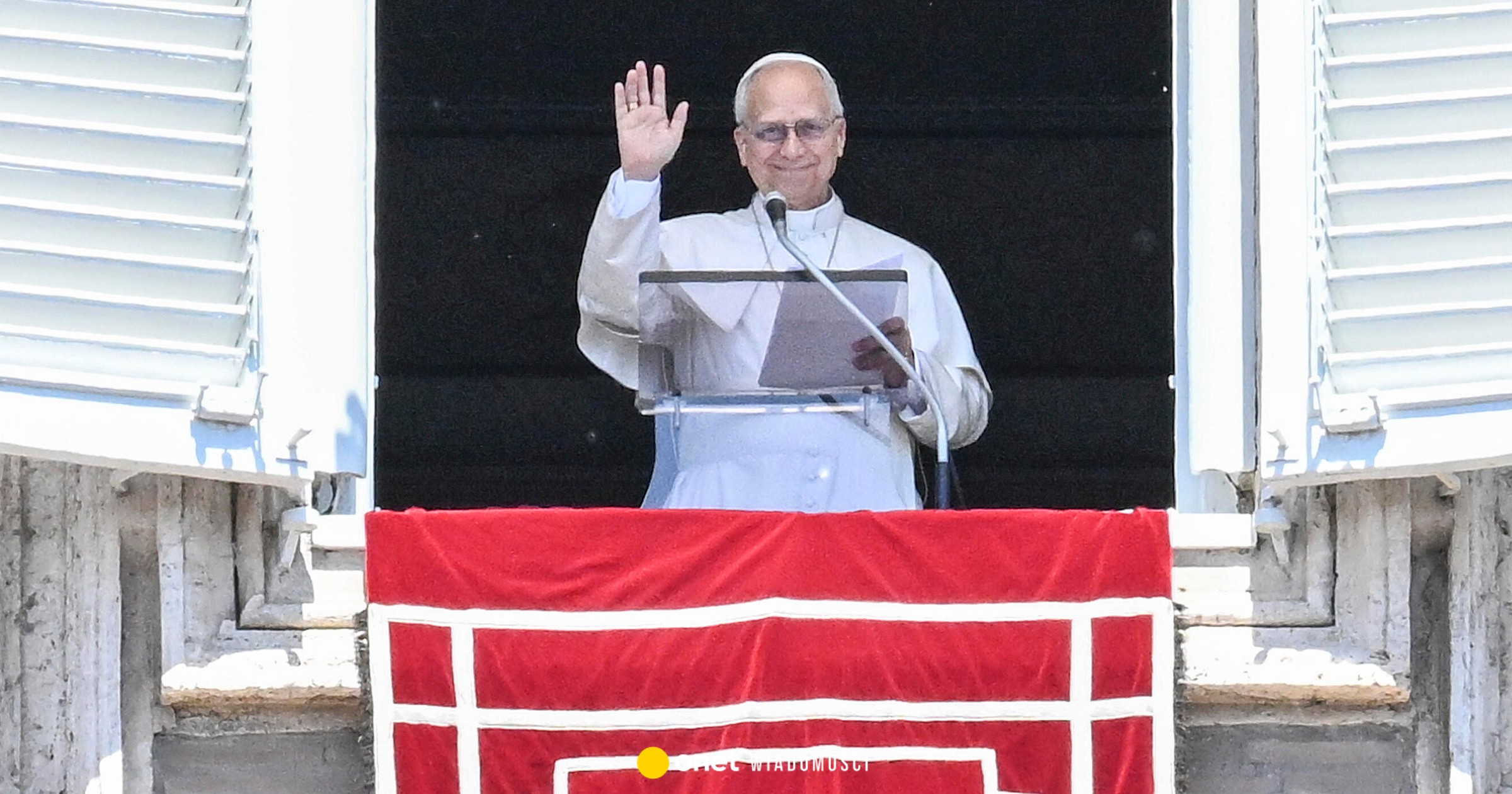
You should not live in California. What happened to the richest state of the USA?

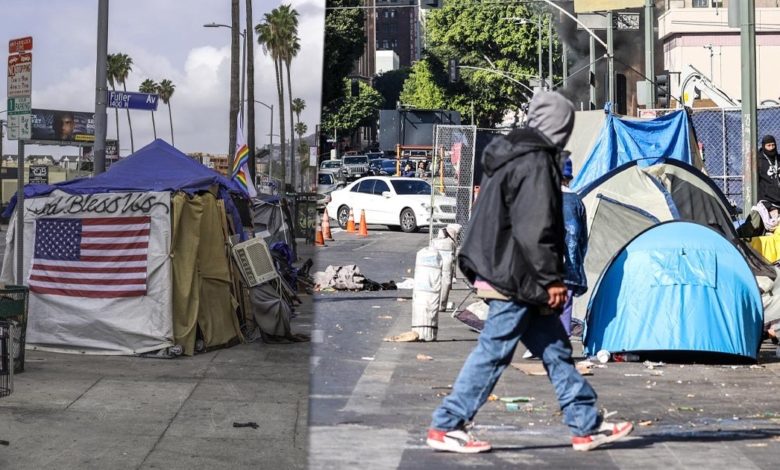
Class divisions are not the only problems that California faces. The earth dries, the trees are burning, and in the place of old ideals the “techno-utopian anarcho-capitalism” reigns. And yet Hunter S. Thompson wrote about San Francisco in 1971: “There was a fantastic, universal feeling that everything we did was right to win. The feeling of inevitable victory over the forces of old and evil.”
“California has always been considered a land of dreams”
In 1964, many people probably felt the same as young David Hockney – a wonderful child of British post -war painting – when he was sitting on the beach in Santa Monica. The air was gentle, in the distance you could hear waves of the Pacific Ocean. Hockney reached for the pencil. At the postcard to the owner of his gallery John Kasmina he recorded a pleasant temperature of 24 degrees C. “Two days ago I came to the Promised Land. You must come here” – he wrote.
The postcard depicted fresh oranges and tanned people in swimsuits. For Hockney, California was a love at first sight. He was one of those who lured the great promises of the future and life on their own conditions to the edge of the American continent – or, as Joan Didion, the patron of the mythical California, “the opportunity to find an open restaurant if you want to eat a sandwich at night.”
The rest of the text is under video material.
David Hockney, with his paintings of pools and glass bungals, shaped the image of California like hardly anyone.
Not that she needed an image campaign. California has always been considered a land of dreams of all those who hoped for a new beginning – and beautiful weather. Stan and its inhabitants still like to see themselves in this light. Rightly?
The more bad news about natural disasters and society's erosion on the west coast of the USA, the more doubts the concept of California as a land of fulfillment of dreams. Is “golden state” still suitable as a model for the future?
California's global success is young. It officially began with the discovery of gold in 1848, which attracted countless crowds of settlers. They broke through the rocky mountains to take possession of the land – the fact that it belonged to others did not matter.
Thousands of indigenous inhabitants were killed or displaced. With the help of water reservoirs, the newcomers transformed the steppe behind the Pacific coast into lemon groves and almond plantations. One boom followed the other – oil and Hollywood, military industry, and finally space travel since the 1950s.
Far from the establishment
California, however, always achieved the greatest successes in exporting life. “The culture of the West Coast is a culture of new products. Further from Europe, closer to the world of the Pacific, the only other such place in the USA is Hawaii,” said Americanist Frank Kelleter in an interview with Arte Magazine. Away from the established establishment of the establishment on the east coast, all kinds of innovations and lifestyles have appeared on the east coast.
In particular, the Bay Area area (the densely populated area surrounding the bays of San Francisco and San Pablo – ed.) Was always considered a laboratory of a non -surżazo -lifestyle. This place became the target of pilgrimages of Beat poets, hippies, surfers and civil rights activists.
“There was a fantastic, universal feeling that everything we did was right to win. The feeling of inevitable victory over the forces of old and bad,” Hunter S. Thompson wrote about San Francisco in 1971.
In a sense, even counterculture and its branches followed the path of all California trends. Fitness, iPhones, vegetable juices or plastic surgery – what works in California takes over the rest of the world. Historian Kevin Starr, an unofficial biographer of “Golden State”, in 2004 summed up the US with these words:
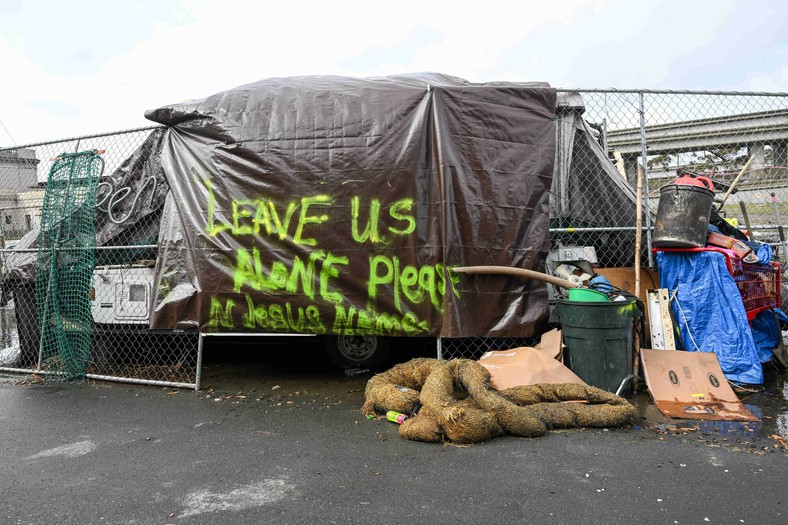
The homeless camp on the street in West Oakland, California, the inscription says: “Leave us alone”
“At the root of the California experiment, there is also some illusion,” said journalist Mark Arax, who writes about the west coast, among others, for the American magazine The New York Times.
The pioneering spirit, driven by immigrants, who paved his way through the continent, settled in California with people arrived there. “The idea of Destina's manifesto, West movement, has something almost religious in it,” Arax said in an interview with “Arte Magazine”. However, there is also a compulsion – the certainty that “now, in California, he really has to go”, because otherwise, according to Joan Didion, “under this immeasurable, washed sky you will miss the continent.”
A prettier, simpler world
The result is California as a paradox. Because her freedom not only invited to self -realization, here the utopia also easily turned into their opposite.
The hippies wanted a totalization of love, but this movement ended not only with the harmless New Age initiatives and ecological farms, but also sets such as the Manson family. For a long time, the dystopian trend is not only about ideology. He also manifests itself in the extreme disproportions of wealth, glaring contrast between countless millionaires and glaring poverty. Those who live here do not have an easy life. And yet the name “California” did not completely lose its overtones.
Inhabitants of the Silicon Valley, Eldorado of the technology industry, are the least inclined to deprive them of optimism. Since Bill Hewlett and David Packard invented a frequency generator (including microwave) in the garage in Palo Alto, tomorrow's technology is invented in California.
You can't imagine companies such as Apple or Google, which are defined by demonstratively laid back ethos T-shirts, anywhere else. Only there people believe in innovation so much. And only there, Venture Capital investors are so eager to pay millions to students who promise that their application will make the world more beautiful and easier – and their investors, rich.
At least this is the assumption, because the ideal of friendly internet has long been exhausted. In its place, “techno-utopian anarcho-capitalism” appeared, whose roots American Kelleter also sees in the California anti-establyment attitude. After all, you can earn a lot of money on other people's data.
Perhaps everything comes down to the art of illusion. It was the Hollywood principle that made the idea of discovering to the rank of maxim. Take, for example, a young woman who came to Los Angeles as Margarita Carmen Cansino and – after numerous and painful beauty treatments – she gained world fame as the red -haired star of the Rita Hayworth screen. In a place that does not know the past, personality can be tried on like a new pair of jeans.
The author Emma Cline wrote about California archetypes in books such as “Girls” (The Girls, 2016) and “Daddy” (Daddy, 2021) – guru, blue birds, beginner millionaires. Cline comes from northern California, where wavy hills and raw coastal landscapes dominate. For her, what is unreal and unstable is what creates this state – like Los Angeles, where modernist houses are built on steep slopes. One rocks, one earthquake and everything will be lost.
“Actually, people should not live here, but we do it,” Cline wrote, because California is also a pioneer when it comes to natural disasters.
“Through the outer layer of the myth, reality begins to break through”
Climate change is in “Golden condition” especially noticeable.
“Warm palm air – air for kissing” – once delighted California Jack Kerouac. The only problem is that the air is now mostly dry and hot. Fans of forests from the last few years are one of the worst in the history of this area, and the intervals between them are getting shorter. Water is missing anyway, also because huge farms redirect it to their fields.
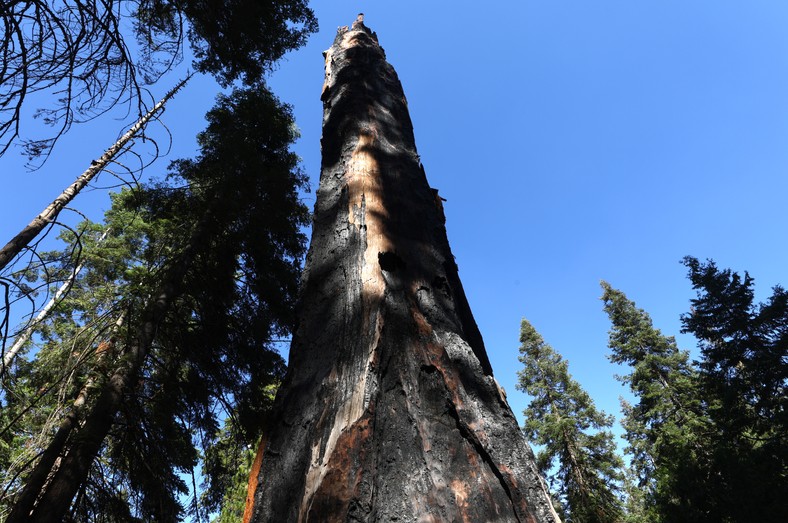
Burned in 2022 in the California Sekwoja National Park, the highest species of tree in the world
Although California is considered an ecologically conscious state, which enforces raw regulations to reduce greenhouse gas emissions, the inhabitants of California have always been bending nature to their own needs.
– It was not people who were in the wrong place, we told ourselves, the rain was in the wrong place – wrote Mark Arax in the book “Cracks in the ground”. So the lakes were drained and the rivers were forced to flow against the tide.
The consequences are now visible. It is quite possible that California still offers the future – the only question is whether it should be treated as a model.
In the light of these facts, the outer layer of myth begins to break through reality. Even in the 70s, the writers were afraid of orange flowers in the smell, although Los Angeles choked gray smog. Today, a climate disaster is increasingly coming to literature.
For example, in the novel “Blue Skies” (2023) TC Boyle draws an apocalyptic panorama of California. The earth is dying, the trees are burning, but a man is annoyed above all by the fact that the family celebration fails because of the weather. Boyle, who lives in the forests of Montecito, experienced fires from previous years and mudslides that followed them.
He accepts the disaster with sarcasm. “Every time I hear the Mermaid, I hope that only someone has a heart attack,” said the writer.
Perhaps this is another achievement of the California paradox – even in the dark times you can sometimes joke.