The public debt explodes. Romania exceeds the estimates, and the deficit becomes a major challenge

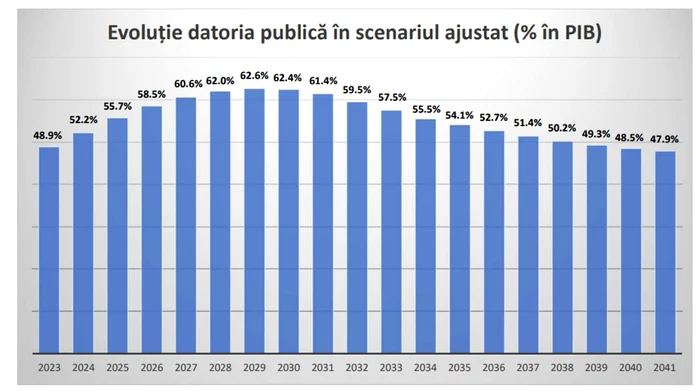
The projections on the public debt, published in the Fiscal Plan for reducing the 7 -year deficit, agreed in October by the Government, provides for a significant increase of it up to 62.6% of GDP in 2029. But the current estimates show that the level will be exceeded next year.
Romania's public debt grows faster and more than estimated. Photo shutterstock
Estimates regarding the share of public debt in GDP, included in the fiscal plan to reduce the 7 -year deficit, indicate an upward evolution until 2029 (62.6% of GDP), corresponding to the period of implementation of the reforms and investment projects, including those carried out within the National Plan of Redress Descending as a result of the fiscal consolidation more pronounced in terms of ESA deficiency, with the classification of 60% of GDP until the end of the analysis horizon (2041).
However, the situation seems to have been out of control.
“The current situation of the debt of Romania has a worrying parallel with that of Greece in the first stages of the Sovereign debt crisis in 2009-2012. However the economy. Points the analyst Etoro Bogdan Maioreanu.
According to him, the Tax crisis in Greece started with a similar model of uncontrolled increase in expenses. “The country's budget deficit exploded from manageable levels, reaching over 15%of GDP in 2009. The ratio between debt and GDP was 115%, the second largest in the EU, after Italy, with 116%. The disclosure of statistical irregularities and underestimation of the deficit by previous governments has created a bad combination between an unsustainable fiscal position and a lack of credibility. The crisis of the sovereign debt of Greece has led to one of the most severe economic contractions in modern history. And it all started with an unsustainable budget deficit ”, emphasizes the analyst.
Romania has the largest EU deficits
Although Romania is still far from this scenario, the budget deficit, which seems so difficult to reduce, is worrying, because it can contribute to a marked increase in public debt. The public debt of Romania reached 56.3% of GDP in February 2025 and is accompanied by one of the largest budget deficits in the EU, of 9.3% of GDP in 2024. Although the debt level remains significant below the maximum levels recorded by Greece during the crisis, the current projections suggest that the trajectory of the Romanian debt could reach 63%, in 203% With possible increases up to 70% of GDP by 2028, if not sufficient tax correction measures will be taken.
“However, there is an essential difference: the moment we are. Romania has the opportunity to implement corrective measures and to maintain economic growth before reaching non -useful levels of debt. The experience of Greece is a clear warning that it is essential to take decisive fiscal measures to prevent a much more severe adjustment process.
However, the current global situation is more complex than it was 15 years ago. The deficit generated by the pandemic led to an unprecedented increase in global debt, which exceeded 323 trillion in 2024, fundamentally transforming the investment landscape and creating complex challenges and opportunities that reshape the World War Portfolio Strategies. “explains Maioreanu.
This debt represents about 326% of the global GDP and is not just a statistical concern, he points out, adding that it is a systemic force that redefines how investors addresses the risk, efficiency and allocation of assets on all markets. In addition, the inflation post pandemic has led to an increase in interest rates, and the debt is difficult to manage even for mature savings such as the US or the United Kingdom, with interest payments consuming an increasing part of national budgets.
Countries with the highest public debts
Investors assist a fundamental change, in which positive economic news is shaded by increasing concerns about tax sustainability. The erosion of the sovereign bonity is probably the deepest challenge that investors are currently facing. In the G20 group of developed economies, the largest debt report – GDP belongs to Japan, with 235%, followed by Singapore (173%), Italy (135%) and the United States (124%). In Europe, the country with the highest debt report/GDP is Greece (154%), followed by Italy (135%) and France (113%). The euro area is at 87%. Germany is at 63%. Of the Eastern European countries in the EU, Hungary is 73%, Slovenia at 67%, Slovakia in 59%and Croatia at 58%. Poland is at a level similar to Romania, with 55%, but with a lower budget deficit. Compared to them, the debt of Romania is not at a very high level, but our main problem being the budget deficit, the largest in the EU and the country rating.
Romania, close to “junk”
Standard & Poor's and Fitch gave Romania BBB credit ratings, with a negative perspective. The credit rating granted by Moody's was last settled at BAA3, also with a negative perspective. This means that Romania is at a single fragile level above the “junk” category, in which investments are not recommended. All three agencies recommended to reduce the budget deficit and warned the challenges related to implementation, without decisive and credible fiscal measures.
At the global level, investors are in a process of quality search in all assets, seeking assets with solid foundations and reduced exposure to the lever effect. This is another reason why maintaining the country's credit rating and avoiding the fall in the “junk” category becomes very important. In this hypothetical case of the loss of investment rating, the new government could have difficulty finding the creditors willing to buy its debt, possibly paying much higher interest than at present, which would exert additional pressure on the budget, because more money would be spent for debt service and refinancing.
“That is why, beyond avoiding the possible loss of EU funding, the future government of Romania should approach the challenges related to deficit and debt through government and fiscal reforms, a credible plan and a realistic implementation strategy. Political statements regarding the reduction of unnecessary expenses will not be sufficient, because the markets have learned to be skeptical. Inability of recent governments to carry out cost reduction reforms“concludes the analyst Bogdan Maioreanu.