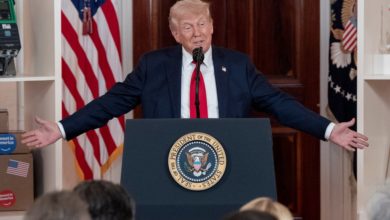
“He has zero chances.” Like Donald Trump gained power in America [FRAGMENT KSIĄŻKI]

Below we publish a fragment of the book “Lost Hegemon”.
August 2010 remain three months for Congress elections, in which Republicans will take control of the House of Representatives and make up for the distance to democrats in the Senate. Their libertarian and anti -system faction, Tea Party, is on the science, fights with the party establishment and is successful.
Citizens United, a conservative organization that supports the efforts of “Teaver”, is also on the wave, because a few months earlier it won a breakthrough case before the Supreme Court. From then on, de facto no longer applies to the limits of expenditure on election campaigns, because organizations not related to the candidate's election staff may spend unlimited sums of money to promote his candidacy.
Steve Bannon, who two years later will take over the total control over the Anti -Establishment portal Breitbart News, but for now also works on orders for Citizens United, receives the phone and hears the voice of the boss of the organization, David Bossi in the handset. Boss – as we know from the report of “Washington Post” by Bob Woodward – he wants Bannon to go with him to New York. The matter is serious because it is about meeting Donald Trump, who is considering starting the president. – What country? Bannon asks mockingly.
The book “Lost hegemon. The wasted chance of America's Trump Revolution” in pre -sale you can buy here!
Most Americans would react very much as Bannon. Over the decades, Donald Trump was a colorful element of the New York landscape, but hardly anyone considered him a serious candidate for president of the United States. He ran numerous businesses, built skyscrapers in the most prestigious Manhattan locations, organized beauty contests and liked to shy with his wealth.
He visited construction sites as often as courtrooms, and for the younger generation he was a famous miller businessman from television, who in his program assessed the participants' business abilities. When he still took the floor in social or political matters, it was most often thought that he wanted to make an advertisement in this way and increase the recognition of his brand. The surprising coherence of many of his beliefs was less often seen.
Trump himself did not facilitate the task of those who tried to keep up with his political affiliation. In 1988 he was serious about starting in the election for the first time. Rather as a republican, although he was registered as a democrat in the past. One of the senior's bush advisors was even to ask him if he would be interested in vice presidency. It ended only in talks, because Trump preferred to develop his New York business empire, not a political career.
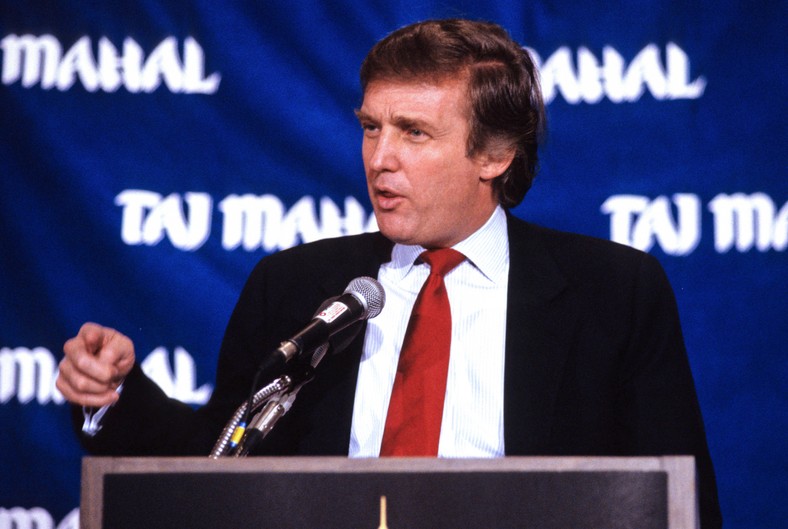
Donald Trump in 1989
In subsequent years, he lectured in a demonstration and Republican campaigns, but already in 2000 he wanted to start as president on behalf of the niche Reform party. And it finally didn't come out of it. So he returned to his traditional Modus Operandi – in 2008 he supported both Hillary Clinton (until he lost the primaries with Obama) and the Republican candidate John McCain.
When the boss and Steve Bannon arrived at Trump two years later, he declared that he would see himself as the candidate of Tea Party. Bannon noticed some contradiction. Libertarian and the anti -system “Haebackers” told – even if the economic and financial support of right -wing billionaires – against such people as Trump: metropolitan elites who buy themselves the favor of both great parties and who are primarily about the success of their own businesses, not the fate of ordinary people.
There was a lot of truth in it. It was impossible to hide that Trump lived well with the politicians of the two largest parties and that most of his payments went to the Democrats accounts. Everyone also knew that he often changed his mind in such delicate social matters as admissibility or ban on abortion. In this sense, he did not match the profile of a typical Tea Party policy.
Nevertheless, under this layer of chaos, games and appearances there was also a layer of well -established beliefs about the economy, trade and international policy, which Trump publicly article from the mid -1980s.
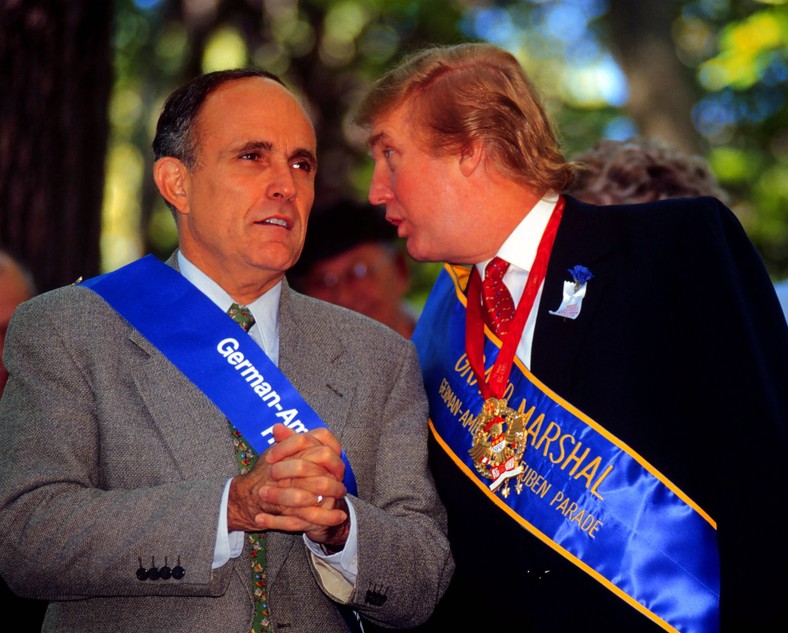
Donald Trump with the then mayor of New York Rudy Giuliani in 1999.
Donald Trump against liberal elites
He was an opponent of liberal internationalism with his focus on the promotion of democracy, liberalism and open borders. He did not consider free trade, on the contrary, he was an zealous advocate of economic protectionism and repeatedly claimed that the power of the United States came from high customs barriers and low taxes. That is why he believed that the return to free trade policy, which was gradually taking place from World War II, served the interests of America. The American elite blamed for this state of affairs, which naively, he thought, allowed to use the smarter elites of other countries.
Trump was convinced that globalization was too far away; He was not an opponent of globalization per se, but a situation in which the United States was no longer the largest producer and factory in the world, and yet they were increasingly opening their market for foreign goods. This contributed to the situation on which Trump was obsessed, i.e. to the growth of the American trade deficit. The growing deficit meant that America produced less and less, and this was associated with the loss of jobs in industry.
At the same time, the pace of immigration was growing all the time, mainly from Latin American countries, which Trump connected with the growing crime and the distribution of social tissue in American cities, primarily in the Rusta belt and the Appalach region, but also New York. In the light of this logic, America's biggest problems took place from incorrect trade and foreign policy.
Trump articulated all this openly in the books he published over the years under his name. For a long time, however, he did not allow political views to obscure his media and business career. He did not shun public comments, but his words were rarely taken seriously. He did not seem to bother himself.
However, when the government of souls in the Republican Party began to take over the anti -stabland and opposed to the dogma of the liberal internationalism of Tea Party, the situation changed. Trump sensed his chance and kinship of souls with people who wanted no evolutionary change that Barack Obama previously proposed, only the Washington elite revolution and settlements.
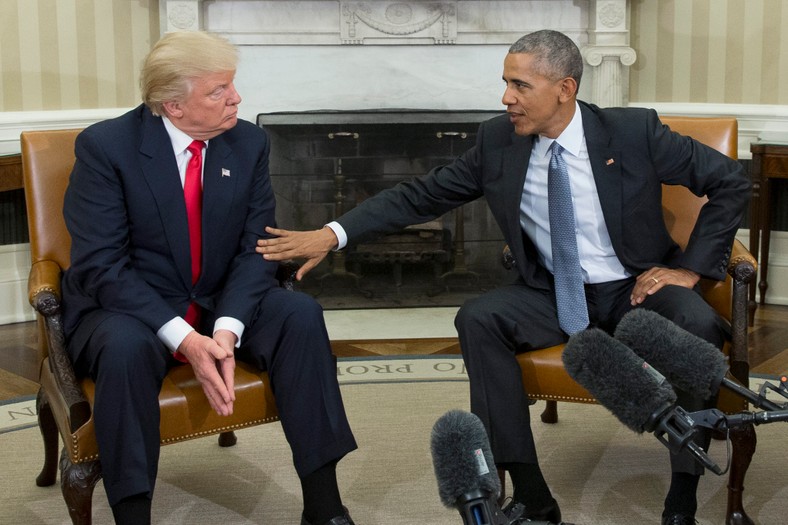
Donald Trump and Barack Obama after the presidential election in 2016.
When in August 2010 he convinced his guests that this time he was serious about the presidency, he genuinely believed that for his beliefs a more favorable time was coming. “He has zero chances. Less than zero,” Bannon said, leaving the Trump Tower after meeting the future president.
Like Donald Trump took over the republican party
Trump did not take the glove and did not stand until the election in 2012, but paradoxically he turned out to be their great winner. Tea Party was already an important faction inside the Republican Party, but she could not organize around one candidate. The Republicans put safely on Mitt Romney, Mormoński billionaire, former governor of Massachusetts and a man for decades associated with the party's mainstream.
Romney, however, was not a great challenge for Barack Obama fighting for re -election. He did not have one guiding idea with which he would be associated, while he made numerous mistakes and blunders, as when he said that 47 percent would vote for Obama. Americans who “believe they are victims” and will always count on the federal government to help them. “It's not my task to worry about these people,” he added. History can be perverse, so Romney himself obtained 47 percent. He lost the election with a crete.
Romney's defeat only strengthened radicals inside the Republican party. In 2013, associated with the Tea Party Congressmen and Senators led to over two weeks of “closing the government” because they did not want to agree to finance Obama's social programs. Two years later, they forced to resign from the announcer of the House of Representatives John Boehner, who was to not actively fight the president's initiative.
Their methods were even taken over by the leader of the Senate majority, Mitch McConnell, who in 2016 without any mode refused not only to approve, but even to hear the nominee Obama to the Supreme Court. Republicans, and above all Tea Party, were able to efficiently obstruct the congress, but this did not annul their most serious problem: lack of clear leadership.
This situation was used by Trump, who a few months after meeting Bossi and Bannon began to perform at the rallies of conservative organizations and argue that America became the “laughing of the world”, that there is no “quality leadership” and that Barack Obama was not really born in the United States.
For a long time he promoted the conspiracy theory about the place of birth of Obama, accused him of being a communist and that he conducted too conciliatory policy towards China. Thanks to the attacks on President Trump hated by the extreme right, he quickly became a favorite of Fox News (previously involved in promoting Tea Party) and portals such as Breitbart News, which Bannon has already fully commanded.
When in mid -June 2015 he announced that he was starting the election campaign, hardly anyone gave him a better chance in republican primaries, but it quickly turned out that the ideas of Tea Party went to their time and are extremely load -bearing. Only that they needed a louder and more charismatic spokesman than young angry senators – Ted Cruz, Rand Paul and Marco Rubio.
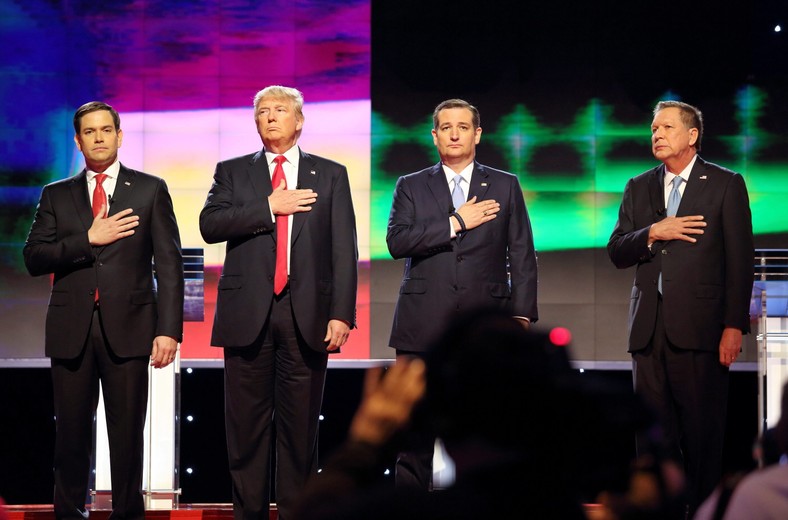
Marco Rubio, Donald Trump, Ted Cruz and John Kasich during the debate of the Republican Party in 2016.
Naturally, Trump's start in the election threatened the position of young anti -spinemen, not to mention the Republican establishment represented, among others, by Jeb Bush, brother George W. Bush. However, when it became clear that republican voters want to change, and the changes offered by Trump, young radicals had no resistance to stand on his side.
The party establishment was more divided: some did not enjoy, but sailed with the current of changes, others gave up politics, and it happened that they warned at the faeces of the threat that Trump was for liberal democracy. The ambitions of “tea -people” and submission of the party elders determined that the Republican Party quickly became the Trump party.
The book “Lost hegemon. The wasted chance of America's Trump Revolution” in pre -sale you can buy here!