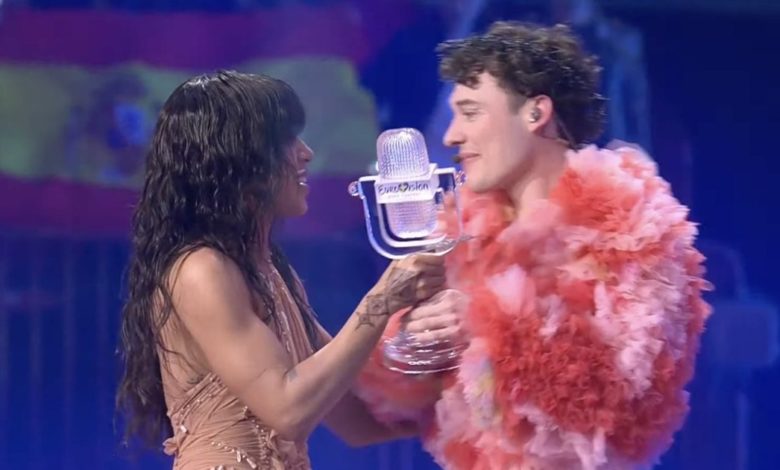
The Russian propaganda invented the term “gayropo” after Eurovision 2024, which was won by a “homosexual in Switzerland” and considered that it was the definitive proof of “degeneration of Europe”. This year, Russia has set up its own Eurovision, which will be carefully supervised by a SP Commission
After Eurovision 2024, Russian propaganda introduced the term “gayropa”. Photo: AFP
The famous Eurovision contest took place in Basel, Switzerland, on the past weekend. Unexpectedly, the competition was won by the Austrian artist JJ, on his real name Johannes Pietsch.
The portal of the European Commission that fights Pro-Kremlin misinformation-I vs disinfo-analyzes the complicated relationship between Pro-Kremlin and Eurovision propaganda. The undeniable popularity of the competition among ordinary citizens in Russia must be compared with the insistence of the Russian government that Eurovision – in Ca Europe – is bad.
A colorful moral decline in the rainbow
The Kremlin allocates considerable time to distort the public speech in Russia to promote the idea of Russia's moral and civilizing superiority towards the West. Even a general derogatory term was invented to capture what is wrong with Europe. This term is “gayropa” – which suggests the idea that Europe is “gay”. And from the perspective of the Kremlin, to be gay means total moral and degeneration, therefore Europe is heading for collapse, rainbow flags and all the silence. As a rule, the Kremlin then contrasts this notion with the praise of Russia united spiritually.
This slanderous term is now ubiquitous in the Russian anti-Western discourse. However, it was initially used in the context of Eurovision in 2014. And so, since then, the Kremlin's misinformation vendors have sought to target Eurovision as an original symbol of Western “degeneration”.
Maria Zakharova: “He passed any orgy, Sabbath or ritual sacrilege”
In 2022, the European Broadcasting Union (EBU) eventually helped Russia resolve its internal conflict with Eurovision. The country was completely excluded from the competition for the launch of a large, unprovocated -scale aggression war against Ukraine.
Despite the pro-Kremlin rhetoric that defames Eurovision, that decision of the EBU must have been stinging, because the subsequent competitions, now devoid of the moral correctness of the Russian participants, have been met with more vitriol than ever. Eurovision 2024, held in Malmo, in Sweden, is a great example. Rossiyskaya Gazeta, the official newspaper of the Russian government, quoted the spokesman of the Russian Foreign Ministry, Maria Zakharova, saying that the competition “has passed any orgy, Sabbath or ritual sacrilege.”
A Pro-Kremlin Think Tank noted that the 2024 competition was won by a “homosexual in Switzerland” and considered that this is the definitive proof of “degeneration of Europe”. Another pro-Kremlin site proclaimed Eurovision a “marsh of immorality, anti-Christianity and corrosive anti-values.”
A vision for the Russian soul
Something had to be done. As a Russian parliamentarian argued, Eurovision became harmful to the children. The state had to ensure the “affirmation and protection of traditional Russian and spiritual values” in front of the gay attack of Europe. Russia needed a non-gay variant of Eurovision.
Therefore, on February 3, 2025, Putin issued an edict requesting the creation of such a competition – the intervision song contest. The idea is not new: the intervision song contest was the attempt from the cold war of the block led by the Soviet Union to create its own version of Eurovision and took place intermittently between 1965 and 1980. Its resurrection is not just a nostalgic gesture: it is a deliberate tendency to return to the Soviet inheritance.
Eurovision in the Russian version
Putin's edict also requires the creation of a supervisory board to supervise the competition, increase its international prestige and control its presentation in the media. The deputy head of Putin's office, Sergei Kirienko, will challenge the Supervisory Board. In fact, he is also a person who honestly believes that society should be scheduled, a pioneer of modern misinformation methodology and Putin's right hand.
The Russian Foreign Minister Serghei Lavrov has assured the public that the intervision will be free of any “perversion and mockery of human nature.” A participant – Belarus – has already confirmed. Maybe because Putin personally asked Lukașenka at a recent meeting. Other expected participants may include Azerbaijan, Brazil, China, Karzzstan and Cuba, along with a probable representation in the Middle East.
A scene for the Kremlin's spokesman
On the paper, the leader of the POP tops in each participating country will represent its nation. In the case of Russia, the top choice is, without being surprising, an artist who supports Putin, an pro-Kremlin Yaroslav Dronov, aka Shaman. His Vstanem song (Time to Rise) has opened Putin's rally from 2022 and has since become a kind of war in the context of Russia's aggression against Ukraine.
Another shaman's “masterpiece”, Ya Russkiy (I'm Russian), says: “I'm a Russian, to bother the whole world.” Shaman's military aesthetics and nationalist rhetoric compared to Germany with the 1930s-some users of social networks have even proceeded because they resembled the Hitler youth singer in Bob Fosse.
Cultural War
It has been a long time since 2003, when Russia was represented at Eurovision de Tatu, a pop duo that was given as a lesbian couple. At that time, it would have been difficult to imagine that one day Russia will forbid people to open their sexual orientation, inventing an “LGBT international movement” and designating it as an “extremist”.
Clearly, the decision to restore the intervision is less about music and more about cultural war. It is part of the wider strategy of the Kremlin to redefine culture in its own conditions, rejecting everything is perceived as a stranger or too liberal and putting the state and tradition above all else. Putin's Russia not only returns the back of Europe and the West, but is positioned as a new power center – an ambition that extends even to pop song competitions.