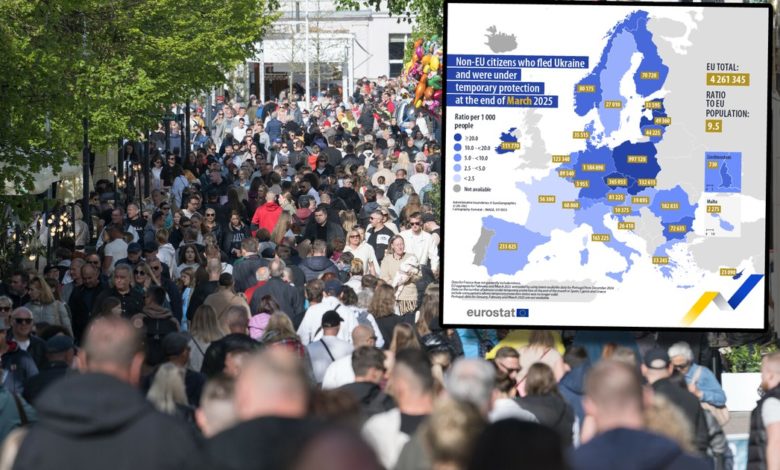
The latest Eurostat data show how many Ukrainians are still in the European Union countries. At the end of March 2025, 4.26 million citizens of this country lived in the entire community.
Significantly, almost exactly half of them live only in two EU countries. The leader is Germany with a number of 1 million 150 thousand Refugees from Ukraine, but right behind them is Poland, where 992 thousand live. people from this country.
The Czech Republic is in third place, but in absolute values it is already a gap. Over the swan statistics recorded just over 360 thousand. Ukrainian immigrants and refugees. Above 100,000 Ukrainians live in Spain, Romania, Italy, Slovakia, the Netherlands and Ireland.
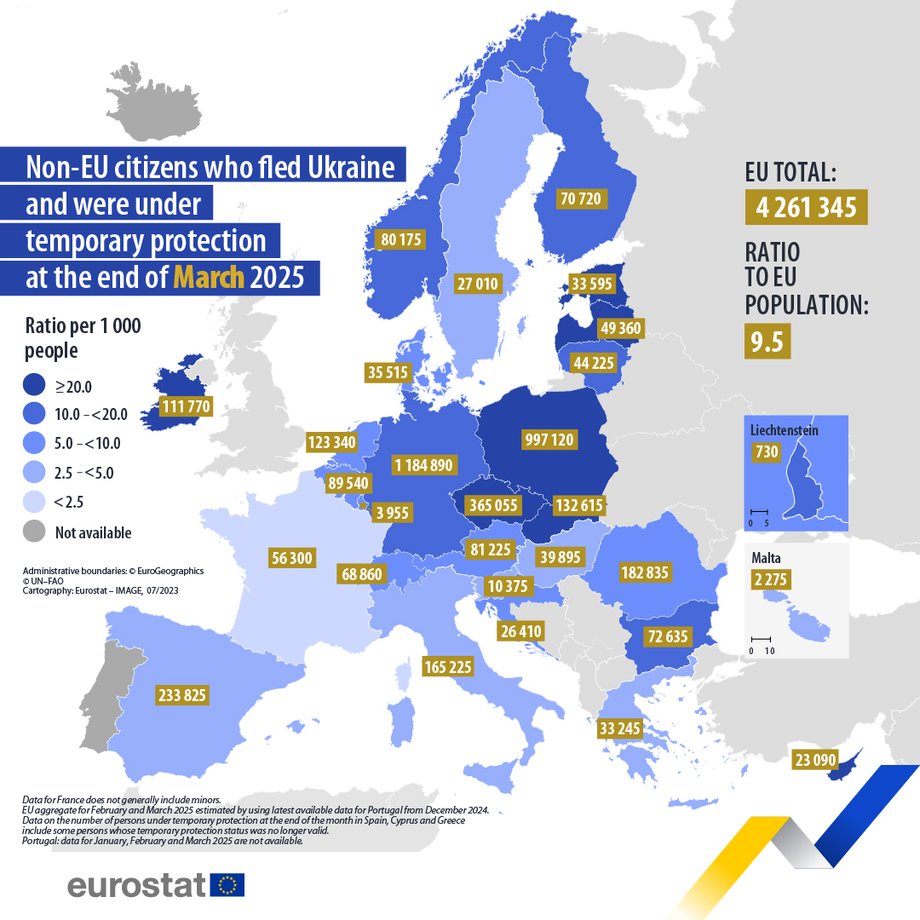
The number of refugees from Ukraine in individual European Union countries.
|
Eurostat
Ukrainians are increasing in Poland
It is worth noting that Eurostat's data show two trends, which until recently were unthinkable. We got used to the fact that after the first inflow of refugees from Ukraine, in the period shortly after Putin's aggression, more and more citizens of this country were guided from Poland further west and settled primarily in Germany.
This is perfectly seen in the statistics. In the first months of 2022, Poland was the EU leader in terms of the number of Ukrainian refugees. With time, however, this number began to fall, while in Germany the trend was completely the opposite. “Mijanka “took place in January 2023 and since then it was west of the Odra that much more Ukrainians lived.
However, the situation has reversed for about a year. It was Poland that began to grow again, and the Germans – to fall. Only within 12 months in our country the number of Ukrainians increased by over 40,000, while in our western neighbors it fell by over 100,000.
For now, there is no data that would confirm the return of Ukrainians from Germany directly to Poland. Especially They also come in Slovakia, Hungary, but also more distant Italy and finally Spain.
If the trend persists, then in Poland there may be officially over a million Ukrainians. The last time such a situation took place in October 2022, i.e. less than eight months after Russian aggression.
The data speak directly. The Polish economy is gaining
Apart from the cultural and social issues of Ukrainians in Poland, which largely depend on political views, the numbers quite clearly show that the presence of immigrants in our country is not only inevitable, but clearly beneficial to the economy.
Andrzej Kubisiak, deputy director of the Polish Economic Institute, wrote about it in Business Insider Polska recently, in the opinion entitled “Immigrants in Poland. Facts that can change the public debate. ” You can read it entirely here.
The data cited by the expert is quite clear that Poland in the presence of foreigners in our labor market is mainly gaining.
National Bank of Poland For example, he reports that in the years 2021–2023 the average annual contribution of immigrants to GDP growth was 0.5 percentage points, i.e. corresponded to nearly one fifth of all Polish economic growth.
In the case of Ukrainian refugees who arrived in 2022–2023, it is even better. Their contribution was as much as 0.8 percentage points per year, which gives as much as 29 percent. general growth of our economy.
Bank Gospodarstwa Krajowego, in turn, estimates that Ukrainians increased revenues to the Polish budget by PLN 15.1 billion in 2024. For comparison: for each zloty spent on a 800 plus benefit for Ukrainian citizens, as much as PLN 5.4 from their taxes and contributions.
Administrative data collected by the Demagog website from various institutions and ministries illustrate a more accurate balance: Revenues from Ukrainians (ZUS, PIT, CIT and VAT part) amounted to PLN 17.7 billion, while budget expenditure on services and health care – PLN 3.3 billion. The difference is huge and positive, and it is worth adding that these calculations do not take into account the full impact of VAT from consumption.
It is also worth looking at the detailed data of ZUS. In 2023, there were only 3.8 thousand in Poland. unemployed foreigners, which is only 0.33 percent. earning immigrants. In turn, pensions were collected by 13,000 foreigners, which accounted for 0.18 percent all benefits. The cost of their pensions is only 0.079 percent. the total amount of benefits in ZUS.
See also: Rafał Trzaskowski wants changes in 800 plus. In June, some Ukrainians will lose money anyway
“Are there other costs of the presence of immigrants in these combinations? Probably, but the gap between revenues and key costs is significant. It will probably decrease longly, but it is worth seeing the starting point and setting the current debate on data and facts” – appealed Andrzej Kubisiak in Business Insidera.
Polish companies would feel the lack of foreigners
Anyway, not only Ukrainians have a positive impact on our economy. In principle, Polish companies need immigrants, regardless of which country they come from.
The latest report of the Polish Economic Institute only confirms this. It shows that the most foreigners can be found in companies from the TSL industry (transport, forwarding, logistics), but also in industry and construction. They are usually used by large and medium -sized companies.
“We asked entrepreneurs in a study of a hypothetical situation, consisting in the disappearance of foreigners from the Polish labor market. The lack of foreigners as employees would have consequences for every fifth company. However, only 13 percent Companies would manage in such a situation, employing more Poles ” – we read in the PIO report.
The lack of foreigners on the labor market would be associated with an extension of working time for other employees. This is what every third company thinks, which would feel the consequences of the lack of foreigners.
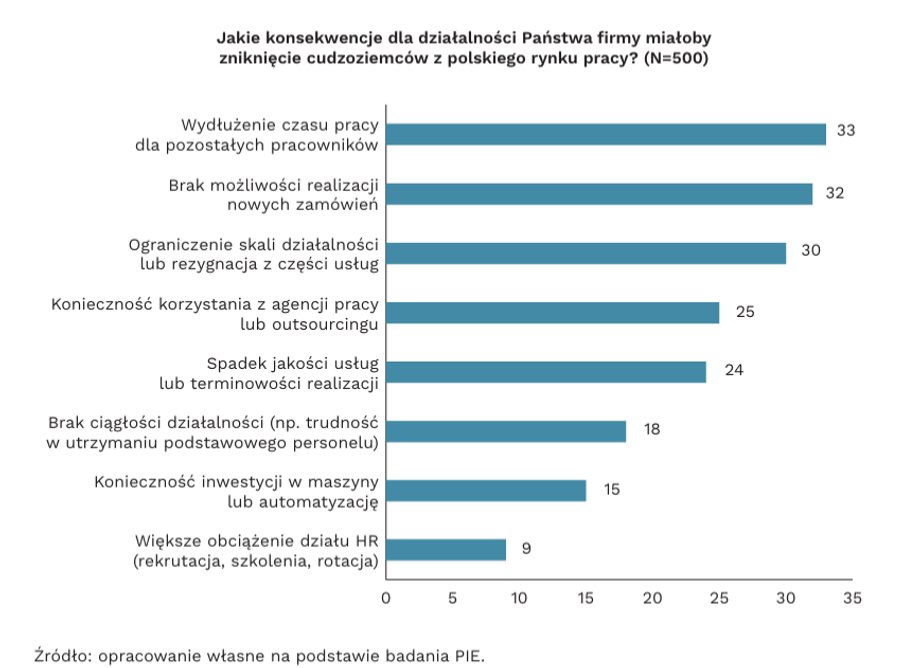
Results of the Polish Economic Institute.
|
Polish Economic Institute
32 percent companies are afraid that they could not process orders, and 30 percent. It indicates the need to limit the scale of activity or resignation from some services, especially in the construction and TSL industry.
A decrease in the quality of services or delivery delays provides 24 percent. companies, mainly commercial and from the TSL industry. For 18 percent enterprises, especially production and TSL, the lack of foreigners threatens to lose their continuity. 15 percent companies, mainly production, is considering replacing their work with automation.