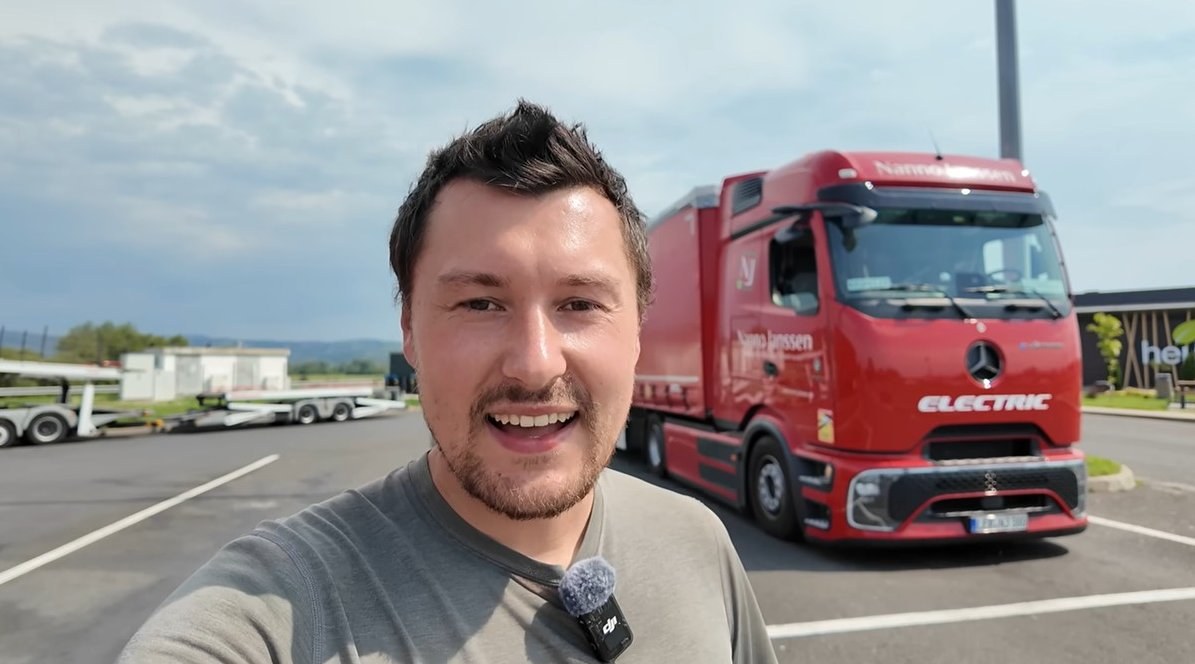
Tobias Wagner, a truck driver and YouTuber, is challenging the longstanding skepticism surrounding electric trucks. Critics often claim that electric trucks are unsuitable for long distances, citing inadequate charging infrastructure and inconvenient downtime. However, Wagner is proving otherwise.
During a recent trip through the Vosges Mountains, Wagner faced a tense moment when his truck’s battery was nearly depleted, a scenario that could bolster the arguments of skeptics. “Don’t try this at home,” he cautioned, as he maneuvered his DAF truck with just 1% battery left, successfully reaching his destination.
Wagner is not only a driver but also the founder of a startup focused on charging infrastructure. He has fully committed to driving electric trucks on long hauls, an area where many in the industry doubt their viability. Currently, only 3.5% of newly registered heavy trucks in Germany are electric, a figure Wagner aims to increase.
He has driven an electric truck from East Frisia to Turkey, tested its performance in extreme weather conditions—from -34°C in Finland to +34°C in southern Spain—and shared insights on his YouTube channel, which now boasts over 100,000 subscribers. His videos demonstrate practical driving tips, such as efficiently parking to charge in tight spaces and outperforming diesel trucks in hilly terrain with his Mercedes eActros 600.
Wagner’s efforts are not without evidence, as he dismantles several myths associated with electric trucks: their limited range, inadequate charging infrastructure, and incompatible driver rest regulations. The introduction of the Mercedes eActros 600, with a 600 kilowatt-hour battery capacity—significantly larger than that of a Tesla Model S—has shifted perceptions. Fully loaded, it can travel over 500 kilometers and recharge to 80% in just 30 minutes using 800-volt charging technology, which is also being adopted by Scania and MAN.
Cold Calculations Drive Adoption
One of Wagner’s allies in this transition is Hannes Voigt, managing director of Voigt Logistik in Neumünster. His company currently operates seven electric trucks, with plans to expand to 25 by 2027. Voigt emphasizes pragmatic calculations over ideology; while the eActros 600 has a net price of around €270,000—approximately 2.5 times that of a comparable diesel truck—its operating costs are significantly lower. Electric trucks can save over €0.30 per kilometer compared to Euro 6 diesel trucks, especially as diesel prices rise.
Despite the perception that electric trucks are only suitable for short-distance routes, Voigt’s analysis shows that the savings on long-haul routes can quickly outweigh initial costs, with daily savings of nearly €200 at an annual distance of 120,000 km.
Voigt is also investing in his own charging infrastructure, including a 750 kW solar system and energy storage solutions. He plans routes that maximize charging opportunities during the day, ensuring efficiency and cost-effectiveness.
Infrastructure Needs Overhaul
However, transitioning to electric trucks presents significant challenges, particularly regarding infrastructure. The industry requires a complete overhaul, including affordable fast-charging stations for trucks, high-capacity connections at logistics centers, and overnight parking solutions for charging. Electric long-haul trucks need a charging standard that allows for one megawatt of power, which is not currently available with standard car chargers.
Dutch startup Milence is working to address this by developing dedicated MCS charging parks across Europe with support from EU infrastructure funds. They are already constructing one of the largest such facilities in Recklinghausen, Germany, and are actively seeking suitable locations along major transit routes.
Voigt’s company faces practical challenges, including the risk of all available chargers being occupied, which could disrupt tight delivery schedules. To mitigate this, he has partnered with Munich-based startup Depotcharge, which offers a platform for transport companies to rent charging capabilities from each other, ensuring reliable access when needed.
Drivers’ Concerns with Charging Logistics
For long-haul truck drivers, the primary concern is finding an available charger. Strict EU regulations on driving times and rest breaks complicate this further, as drivers must adhere to a 45-minute break during which they may struggle to find a suitable charging point. Mismanagement of charging agreements can also lead to significantly higher costs.
Wagner launched the eTrucker app to help drivers optimize their routes with real-time information on truck charging stations across Europe, including whether they can park with a trailer. The app has gained over 10,000 downloads, providing a free resource for drivers while transport companies pay a subscription fee for additional features.
Despite these advancements, regulatory barriers remain. EU regulation no. 561/2006 restricts driver movements after work hours, preventing repositioning trucks after charging, which can lead to overnight blockages at charging stations. Wagner has been advocating for more flexible regulations, highlighting that exceptions exist for trucks boarding ferries. However, recent attempts to revise these regulations have met resistance, indicating that the electric truck revolution has yet to fully penetrate European bureaucratic processes.