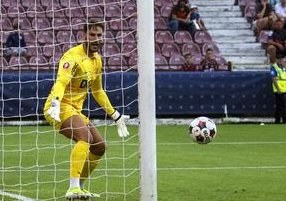
For several days each year, Europe reflects the state of Romanian football, and like always, when faced with an unflattering image, the instinct is to deflect. CFR Cluj suffered a humiliating 5-0 defeat to Tromso, while Universitatea Craiova managed a disappointing 1-1 draw in Finland. This begs the question: what are we doing wrong and what fundamental issues plague our football?
Romania’s football is in a dire state, categorized as subpar, despite UEFA not collaborating with any rating agency. Understanding our identity is crucial, especially after such performances, which inevitably lead to the chorus of lamentations that are familiar from past seasons.
Misplaced Focus on Youth Development
After his disappointing match, Alin Fică discussed the problems facing Romanian football. He noted that Mario Camora has integrated extremely well into youth and junior sectors. Yet, the same debates about academies, infrastructure, coaches, selection, parents, federation, and government are being recycled.
These are real issues, but they also serve as a trap. We lament a cause that exists but which doesn’t address the immediate failures. CFR Cluj did not lose 5-0 because of a Romanian child’s lack of skill two years ago. The same applies to foreign players. Cluj’s lineup included players trained in respected football schools, such as Christopher Braun from Hamburger SV and St. Pauli, and Aly Abeid from Levante.
Moreover, Karlo Muhar is a product of the highly regarded Dinamo Zagreb youth system and Bruno Costa is from FC Porto, where he gained European experience. While discussions on training children in Romania are valid, it’s hard to understand how such well-trained players can concede five goals in a European match. This points to deeper issues.
Professionalism in Decline
The problems besetting Romanian football begin well before the youth level and persist long after. The core issue is deprofessionalization.
An ecosystem has formed where mediocrity is the norm, veering towards amateurism. Late salaries? They’re manageable. Debts? We’ll see. A radically changed squad in summer? Just part of the routine. A coach who leaves after a few matches? Commonplace. Clubs unaware of their budgets in June for the August season? Not unusual at all.
In any serious industry, such symptoms would indicate a company in distress. In Romanian football, these are accepted norms.
We should start by expecting that players are paid on time, which should be standard practice rather than an exception. Clubs that honor their contracts shouldn’t require commendation.
Moreover, it would benefit us if licensing for European competitions involved more than a one-day financial snapshot. Why not have multiple verification points throughout the season? The capacity of a club to consistently pay its players, staff, and obligations should carry more weight.
Endless Team Restructuring
Another aspect where Europe harshly judges us is the lack of continuity. Rarely does the team from May share anything in common with the team that starts in August. The end of the championship marks the beginning of construction.
Some players leave, new ones arrive, often unprepared, and coaches request specific positions while owners provide mismatched solutions. By July, crucial elements are often missing. Apart from Craiova, which has managed to maintain some continuity, clubs like CFR and FCSB are far from this ideal.
We regularly purchase new squads and then wonder why we’re outmatched. To say we buy players is a stretch in a league funded, or rather, borrowed.
Yes, academies need rebuilding. Yes, coaches must improve. Yes, we must develop better generations, but the 14-year-old is the solution for Romanian football in 2032, not the scapegoat for a 0-5 loss in 2026. The current failures must be addressed by present decision-makers.
This includes club leaders, coaches, players, federations, and owners. A system has become so accustomed to improvisation that it has turned into a national characteristic.
Then Europe comes along and disrupts our narrative. Tromso revealed far more troubling truths about today’s adult football in Romania than about our children’s potential.
By tonight, we may likely forget as Superliga resumes.