Elon Musk and SpaceX with a record IPO. The space debut is already influencing and will continue to influence the stock exchange

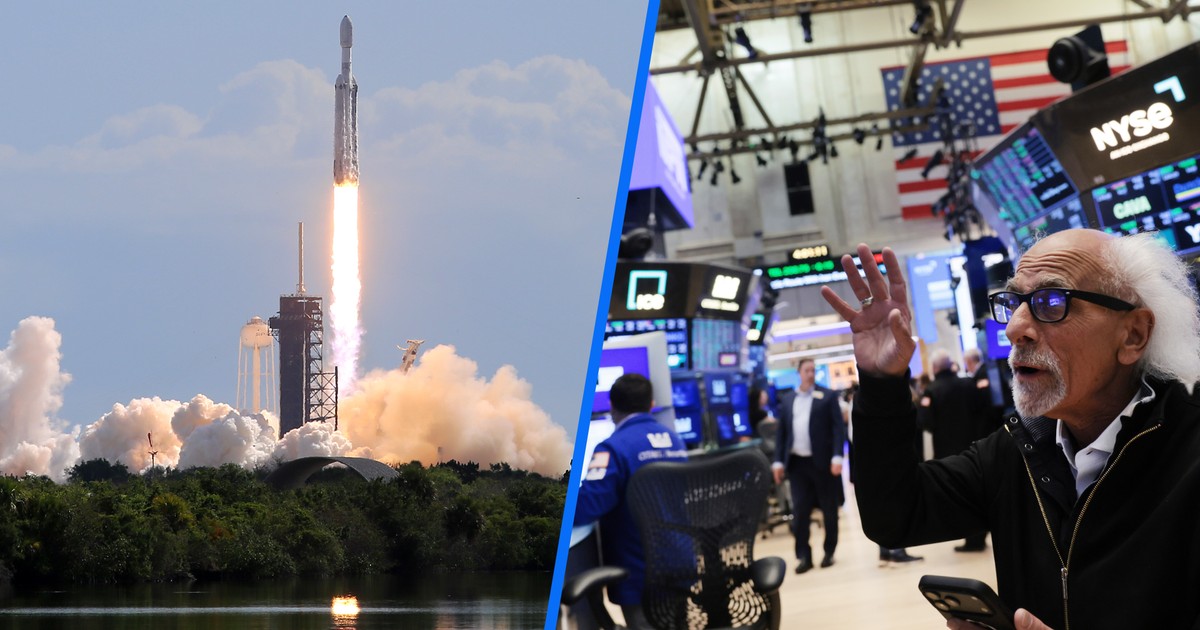
The initial public offering (IPO) of SpaceX, a company dealing with artificial intelligence and space, was accompanied by great interest from the beginning. Not only because it is the company of Elon Musk, who has numerous ideological and financial followers.
Pre-market data indicated that in the first session, orders were balanced at a level suggesting an opening price of around $174-175. per unit, which would mean an increase of almost 30%. compared to the IPO price. Ultimately, the opening price was $150, or 12%. more than the IPO price.
Many things were “best” in the SpaceX IPO: it was the largest stock exchange debut in history (the size of capitalization, i.e. the valuation of all shares on the first day of trading) and the largest amount that the company raised from the issue of new shares.
A big debut means you need to raise money
SpaceX raised $75 billion in the IPO. gross (the share price was set at USD 135 per share, investors acquired a total of 555.6 million shares), which is the equivalent of approximately PLN 275 billion. At this price, it means a capitalization of USD 1.77 trillion. The capitalization of Saudi Aramco on the day of its debut a few years ago was USD 1.7 trillion, but this oil company raised “only” USD 29.4 billion from the IPO.
SpaceX capitalization based on the IPO valuation – i.e. the above-mentioned USD 1.77 trillion. — ranks the company seventh among the most valuable companies in the US, ahead of Tesla, an electric vehicle manufacturer also owned by Elon Musk.
— The SpaceX IPO is one of the most interesting debuts in recent years, because the company is not only an independent leader of space technologies, but also an important element of Elon Musk's broader business puzzle – from satellite infrastructure and communication to potential applications for AI, autonomy and logistics – comments Alan Witczak, manager of the VIG/C-Quadrat TFI funds.
He adds that SpaceX has truly changed the economics of access to space, lowering the cost of launching cargo thanks to reusable rockets, and today it remains the most advanced commercial candidate for transporting heavy infrastructure to orbit.
— From the investors' point of view, the largest part of the company's value is not the Starlink satellites, but the potential AI business offered to enterprises embedded in xAI. Therefore, SpaceX is not a space company with the addition of AI, but more of an AI company like Anthropic or OpenAI, which plans to base its computing power on orbital data centers. And this is the biggest “bet” with the market on whether and when SpaceX will implement these plans, explains Witczak.
The space IPO of SpaceX affects the entire market
The scale of the SpaceX IPO is so large that it could have influenced the quotations on the New York Stock Exchange. In the first days of June, when the IPO was underway, the S&P 500 indexes, and especially the technological Nasdaq 100, were under pressure. The mechanism is this: SpaceX is a “hot” company whose shares investors want to own, but the pool of shares being sold is so important that they may have to make room for it in their portfolios. That is, to create liquidity by limiting purchases on the secondary market or even increasing supply, which may explain the recent weaker performance of the New York indices.
See also: Where to go on holiday in Poland? This resort will be best for families
Kamil Cisowski, manager at Opoka TFI, pointed out that the USD 75 billion that SpaceX acquired is a significant value for the American stock exchange, especially since the oversubscription was apparently about four times.
— We believe that the recent underperformance of US technology is significantly related to this debut and that a similar effect will occur with the debuts of Anthropic and OpenAI. We do not see any significant other negative factors, but it should be remembered that the Nasdaq rebound after the previous correction was extremely strong and fast in historical terms, records were broken for consecutive weeks of growth in a row, so some form of recovery was quite natural, says Cisowski.
Tomasz Matras, director of the Stock Market Office at TFI PZU, assessed that due to its spectacular scale, the debut of SpaceX was undoubtedly an important “liquidity event” for the American stock market. However, he points out that The “draining of liquidity” by the IPO coincided with better macroeconomic data from the USgenerating concerns about interest rate increases that are unfavorable from the perspective of technology companies and a renewed increase in tensions in the Middle East.
— Apart from the typical correction after strong increases, these last two factors most likely had the greatest impact on the behavior of the American index of technology companies – notes Matras.
Tomasz Smolarek, manager at mTFI, is also skeptical. — Many may associate the recent decline on Wall Street with the SpaceX IPO, but the coincidence of events in time does not always mean that they are actually related. – says the expert.
He points out that the scale of the decline since the beginning of the month in the group of the largest companies, i.e. the so-called The Magnificent Seven (Apple, Microsoft, Amazon, Alphabet, Meta, Nvidia and Tesla) reached approximately USD 2 trillion in value terms.
— And this is not the entire market. It is difficult to explain the correction of this scale by the need to obtain funds to participate in the SpaceX IPO, where the issue is expected to reach USD 75 billion.. Even taking into account the multiple oversubscription for shares in Musk's company. Adding to this the recent announcement of the issuance of shares by Alphabet for USD 80 billion, which is 2%. capitalization of this company, this still does not explain the scale of the discount – notes Smolarek.
What does liquidity preparation look like behind the scenes?
It indicates that the technology sector, and with it the Nasdaq index, entered June after two months of strong growth. — Each scratch in the AI trend now had a completely different importance. The SpaceX share offering, Alphabet's announcement of share issuance, speculations about issues of further technology companies to finance investments, and at the same time recurring concerns about the return on these investments – this is what later explained the declines. And part of the market simply decided to take solid profits. We have seen what has been happening with semiconductor companies since April. Massive price increases. Although they were accompanied by solid upward revisions of company earnings forecasts, that short-term trend has ended and a correction has arrived, says an mTFI expert.
He adds that at the same time, the blocked Strait of Hormuz continues to have a negative impact on the perception of the current economic situation, which made it difficult for the growth to spread to other sectors and for them to somehow take over “responsibility” for maintaining the upward wave on the stock exchanges.
See also: Bank summit meeting on lawsuits. KNF: “You have to react quickly”
How large could the IPO share have been in the last correction? The TFI PZU analyst points out that, to put it simply, the demand reported by investors for SpaceX shares as part of the public offering exceeded the supply of shares several times.
— The IPO value of Elon Musk's company is less than 2%. current capitalization of the Nasdaq 100 index, which is approximately USD 39.5 trillion. An important caveat here: due to the relatively large share of individual investors, subscriptions from institutional investors were lower. Additionally, many managers were certainly preparing cash for SpaceX shares earlier, he reserves.
He adds that the “cuisine” of such transactions is important. Active funds often finance participation in large IPOs by reducing existing positions, and the easiest way to do this is by selling the largest and most liquid companies — in this case, AI-related “megacaps.”
— Preparation for the SpaceX IPO could therefore increase the supply of shares of market leaders in the short term, especially since investors had a comfortable option to take profits after the previous dynamic increase in share prices of companies related to the AI megatrend since the end of March, he explains.
SpaceX will not enter the S&P 500 for now. First, promotion to the Nasdaq 100
For now, SpaceX will not enter the S&P 500 index, as the criteria there are quite stringent – including: the obligation to be listed for at least one year, achieve profitability in accordance with American accounting standards and hold at least 10 percent. shares in free float. SpaceX does not meet any of these conditions.
However, the company could be included in the Nasdaq 100 and FTSE Russell indexes in just a few weeks. This could have another effect: passively managed funds (ETFs) would have to rebuild their portfolio (proportionately sell a small portion of shares of other companies) to accommodate SpaceX's share.
— SpaceX's entry into the Nasdaq 100 index itself should not directly put pressure on the markets. Although we will probably be able to see such translations if the index correction continues. Even though the company's capitalization may exceed USD 1.7 trillion. and place it among the largest companies in the world, however its weight in the said index will not reflect this. SpaceX's share in the Nasdaq 100 will be adjusted to the number of shares in free float, i.e. free float. And this will be negligible, reaching a few percent of all shares. As a result, the initial weight of Musk's company in the index may range from 0.5% to 0.75%, but in any case it should not exceed 1%. – explains Smolarek from mTFI.
See also: AI giants compete for users. Drastic price drop possible
— Global ETFs and passive funds will have to buy shares in Elon Musk's company, financing it with proportional sales of other portfolio components. Undoubtedly, such a scenario must be taken into account, although the effect of such an operation will be short-term. Just like cutting off the dividend, it also brings the share price lower, but its long-term behavior depends on the environment and the company's fundamentals, Matras emphasizes.
He emphasizes that the prospects of the Nasdaq 100 must be analyzed primarily through the prism of the fundamental strength of big-tech companies, current share prices in relation to expected profits and the potential risk of a deterioration of the macroeconomic environment or an increase in interest rates in the US in response to increased inflationary pressure.
— In terms of valuations, the Nasdaq is expensive, and the P/E ratio based on projected earnings for the next 12 months is approximately 25x, which is above the historical average. The largest AI-related companies are improving their results at a double-digit rate, and the investment boom in the field of artificial intelligence shows no signs of slowing down. CAPEX for AI is growing and, according to the Bloomberg consensus, it is expected to grow until the forecast years 2030-2032, exceeding the level of USD 1 trillion. annually. If these investments work out, they may translate into higher earnings per share growth. Unless these companies encounter problems first, e.g. in the form of financing costs, adds the PZU TFI expert.
Promotion to the indexes may mean passive demand for SpaceX shares
There is also the other side of the coin: qualifying a given company for the index means additional demand for its shares from ETFs. JP Morgan analysts estimated that such additional passive demand for SpaceX shares would amount to approximately $10 billion. after the company's promotion to the S&P 500 (assuming a market capitalization of USD 2 trillion and 5% of shares in free float and a weight in the index of 0.15%). Under the same assumptions, SpaceX's promotion to the Russell 1000 indexes would generate approximately $4 billion. passive demand, and to the Nasdaq 100 approximately USD 4.3 billion.
It is worth emphasizing that such information in itself does not say much in terms of its impact on quotations. What is important is what part of the “natural” turnover in a given company's shares constitutes (e.g. using the average turnover per session indicator).
Note: the information contained in the text is for informational purposes only and does not constitute an investment recommendation, information recommending or suggesting an investment strategy within the meaning of applicable regulations, or any other form of advice regarding the purchase or sale of financial products.
Author: Maciej Rudke, journalist of Business Insider Polska