Online debate after a mother was warned by the police for carrying her baby in the front of the car. What does the law say?

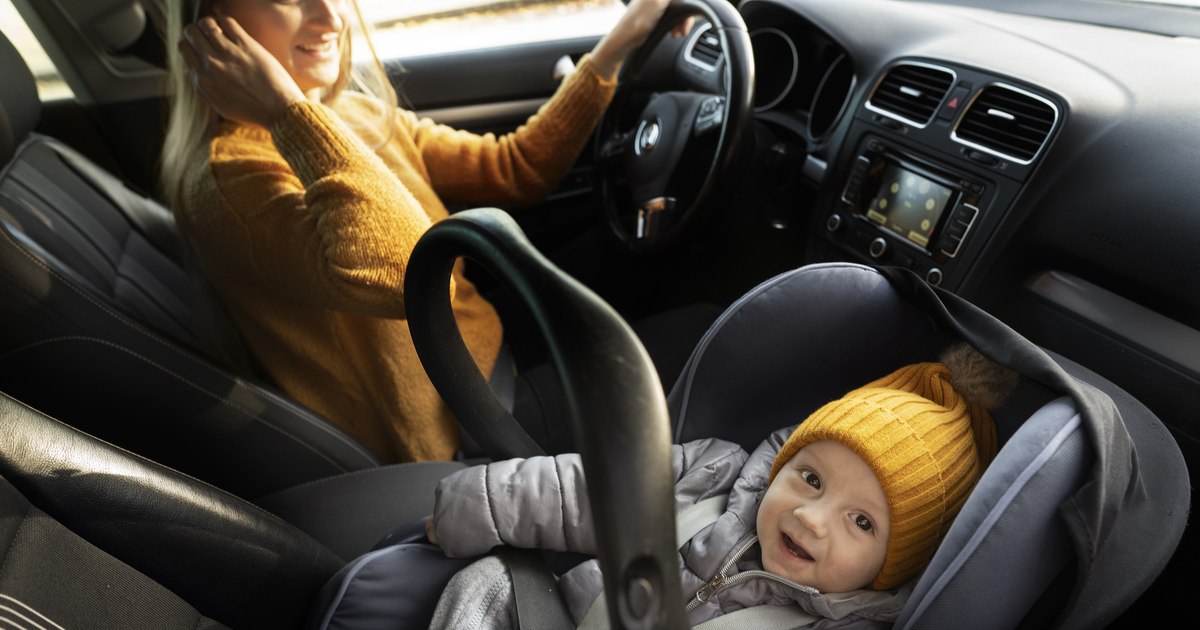
The complaint of a Romanian woman who was verbally warned by a policeman for transporting her baby by car, in a car shell mounted on the front passenger's seat, sparked an extensive debate in the online environment.
Babies can be kept in the front seat under certain conditions. Photo: Magnific.com
The notification of a Romanian woman, published on a Facebook page dedicated to the safety of children in the car, sparked a wide debate in the online environment.
She said she was stopped in traffic and given a verbal warning by a police officer for carrying her baby in a rear-facing car seat in the right-front passenger seat with the airbag disabled.
Romanian woman warned by the policeman
According to the administrators of the “Siguranța Auto Copii” Facebook page, who submitted the woman's report, the warning she received was allegedly unjustified.
They explained that carrying an infant in a rear-facing car seat in the right-front passenger seat is permitted, provided the front airbag is deactivated and the device is installed according to the manufacturer's instructions.
They explained what the law provides in such cases and where the confusion would have arisen.
“The baby was seated in an approved car seat suitable for his age and size. The seat was rear-facing and positioned in the right-front passenger seat with the front airbag deactivated. It's not the safest possible placement – the rear seat and rear-facing orientation is ideal – but it is a legally permitted configuration if the car seat manufacturer's instructions are followed, and the airbag is deactivated”, show the administrators of the Facebook page.
According to the complaint, the police officer told the woman that “she is not allowed to do that” and that “she can only carry the child in a seat facing the direction of travel, if he is over 135 cm”.
“The problem is twofold. The 135 cm threshold in the Highway Code has nothing to do with the mandatory orientation of the seat facing the direction of travel. In addition, the law explicitly allows the installation of a child device in the front seat under certain conditions.” reminded the administrators of the “Children's Car Safety” page.
What does the road legislation provide in such situations
Article 97 of the Traffic Code Enforcement Regulation states that minors with a height of up to 135 cm must be transported in a child seat restraint device, approved and suitable for their physical characteristics.
“Children with a height of up to 135 cm may be transported in motor vehicles equipped with safety systems for the driver and passengers, hereinafter referred to as safety systems, only if they are secured or restrained by means of a child seat restraint device installed in the motor vehicle”, provides for the Regulation on the application of the Road Code.
Included in this category are, among others, pushchairs, car seats and booster seats. The law does not stipulate that the device must be oriented towards the direction of travel. Children taller than 135 cm can be transported with the adult seat belt, adjusted so that it does not go over the neck or face area. They can still be carried in a child seat restraint.
The general rule is that the car seat should be mounted on the rear seats of the vehicle.
“The child restraint system shall be installed in the rear seats of the vehicle in accordance with the installation instructions provided by the vehicle manufacturer, such as a manual, leaflet or electronic publication with instructions indicating how and in which types of vehicles the system can be used safely”, shows article 97 of the Regulation on the application of the Road Code.
However, the legislation also provides an exception for devices that can be installed on the front passenger's seat. In the case of rear-facing clamshells, installation is only permitted if this location is provided by the manufacturer and the frontal airbag is deactivated or the car is not equipped with an airbag in that location.
“With the exception of the provisions of paragraph (1^5), the types of child seat restraints that, according to the manufacturer's instructions, can be installed including on the front passenger seat by facing the direction opposite to the normal direction of travel of the vehicle are installed on this seat only if the driver deactivates the frontal airbag corresponding to the seat, even in the case of the vehicle equipped with a mechanism that automatically detects the presence of the device and blocks the deployment of the airbag front airbag corresponding to the location, or if the vehicle is not equipped with a front airbag corresponding to the location”, shows the Regulation on the application of the Highway Code.
The road where many drivers admit to falling asleep at the wheel. “If you're too ambitious and think you can handle it, you run the risk of hurting it”
The effects of attention
Thus, the rear-facing car shell can be placed on the right-front passenger seat, if the manufacturer allows this installation and if the frontal airbag is deactivated. Deactivation is required even for cars equipped with an automatic child seat detection and airbag blocking mechanism.
“In loose translation: what mom did – fitting the rear-facing clamshell in the right-front passenger seat with the airbag off – is legal, even if it's not the ideal safety scenario. The recommended option remains the rear seat”add the administrators of the page.
They argue that such a message, coming from an authority, can have two effects. On the one hand, it scares a parent who has invested in the child's safety and installed the shell correctly. On the other hand, it may cause other parents to abandon rear-facing solutions for fear of a fine, although the law does not prohibit these configurations.
“As a parent, it is important to know that the ideal safety scenario for a baby is to be transported in a properly installed rear-facing seat in the back seat. Legally, you can also use the front seat if the device is approved for this position and the airbag is deactivated“, the administrators of the page conclude.
Many Romanians have gone through similar situations
Some Romanians claim that they have gone through similar situations.
“And we were stopped and told that. But I was loud and told him to read the Highway Code. They went to the car, probably read, then came and said that they had not told me legally, but morally. I asked him to keep his morals for when he has a child. I am on my third child, all rear-facing, the eldest is six. I am sorry and I regret very much that I did not report to the commander. Such policemen should not be employed. I understand that the system needs people, but they bring in all the unprepared ones.” another woman complained.
Someone else said that parents should have the law in their car so they can show it to the police in the event of a traffic stop.
However, one netizen claimed that although the arguments presented are logical, legal and practical, there is also a human objection: mounting the seat in front can distract the driver. A woman contradicted him.
Are the Romanians ready for the new highways? Reactions after the opening of Bucharest – Focșani: “They were all running at 150 km/h”
“When I drive alone with the baby, and I do it a lot, I prefer to put her in the front, because I can keep an eye on her. In the back, I can't see her and it's more dangerous to keep going back to her or put my hand on her to calm her down. You can't stop the car every time she whines, to see what's going on. For many mothers, it's very difficult to ignore the crying or whining of the baby.” explained this.
Why is such a mode of transport chosen?
Another netizen said that he was involved in a minor accident caused by a mother who was distracted by the crying of the child in the back seat.
“That's exactly how a mother ran into me, while I was going from bar to bar. She didn't even have her child facing the direction of travel, only that he was in the back seat. The child was crying, and she was alone in the car. In a moment of inattention, she hit me from behind. If she had the child next to her, she could calm him down with a caress or a toy, until he was able to pull to the right.” he reported.
Another mother explained that she chose the same solution for practical reasons, especially when her baby had reflux.
“I didn't drive out of fear that I was doing something illegal or unsafe. Quite the opposite. I did it because the baby had reflux and I couldn't drive calmly, knowing she was in the back and could throw up at any time. I also did it for all the times she dropped her toy and I would have had to stop 30 times in 15 kilometers because I couldn't let her cry and drive me indifferent. I did it just so I could drive responsible and to be able to concentrate on the road”, reported this.
The woman added that many parents wrongly pointed out to her that they would not be allowed to transport the child in this way.
“I haven't had time to educate everyone. The point is that we live in times where the law is adapted, fortunately for mothers, to our needs and the needs of the children. It's very important to know what is legal in certain circumstances.” she also said.