Donald Trump has many cards in his hand, his opponent – an Iranian general associated with the religious regime – only one. “Uno, you lost!” – exclaims the Iranian. Trump looks at his full array of cards in surprise and replies, “You only have one card and I have them all!”
The latest video generated by artificial intelligence, prepared by the Iranian propaganda machine, extremely accurately reflects the current situation in the Middle East. Trump actually holds a lot of cards in his hand. The problem, however, is that he clearly doesn't understand the game he joined exactly three months ago.
His opponents, taking advantage of the deadly impasse on the front, are using new tactics to humiliate the United States.
This week, Iranian negotiators, led by parliament speaker Mohammad Bagher Ghalibaf, announced bluntly that further talks were only possible in cash. The United States would immediately unlock frozen assets worth $12 billion. (approx. PLN 44,400 million), and then transfer another USD 12 billion within the next 60 days. Otherwise, Iran does not intend to come to the negotiating table with anyone.
Such demands are only made by someone who is extremely confident in his position. This shows that after three months of war, Iran remains not only militarily strong – according to American sources, the regime still has approximately 70 percent its missile arsenal — but also remains extremely confident at the negotiating table.
The Iranian authorities want to allocate part of these funds to the prize fund in the amount of EUR 50 million (approx. PLN 214 million). According to the newly adopted law, this money would be a reward for capturing or killing Donald Trump and Israeli Prime Minister Binyamin Netanyahu.
Donald Trump and Binyamin NetanyahuJALAA MAREY / POOL / PAP
While Trump is increasingly harming himself at home with his statements and, in a fit of anger, can publicly attack even allies such as the Sultanate of Oman (“if they don't obey, we'll just blow them up”), the Iranian regime is day after day undermining the authority of the American commander-in-chief, using increasingly provocative and precisely targeted taunts.
Just a few days ago, the extension of the ceasefire, which has been repeatedly violated by all parties to the conflict this week, seemed quite a realistic scenario. Today, however, this possibility also seems to be practically buried.
Iran itself limits the chances of a longer break in fighting through its financial ultimatum. Meanwhile, Trump seems more preoccupied with building a new ballroom and rebuilding the White House's stately swimming pool than with trying to resolve the Iran crisis.
Although U.S. officials such as Secretary of State Marco Rubio are trying to remain optimistic, it is still unclear to an impartial observer how the war in the Middle East could end within a reasonable time. The following three problems alone make a quick resolution to the conflict seem unrealistic.
1. Unclear decision-making channels
Three months after the death of Ayatollah Ali Khamenei, it is still unclear who is actually in power in Iran.
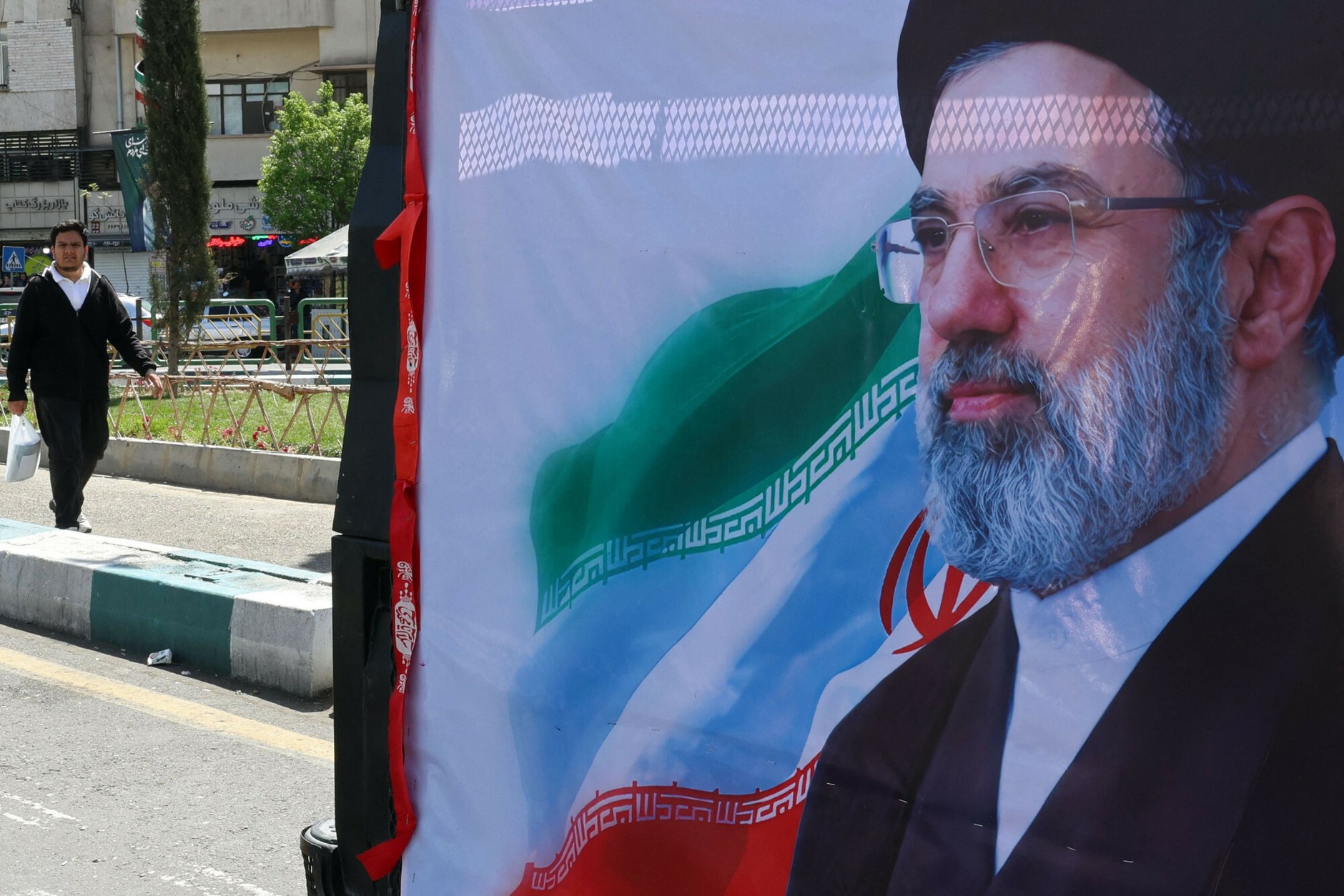
Ayatollah Mojtaba Khamenei has not made a single public appearance since his nomination. It is not known whether he is actually capable of making decisions or whether the commanders of the Islamic Revolutionary Guard Corps have taken full control. It is difficult to answer this question unequivocally today.
A banner with the image of Mojtaba Khamenei in Tehran-/AFP/EastNews
2. Nuclear red lines
Regarding the 440 kg of enriched uranium, the parties to the conflict have not come even one step closer to reaching an agreement.
Moreover, Iranian strategists may be increasingly considering abandoning the principle once established by Ayatollah Ali Khamenei that Iran should not build nuclear weapons.
The example of Ukraine shows how costly not having – or voluntarily giving up – nuclear potential can turn out to be.
3. Loss of trust
The same strategists in Tehran are probably very cautious about showing even the slightest trust in the Americans.
The two countries were negotiating when the United States launched a surprise attack in late February. Trump's chaotic communication and his aggressive statements, such as: “Today we will destroy the entire civilization,” do not give us much reason to uncritically believe the declarations of the American authorities.
The article continues below the video
A must-read for Trump
There are more and more indications that Iran may join the infamous list of American “forever wars” – alongside Vietnam, Somalia and Afghanistan. The United States attacked but failed to achieve a decisive victory.
However, unlike Saigon, Mogadishu or Kabul, Americans cannot simply withdraw from the Persian Gulf and hope that history will quickly cover uncomfortable memories with a thick layer of oblivion. As long as Iran controls the Strait of Hormuz, the world economy remains, in a sense, a hostage to decisions made in Tehran.
The situation is becoming more and more uncomfortable for Trump. The midterm elections in the United States are fast approaching. Oil prices are not falling, and with them, the Republican Party's chances of getting through the elections without serious political losses are also decreasing.
It's a situation that could lead to despair. And it is desperation that further weakens Trump's negotiating position.
The worst thing you can do in a negotiation is to seem desperate
— wrote Trump himself on page 63 of his book “The Art of the Deal.”
The American president's hopeless situation prompted even a conservative Financial Times commentator to offer malicious advice this week.
Perhaps Donald Trump should finally read his own book
I’m Ashley Davis as an editor, I’m committed to upholding the highest standards of integrity and accuracy in every piece we publish. My work is driven by curiosity, a passion for truth, and a belief that journalism plays a crucial role in shaping public discourse. I strive to tell stories that not only inform but also inspire action and conversation.