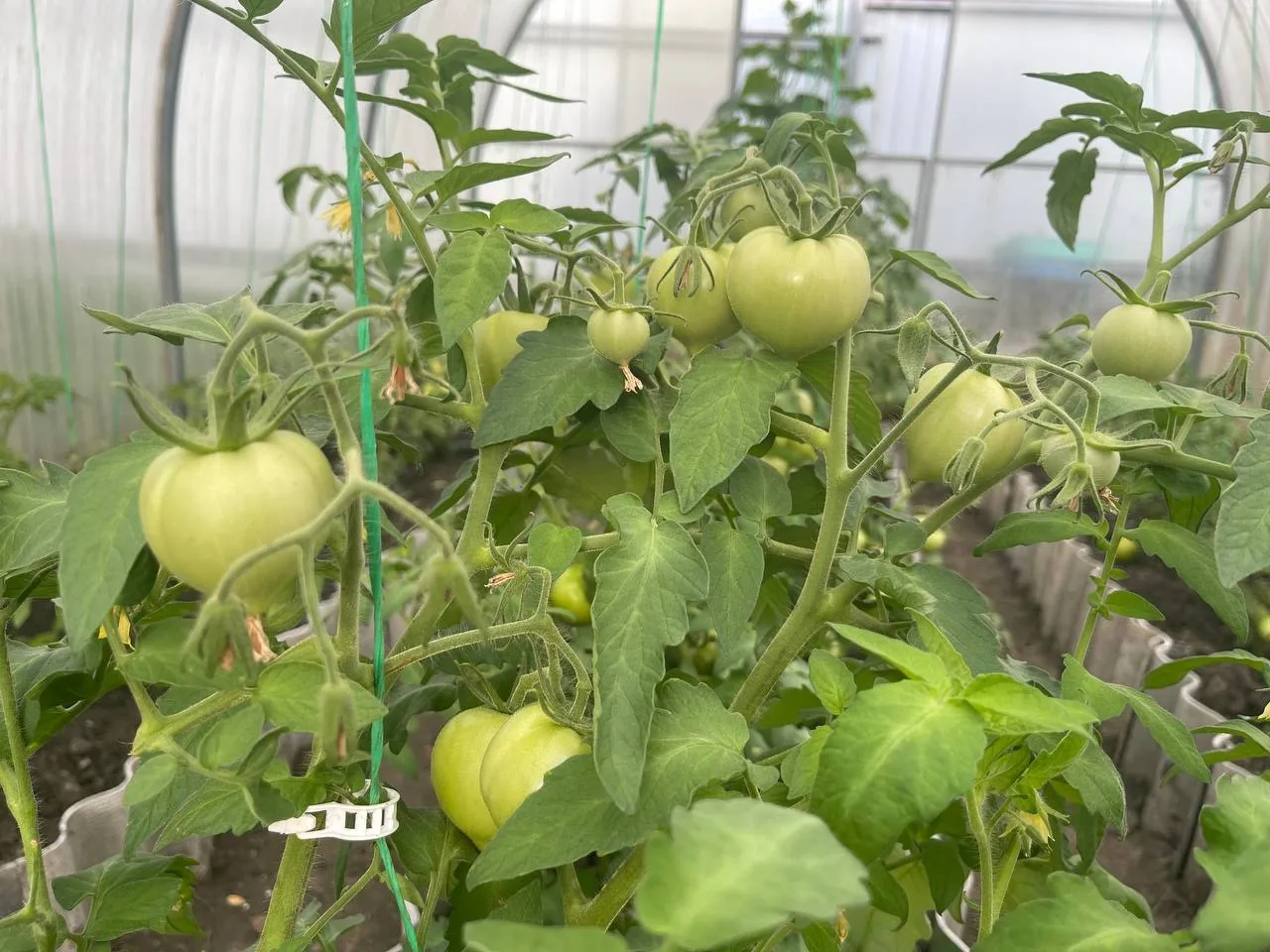
Many gardeners are faced with a situation: tomato bushes grow powerful, but the bunches remain half empty – the flowers fall off, the ovaries dry out. Experienced agronomists explain this by a lack of boron during the period of mass flowering. Boron fertilizing, carried out on time, completely solves this problem.
Mid June The tomato has already grown roots, opened its second and third clusters, and the most important period begins. Without a sufficient amount of boron, the pollen becomes weak and partially sterile – the flowers fall off and the ovaries dry out. This is reported by the author of the channel “Green Stories” (12+).
This happens especially often in heat above +30°C. Boron helps the plant transport sugars normally, supports pollination and makes the ovaries stronger. If you treat tomatoes in the phase of mass flowering of the second cluster, the result becomes noticeable after a week and a half.
Dosages and timing
For 10 liters of water, take 1.5 grams of boric acid. More does not mean better: an overdose is dangerous due to burns and yellowing of the leaves. Boric acid is first dissolved in a glass of hot water, then poured into a bucket.
Treatment scheme:
- approximately June 15;
- after 14 days;
- in another two weeks;
- at the end of July.
Spray early in the morning or in the evening after 6 pm, paying special attention to the underside of the leaf. Sometimes a drop of iodine is added to the solution in a bucket to protect against fungi.
Common mistakes
Boron will not be a magic wand if the tomato suffers from cold, overwatering, lack of potassium or disease. Here are the main processing errors:
- spraying in heat above +30°C – the leaves close the stomata, absorption decreases;
- mixing with ash and calcium fertilizers – boron becomes less available;
- too high a concentration (5–10 grams per bucket) is toxic to tomatoes;
- treatment for dry, dehydrated plants – first you need watering, then spraying.
Boron is not a replacement for normal care. If a tomato is overfed with nitrogen, is damp, or is suffocating in an unventilated greenhouse, no amount of boric acid will save it.
But if the plant is healthy and you can simply help it at the most crucial moment, the effect is impressive: the clusters are denser, there are more ovaries, the fruits are larger, the tomatoes can withstand the heat more easily, and the harvest becomes stable.
Personal experience
Previously, the tomatoes bloomed beautifully, but then half of the flowers fell off and the clusters were sparse. Last year, in mid-June, I treated the bushes with boric acid (1.5 g per 10 l). After just two weeks, the difference became obvious: there were twice as many ovaries, the clusters were dense, and the fruits were even. Now I don’t miss this treatment even a single season.