A “giant” sword and a bizarre grave have been discovered in the steppes of Russia. The connection with one of the most feared peoples in history

At the confluence of Europe and Asia, on the banks of the Volga, archaeologists discovered the impressive vestiges of a mysterious world of the steppes, dominated by fearsome warriors, with bizarre rituals and traditions. A huge sword that belonged to a gigantic fighter has been discovered.
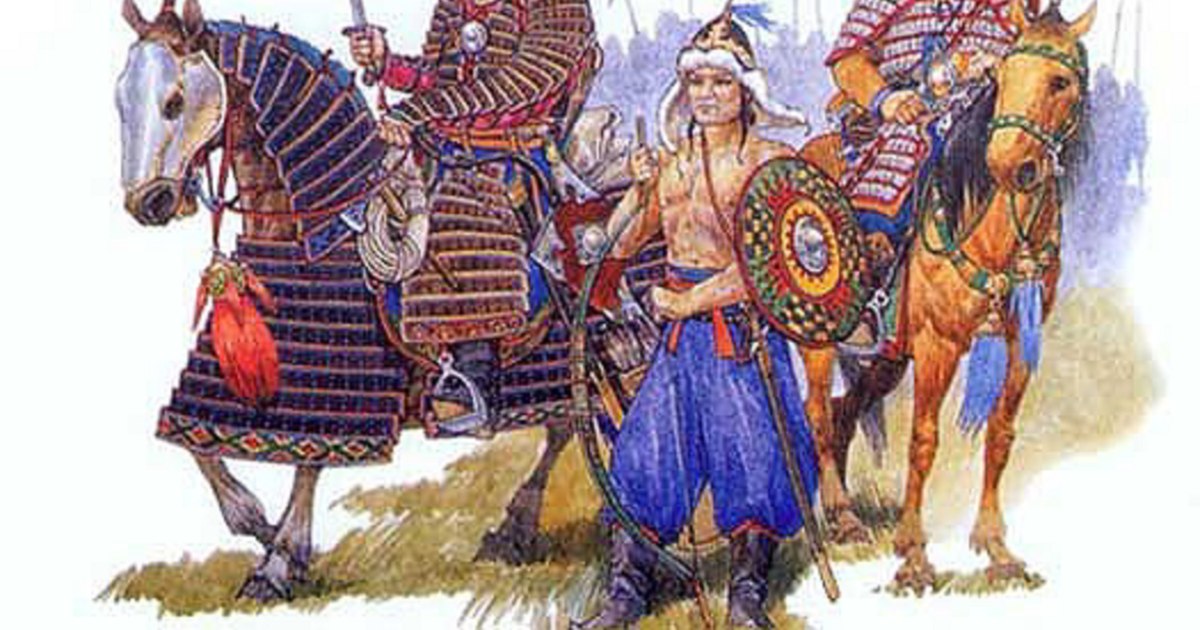
Warriors of the Golden Horde PHOTO historyfiles.co.uk
In the Krasnoyarsky District of Astrakhan Region, Russia, there is an absolutely remarkable archaeological site. It is about Orlinoye Gnezdo or, in translation, “Eagle's Nest”, a settlement and cemetery from the 13th century. In addition to the fabulous landscapes and the cliff-top positioning of the entire site, archaeological discoveries have revealed special, unique funerary objects and rituals, including the weapon of a true giant. It is a sword over 1.12 meters long. It is estimated that one who could easily wield such a weapon would have had to be around 2 meters tall. A real giant, for the period between 1201 and 1300. In addition, bizarre funeral rituals were discovered in the same location, associated with the fearsome warriors of the Golden Horde, those who controlled, for a period, the Romanian space.
A steppe empire that dominated a huge territory
The site of Orlinoye Gnezdo was actually a settlement in the Astrakhan region at the confluence of Asia and Europe on the banks of the Volga River. An area heavily transited by trade caravans and which, in the 13th century, was under the rule of one of the most powerful empires of the steppes. It is about the Khanate of the Golden Horde, the one that controlled politically and militarily including today's Romanian territories, up to the Carpathian Mountains.
The Golden Horde was basically a great Mongol khanate that emerged in the 13th century after Genghis Khan's westward expansion. In short, it was one of the “successor states” of the Mongol Empire, established by Batu Khan in the Eurasian steppes to better control the western areas of the huge empire. Basically, under the control of the Golden Horde was a huge territory, from the steppes of Kazakhstan to southern Russia and the Volga region, but it extended its influence to the Carpathians, to the west. A large part of this territory was controlled mainly through tribute and the obligation to participate in military campaigns, rather than directly. The first capital was Sarai Batu, founded by Batu Khan around 1240. It was located on the Lower Volga near the present-day village of Selitrennoye in the Astrakhan region.
Although this Golden Horde empire was established by the Mongols, they represented only the warrior and political elite. The majority of the population consisted of Turkic peoples, who lived in the Eurasian steppes and were subdued by the Mongol armies. In addition to Turks, Slavs and Finns also lived on the territories of the Golden Horde. The height of his power was between 1240 and 1502.
The power of the Golden Horde was its highly mobile army, which fought in the style of steppe warriors, riders who attacked quickly, knew how to shoot accurately from the horse's rush, but also wielded lethal cavalry swords, being able to decapitate or cut down opponents at a gallop. Basically, it was a melange of Mongol and Turkic fighting styles and tactics, but similar. Over time, the Golden Horde became Islamized (adopted Islam as its dominant religion) in the 14th century.
The Golden Horde meant not only warriors of the steppes bent on plunder and plunder, but also an empire with a flourishing trade and even lavish imperial courts. Many important trade routes connecting Asia and Europe passed through the territories of the Golden Horde. That is precisely why urban commercial centers with important fairs were set up during the Golden Horde. At the same time, these trade routes were well protected by fortresses.
An “eagle's nest” and a bizarre funeral
The site of Orlinoye Gnezdo (“Eagle's Nest”), in the Krasnoyarsky district, has been a focal point for archaeologists studying the medieval period. There was a Golden Horde settlement in the area, probably a fortification and a stopping point on the trade routes that crossed the steppes. Its role as an important surveillance point is suggested both by its location on a high plateau, which dominates the region, and by the traces of fortifications discovered here. Additional confirmation came with the new discoveries at Orlinoye Gnezdo, made following recent excavations by the specialists of the scientific and production institution “Nasledie”. It is a cemetery with over 50 burials dating from the end of the 13th century and the beginning of the 14th century. Among those buried were warriors of the Golden Horde, most of them Muslims, as the burial rite indicates.
The truth about the Tatars, the nightmare of the Romanian governors. The mysterious origin of the steppe warriors who took tens of thousands of slaves
Most of these graves contained no artifacts, but two of them stood out, revealing unusual practices and exceptional grave goods.
The first of these unusual graves belonged to a warrior, a horseman of the steppes. It contained the remains of a man seated face down with his head to the west. The strange thing is that the way he was seated and laid down, with his hands tied behind his back, gave the impression of a ritual sacrifice. Archaeologist Tatyana Grechkina realized that there was severe trauma to the neck area when she studied the skull. It could not, however, have been an execution for a common crime, given that the warrior was buried on horseback with his harness. Rather, it was a complex funerary practice with symbolic significance. What does it mean? It remains a mystery for now.
A Giant's Sword, A Medieval Weapons Mystery
Beneath the individual's grave was another, of even greater archaeological value. Basically, in grave 53, next to the skeleton of a warrior from the 13th century, probably before the one killed and deposited on top, there was a formidable weapon, very well preserved. This is an exceptionally large sword, especially for steppe riders. It was 1.2 meters long and was still in its wooden sheath. This discovery is now considered one of the most important in the area.
The sword was found next to the skeleton of a man who, as evidence shows, may have had a leather breastplate for protection, arm guards and a leather helmet. Arrowheads were found near the body. Basically, he was a warrior of the steppes who shot his bow from the horse's spurs and also used the huge cavalry sword to strike terror among his enemies.
The sword, the site's most valuable artifact, was pulled out of the ground with a 15-kilogram block of earth. Subsequently, for four months, the weapon was painstakingly restored by specialist Mikhail Golovachev. According to the experts' analyses, the sword had only a one-meter blade, to which the handle and the guard were added. It far surpassed the typical swords of the era; they were about 70 centimeters. Specialists say that such a weapon was not mass-produced, but was made “to order”, probably for an elite warrior or commander.
Europe, saved by a cruel drunkenness. The emperor who brought apocalypse to Europeans was enjoying himself with a fountain of alcohol
The giant sword of Astrahan PHOTO ancient origins/Astrahan Museum Reserve
Based on analyzes of the sword's functionality, it was concluded that wielding such a long blade would have required a considerable arm span, implying that the user was probably an individual about two meters tall. The climax, the anthropological and medical research carried out on the skeleton of the warrior next to which the sword rested shows that he was no more than 1.75 meters tall. How did he wield that sword? It is still a mystery.
It is suspected, however, that it was either a ceremonial sword, not used in combat, or a weapon taken as booty from a very high warrior and made an object of prestige. However, there were no warriors of such stature in the steppe world. There are also specialists who say that these swords were successfully used even by shorter individuals. They were not worn at the waist, but at the edge of the saddle. They were issued during mounted battles and used against infantry in particular. The rider did not have to make a great effort to lean in the saddle when attacking his enemy. Also, keep your distance with such a long blade.
For now, the sword and other artifacts found at Orlinoye Gnezdo are at the museum in Astrakhan, where they are being studied by researchers. This site provides new clues to bizarre burial rituals within the Golden Horde Khanate, as well as new insights into the use of military equipment.