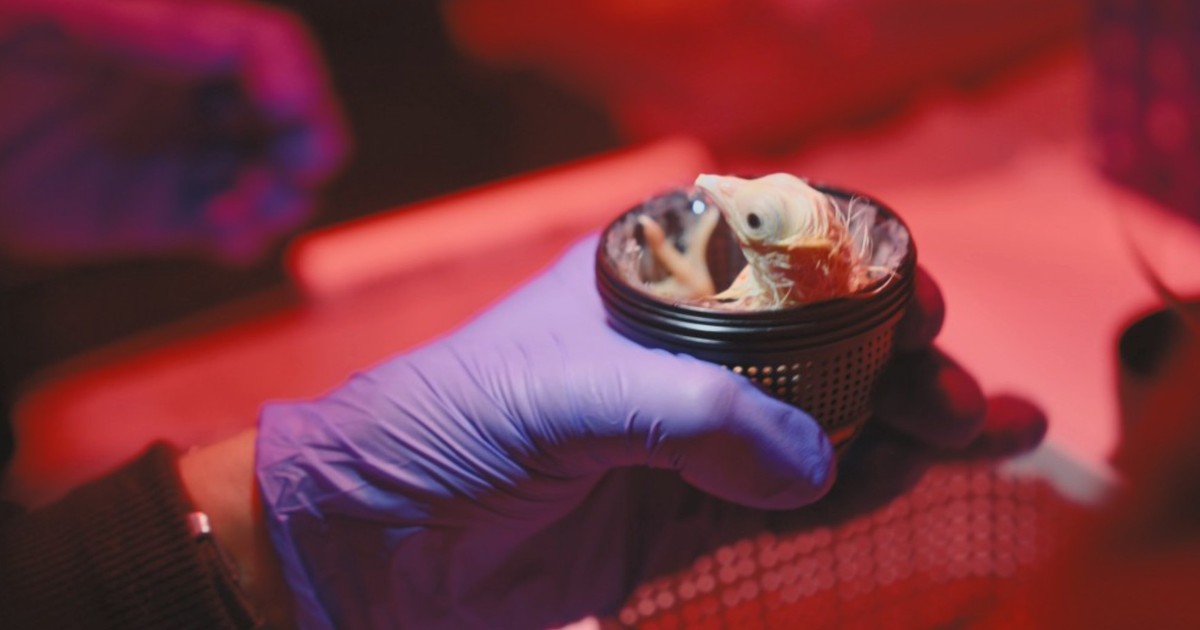
The South Island Giant Moa is one of the largest birds that have ever walked the Earth. It grew to almost four meters tall and weighed over 230 kg. Unfortunately, this bird was completely exterminated by people around the 15th century, mainly by Maori. Colossal representatives say the artificial egg is a key element of their plan to bring this species back to life. Without it, it would be impossible to carry such huge embryos to term – no living bird can lay such large eggs.
Behind this media announcement is a company that since 2021 has been consistently building the image of a pioneer of “reviving extinct species”. Colossal Biosciences has already raised hundreds of millions of dollars and achieved a valuation in the billions. Their vision – bringing mammoths, Tasmanian tigers and dire wolves back to life – is selling very well. The only question is whether this time the beautiful story is followed by real, scalable scientific progress, or are we again dealing with a highly tweaked marketing message?
Size comparison of a human and moa skeleton (left) and moa and chicken eggs (right)
|
Colossal Biosciences
Chickens without a hen
Colossal Biosciences did not resurrect any extinct species this time. Instead, she performed a precise experiment on a well-known biological model: the domestic chicken. The researchers collected fertilized chicken embryos at a very early stage of development, just a few hours after fertilization, when the embryo consists of only a few hundred cells. Then they transferred them to a specially designed artificial egg, in which the entire further incubation process took place without the use of a natural shell.
- Read also: Doctors said: no chance of biological paternity. “It was like a miracle”
The result exceeded expectations: 26 fully healthy chicks hatched from 26 embryos placed in artificial eggs. All chickens are currently monitored in the company's Texas laboratory – researchers check not only their growth and development, but also long-term parameters such as fertility, behavior and possible future health problems.
So this is not the “first hatch from a test tube” in the classical sense. Such experiments with in vitro bird embryos have been carried out before. The key difference is that for the first time in history, the entire development cycle from early embryo to hatching took place in a fully synthetic, scalable system that 100 percent replaced the natural egg shell.
Success is engineering and technological, not genetic. No modifications were made to the chickens' DNA – it was merely to prove that the artificial incubation system could safely carry the embryo to term. For Colossal, however, it is much more than a laboratory test. The company treats chicken eggs as a model to confirm the readiness of the technology to work with much larger and more complex eggs of extinct bird species, such as moas, and in the future also with the creation of an artificial uterus.
What is this “artificial egg” and how did they create it?
The Colossal Biosciences artificial egg is not a simple replica of a natural shell, but an advanced incubation system designed from scratch by the company's engineers and biologists. It consists of two key elements: an external, 3D printed “lattice” and an internal, permeable silicone membrane. The lattice, made partly of titanium and special polymers, provides mechanical protection for the embryo while leaving hundreds of small pores that allow controlled gas exchange – just like the porous natural shell of a chicken egg does.
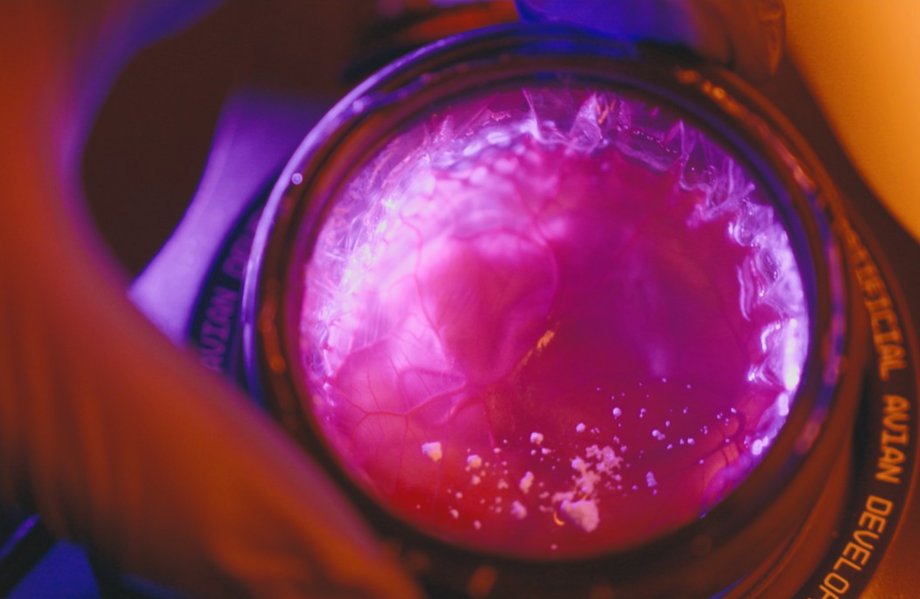
Artificial egg
|
Colossal Biosciences
The silicone membrane, developed in Colossal's own laboratory, is partially transparent, which allows scientists to observe the development of the embryo in real time, without having to interfere with the natural shell. The entire system exactly imitates the key functions of a real egg: it regulates the supply of oxygen, removes carbon dioxide and maintains appropriate humidity.
The most important feature of this technology is its scalability. The current artificial egg is adapted to the size of a chicken, but the design allows it to be enlarged up to eighty times – to the size of a moa egg, which was about 80 times larger in volume than a chicken egg and about 8 times larger than an emu egg. This opens the way to work on species whose eggs are too large for any living bird to incubate.
The potential of an artificial egg
Colossal Biosciences' artificial egg technology has the potential to go far beyond one successful experiment with chickens. The company primarily emphasizes its importance for de-extinction projects of birds whose eggs are too large for any modern species to incubate. In the case of the southern moa, whose egg volume was approximately 80 times larger than that of a chicken, a natural host simply does not exist. The artificial egg solves this problem by offering a fully controlled, scalable environment that can be adapted to the size of an extinct species.
- Read also: Secret talks about cloning Elizabeth II's corgi have come to light. Sarah Ferguson under fire
However, Colossal itself admits that this is only one possible way of using the new technology. The artificial egg could prove equally valuable in protecting species that are still alive but critically endangered. Thanks to the transparent design and easy access to the embryo, scientists could make precise genetic modifications – for example, increasing disease resistance, improving genetic diversity or restoring traits lost due to population bottlenecks. This opens up new opportunities for breeding programs for birds such as the kakapo, the California condor and other species with very small populations.
In addition, the technology enables research on the embryonic development of birds in a way that has not been available before. Scientists can observe in real time how individual organs are formed, how specific genes work and how processes occur that remained unknown in extinct species. Andrew Pask, the company's Chief Biology Officer, points out that such access significantly increases the chances of generating healthy, genetically modified birds – not only “reconstructed” ones, but above all those that need urgent help today.
Ultimately, the impact of this technology will depend on whether it can be scaled safely and whether the rest of the chain for bringing back an extinct species – genome reconstruction, cell editing and embryo transfer – can keep up with its engineering success. For now, it's a promising piece of the puzzle that could advance both moa work and broader avifauna conservation efforts.
The story of Colossal Biosciences – lots of talk, less spectacular results
Colossal Biosciences was founded in 2021 on the initiative of entrepreneur Ben Lamm and outstanding geneticist George Church from Harvard. From the very beginning, it set itself an extremely ambitious goal: to “end extinction” through advanced gene editing and de-extinction. Thanks to its charismatic communication and vision of bringing iconic extinct animals back to life – woolly mammoths, Tasmanian tigers and dire wolves – it quickly became one of the most famous biotechnology companies in the world. To date, it has raised over $400 million. financing, and its valuation exceeded USD 10 billion.
Colossal's success is largely based on skillful media storytelling. The company regularly announces “historical breakthroughs”: reconstructing the almost complete mammoth genome, recreating the DNA of the Tasmanian tiger with an accuracy of 99.9%. or the “return” of the dire wolf. These messages reach the top of scientific and popular science websites, building the image of a pioneer of a new era of biology. However, when we take a closer look at the effects, the picture becomes more complex.
- Read also: Scientists are recreating an extinct species of antelope
In April 2025, Colossal announced the birth of three dire wolf pups – Romulus, Remus and Khaleesi – as the first successful “resurrection” of a large mammalian predator. In practice, however, the puppies were gray wolves with only 20 targeted genetic edits introduced in 14 genes. They did not contain ancient dire wolf DNA, only modified features such as fur color, skull structure and size. Even the project's lead scientist, Beth Shapiro, later had to publicly correct that this was not a true restoration of the species, but a highly modified version of an already existing species.
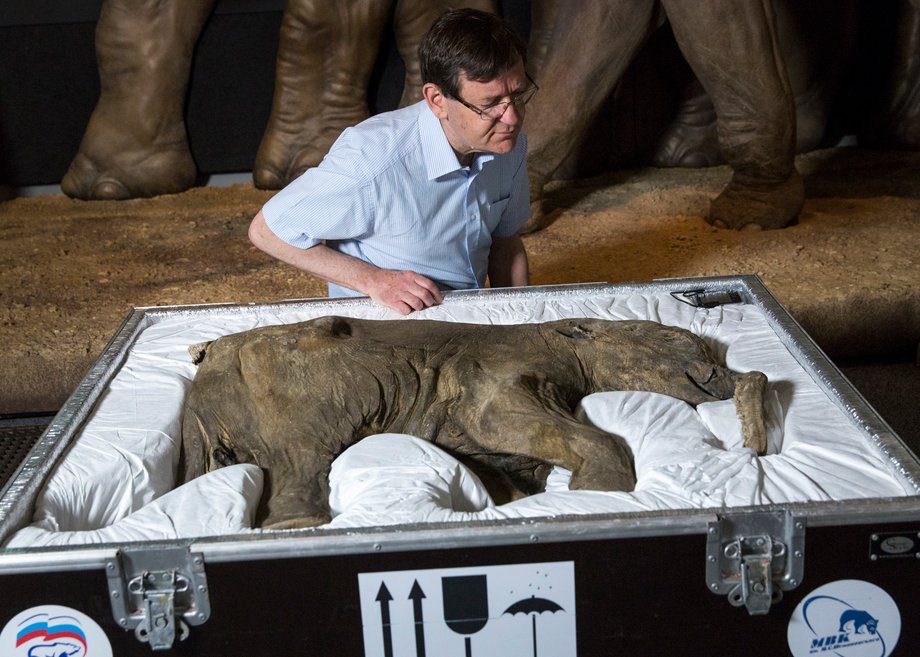
The mummified remains of mammoths were used to recreate their DNA
|
Rob Stothard/Stringer/Getty Images
The situation is similar with other flagship projects. In the case of the woolly mammoth, the company is working on editing the genome of the Asian elephant – it is planned to introduce about 85 key genes responsible for, among others, for hair, a layer of fat and features adapted to cold. So far, only the “hairy mouse” has been shown as proof-of-concept – mice with single mammoth genes responsible for their “hairiness”.
The Tasmanian tiger is still undergoing genome reconstruction and work on an artificial uterus for marsupials. The results are real and scientifically valuable – Colossal is indeed advancing CRISPR technologies in vertebrates, artificial wombs and incubation systems – but they are far from the spectacular “return of extinct species” that the company regularly portrays in the media.