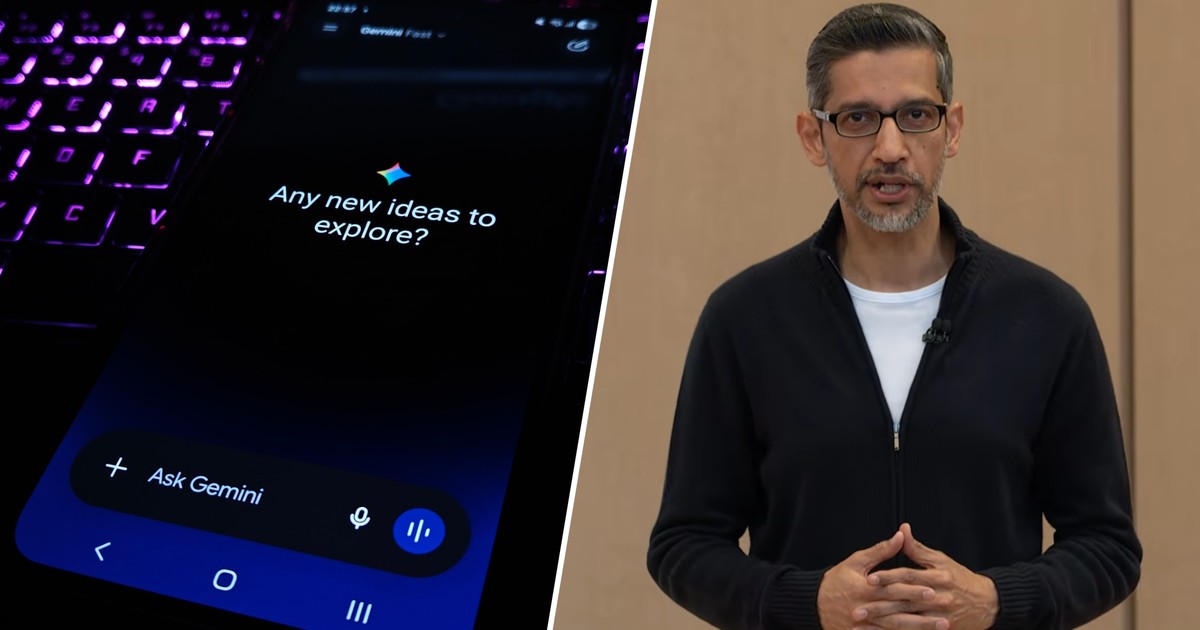
For several years now, the main theme at the most important conference regarding the plans of the Mountain View giant has been, for obvious reasons, artificial intelligence. AI, in new forms, has been the hottest topic in Silicon Valley since 2022, and the impact of this technology on the everyday functioning of society and the economy is enormous. And it will continue to be huge, because although the anti-AI movement and a kind of “counter-revolution”, especially among people most affected by these changes, are gaining strength, big tech seems exceptionally determined to achieve its goal. Everyone is supposed to use AI, whether they like it or not.
This is undoubtedly Google's motto during its last presentation. Those interested can watch it in its entirety at the very bottom of the material, but if you are only interested in the most important or interesting announcements – a short summary can be found below.
If we were to sum them up in one sentence, the most appropriate phrase would be “AI is supposed to do everything for us”. Whether this is really a good thing – you have to judge for yourself.
Google Omni, i.e. don't edit video
Visually, this is the most spectacular novelty from the conference. Google Omni is essentially a video editing tool and the next step in the development of multimodal models, i.e. those that will allow you to work with text and audiovisual materials at the same time. In practice, this is a direct response of the giant from Mountain View to competitive solutions in the field of generative AIfocused on maximizing the simplification of interaction with moving images.
By means of With simple prompts we can not only create new videos, but also edit existing ones — add new elements to it, change the scenery or generate special effects. Although the tool, like Google Genie revealed a few months ago, still has some shortcomings and limitations, its technical level is already very impressive. You can see a demonstration of this tool's capabilities in the clip above. It is now available to all Gemini users – the more expensive the Google AI package, the more videos we can generate.
Gemini 3.5, or don't wait for answers
For language models focused on written content, the most important change is, of course, access new family of models – Gemini 3.5. These are available in three main variants – Flash-Lite (giving the fastest answers), Flash (fast but more accurate answers) and Pro (advanced, in-depth answers, also in the field of coding). The latter is not yet publicly available to everyone (the latest version is still 3.1), but Flash variants have already become the default ones in both the search engine and the Gemini application.
The Gemini 3.5 models differ from their predecessor mainly in better understanding of the context, faster response time and more efficient processing of large-volume files. As announced by Google, the new architecture also has a lot to offer better at analyzing complex prompts and picking out nuances in multi-threaded discussions. Additionally, the algorithms responsible for simultaneous work on text, documents and source code have been improved, thanks to which the system loses the thread less often and hallucinates less oftenwhich, considering mass data processing, has so far been one of the biggest problems of the Google ecosystem. Although it has not been completely eliminated, there will be fewer hallucinations this time.
Gemini application, or don't stay the same
Compared to other announced and implemented changes, this one may not be the most important, but for the vast majority of users it is the most noticeable. Both the web version and the Gemini application itself have undergone visual improvements, mainly adding new, more effective animations and colors when using AI.
On devices that support haptics, pressing individual buttons now also gives a more “tactile” experience. The style used by Google in this case is called “Neural Expressive”.
Gemini Spark, or don't do anything yourself
Gemini Spark is a response to the growing popularity of solutions such as OpenClaw. In other words – an AI agent that is designed to operate 24 hours a day, 7 days a week. Based entirely on the Google cloud, according to its creators, it is to perform the tasks assigned to it regardless of whether we have a computer or smartphone turned on. And if it is given sufficiently broad permissions, it will be able to operate freely in the entire Google ecosystem and combine actions that require the activation of several services.
Examples of its applications include monitoring our mailbox for invoices, automatically downloading and cataloging them in the Drive cloud, and then entering the appropriate amounts into Google Sheets. The agent is also supposed to be able to, for example, constantly track changes in documents shared with the team and send notifications to Google Chat when modifications require our direct response.
New Google Search, or don't search
The AI agent is now also present in the Google search engine, which… de facto ceases to be a search engine and becomes a full-fledged chat with artificial intelligence. In response to our inquiries, we receive ready-made, condensed information summarized by artificial intelligence. In Google's vision, from now on, the user will no longer have to click on anything, and the AI will provide them with all the content they are interested in.
The basis for the displayed information is, of course, to be content from various websites covering a given topic, but instead of displaying it in the form of clickable links, Google will aggregate the data contained there. The window with the conversation with AI is to completely visually dominate the screen of displayed results, and this in practice means that the era of SEO understood as it has been for the last several decades is finally coming to an end.
Ask YouTube, or don't watch videos
Just as Google does not want users to have to read content online and instead rely only on AI summaries… a similar philosophy guided them when designing the next solution. Ask YouTube can be summarized as follows: instead of watching the video on YouTube, just read its AI summary. Gemini, having access to the content of all videos published on the platform, is able to generate summaries and instructions on, for example, repairing an item.
Traditionally, to obtain this knowledge, a user had to watch a video recorded by someone else, and advertising profits were shared between the creator and Google. In the new model watching movies is kept to a minimumwhich raises justified concerns among some people. In a situation where Google generates a text summary or “cuts” the video (omitting the rest of the material) only to the relevant fragment, the proportions regarding advertising profits may be significantly disturbed. The functionality has been gradually being implemented for YouTube Premium users for some time, but it will be available to everyone after the Google I/O conference. Additionally, it also supports more complex queries than before and is better able to “extract” useful information for the user.
You can watch below the entire 2-hour conferencewhich also featured other news.
Short version prepared by Google lasts 15 minutes and can be viewed below: