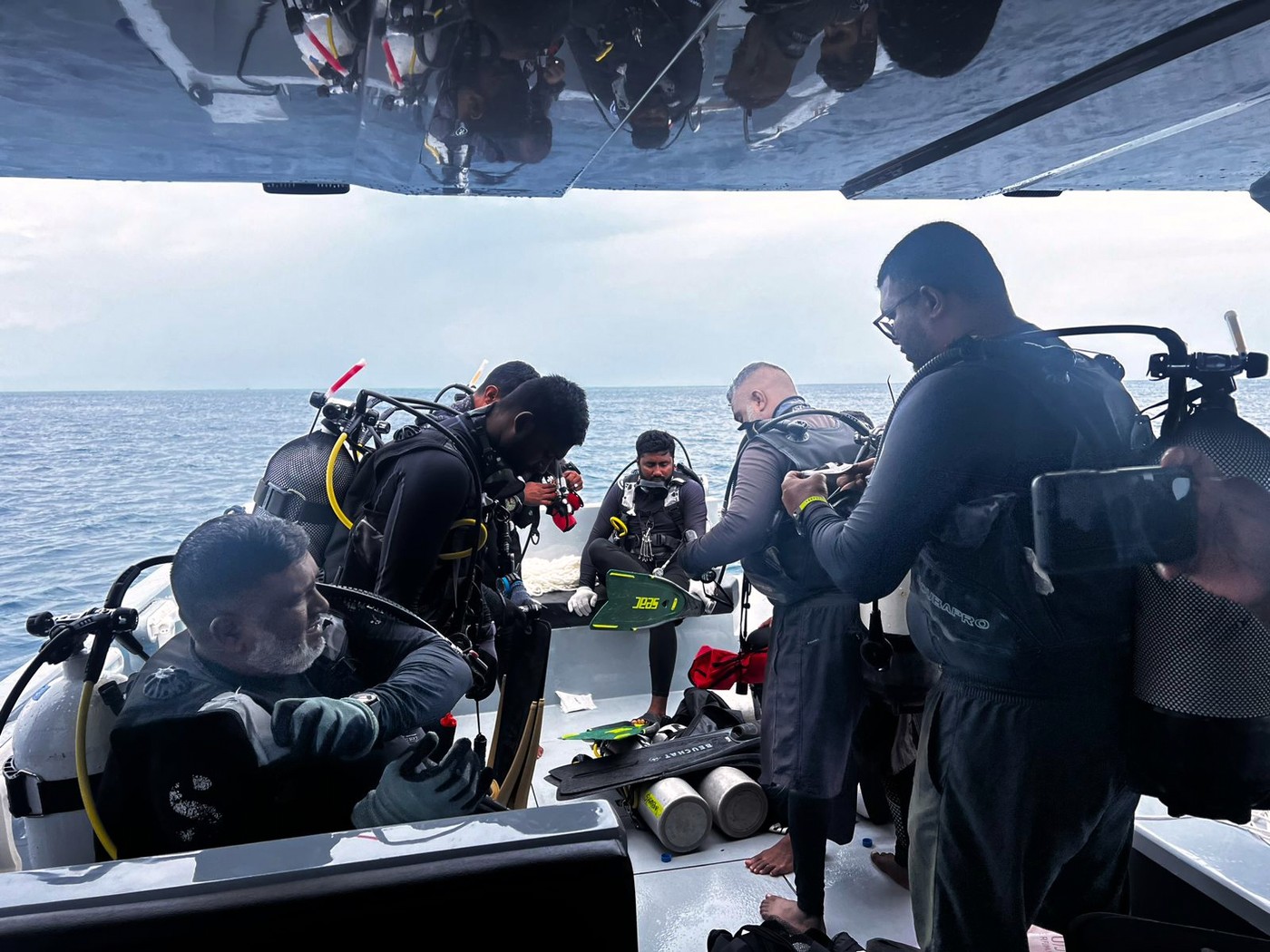
The tragedy that unfolded in the Indian Ocean, when a seemingly mundane recreational underwater dive turned into a deadly trap, has caused shock.
The victims were members of a scientific research team, but their entry into the specific underwater cave was made without receiving official permission. The incident highlights the extreme dangers lurking at great depths, combined with adverse weather conditions and a complex underwater cave system.
Although no one knows with absolute certainty what exactly happened inside the caves – given that there were no survivors – the discovery of four bodies, combined with the geological configuration of the cave, has led experts to formulate specific theories.
At a depth greater than that allowed
The team entered a highly complex underwater cave in Vaavu Atoll on Thursday morning. The dive took place at a depth of about 50 meters, a point well above the officially permitted limit of 30 meters for recreational diving.
The dangerous “anatomy” of the cave
There is a cave system there that stretches for a total length of about 60 meters and is formed inside a coral reef structure.
The cave system is composed of three large chambers, connected to each other by very narrow passages, cornices, tunnels and special places for swimming.
The environment becomes even more dangerous due to the strong currents, the presence of mud, the narrow spaces, as well as the extremely low visibility, which quickly deteriorates in bad weather.
The divers raised a distress signal around 1:45 p.m. and were later officially declared missing after failing to surface.
Oxygen toxicity – Strong currents
As for the causes, experienced diving instructor Maurizio Urras, in an interview with the Independent publication, said that “oxygen toxicity” inside the cave could have played a decisive role in the tragic incident.
“This is a phenomenon that can occur when one dives to very great depths,” he told the Italian news agency Agi, adding: “If the oxygen mixture is not adequate, then it can become toxic to the human body at certain depths. Moreover, there in the Indian Ocean there are strong currents that can sweep divers from one side to another. This is a real danger.”
Diving in adverse weather conditions
Weather conditions in the area were particularly unfavorable that day, to such an extent that a yellow warning was issued for passenger ships and fishing vessels.
Bad weather and sea currents can easily disorient divers as they stir up the mud on the sea floor, reducing visibility to almost zero and making it extremely difficult to navigate or find your way out.
Maurizio Urras emphasized the importance of external factors, stating: “We always have to keep in mind that the Indian Ocean is not the Mediterranean, which is a relatively calm sea.”
Hyperoxia? What does it do to the body?
In a statement to Italian publication Adnkronos on Thursday, pulmonologist Claudio Micheletto said it was highly likely that “something went wrong with the cylinders” during the dive.
Micheletto, director of the pulmonary department at the University Hospital of Verona, explained that oxygen toxicity (also known in medicine as hyperoxia) can be one of the deadliest complications during deep diving. “Death from oxygen toxicity, or hyperoxia, is one of the most dramatic deaths that can occur during a dive – a horrible end,” he said.
During diving, divers breathe compressed air, which is composed of 21% oxygen and 79% nitrogen. However, some divers use a specialized mixture of gases, known as nitrox or nitrox-enriched air, which contains a higher percentage of oxygen and less nitrogen compared to regular compressed air.
“When a very high concentration of oxygen is inhaled, the gas becomes toxic to the body,” explained Claudio Micheletto.
“During the dive, dizziness, pain, altered state of consciousness and disorientation occur, making surfacing impossible.”
The panic factor
At the same time, Alfonso Bolognini, president of the Italian Society of Underwater and Hyperbaric Medicine, pointed out that panic, among other factors, could also have contributed to the tragic incident.
“Inside a cave and at a depth of 50 meters, the only thing you don't need is a problem or a panic attack from a single diver,” explained Alfonso Bolognini.
“The turbulence that will be caused will stir the seabed, darken the water and destroy visibility”, which in turn can lead to “fatal errors”.