Working with artificial intelligence. Where does the employer's recommendation end?


— The debate about artificial intelligence in the workplace often begins with the false assumption that AI is something completely new. Meanwhile, employees have been using such tools for years, although they often do not even notice it. Anti-spam filters in e-mail, translators, word processors and CRM systems are also based on AI mechanisms – emphasizes Paula Miszczuk, attorney and corporate law specialist at J.Dauman Legal.
— A complete rejection of AI as a technology category would be difficult to defend today. I don't see any room for a “general conscience clause” towards artificial intelligence, because it would lead to organizational paralysis of companies, he adds.
The expert points out, however, that although the employer has the right to require the use of specific tools, the Labor Code provides employees with specific protection tools.
The duty of obedience and an official order
The starting point for every employee employed under an employment contract is Art. 100 of the Labor Code. It imposes on the employee the obligation to perform work conscientiously and diligently and to follow the orders of his superiors.
— So, if the employer has trained the team, implemented the tool from a reliable source and regulated the rules of its use in the regulations, Refusal to perform a task using AI may be treated as a breach of employee duties – emphasizes Paula Miszczuk.
Employee responsibilities
|
Created using AI/ChatGPT
In such situations, the argument of “unethical AI” when refusing to obey a command may not be enough to avoid consequences. As the expert warns, persistent refusal may lead to termination of the contract, and in extreme cases – when the employee's action brings damage to the company – even to disciplinary dismissal.
When does an employee have the right to refuse?
However, there are three clear situations in which an employee can, and even should, set a boundary. The right to refuse applies when an official order is:
Illegal. Paula Miszczuk gives a very specific example – an employer orders a customer database containing personal data, PESEL numbers or business secret information to be pasted into a public AI model. In such a case, the employee has the right to refuse to carry out the order because it would violate the provisions of the GDPR and other regulations regarding the protection of personal data and business secrets.
Incompatible with the employment contract: If the employer orders the performance of a task that goes beyond the type of work specified in the contract (e.g. he orders a programmer to perform typical commercial activities using an AI tool) – the order may be invoked as being inconsistent with the contract.
Infringement of third party copyrights. In creative professions – graphic designers, journalists and filmmakers – the use of generative AI raises questions not only about legality, but also about ethics. As the lawyer points out, copyright issues surrounding AI are “exceptionally complicated today and work is still ongoing to regulate this aspect.”
Read also:The head of Revolut demands that HR people be assessed. This is his way of hiring people
The licenses of tool providers and how the generated content is used are crucial. Referring to the trend of “Studio Ghibli-style” graphics, the expert states: – In this particular case, in my opinion, such a system exploits copyrights and infringes the copyrights belonging to the film studio. If the employer recommends the implementation of a commercial project that violates these rights, the employee may refuse to perform the task.
In such cases, the employer should not take any consequences against the employee – however, it is worth securing evidence, preferably in the form of e-mail, in case of a possible dispute.
“Conscience clause” and health aspects
Health is a separate issue. Could an employee refuse to use AI, citing scientific research and “harm to health”? The expert admits that although a general refusal clause due to reduced cognitive abilities resulting from the use of tools is not possible under the current legal status, individual health cases (e.g. depression caused by constant work monitoring) may be a valid basis for refusal. However, each such case would have to be considered individually by the labor court.
Read also: There has been nothing like this in terms of unemployment for 11 months. The data turned out to be only apparently good
Liability for the errors of the “hallucinating” machine
A significant problem related to the use of AI at work is the issue of liability for errors generated by language models, the so-called hallucinations. Paula Miszczuk explains that in accordance with Art. 120 of the Labor Code, if the employee uses the tool in accordance with its intended purpose and after appropriate training, the employer is liable for the consequences of errors in such a tool.
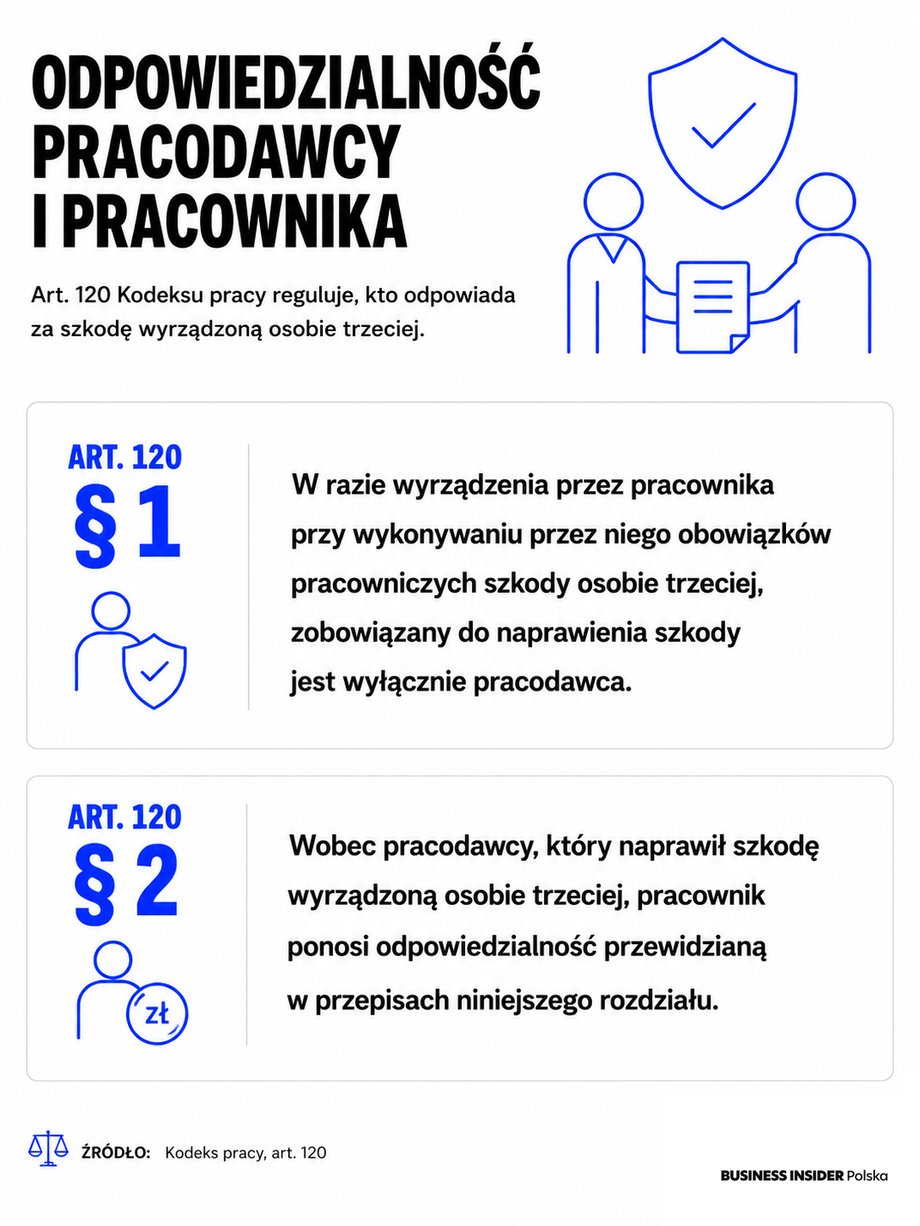
Responsibility of the employer and employee
|
Created using AI/ChatGPT
However, the situation is different when an employee uses AI contrary to applicable procedures or ignores the regulations for using the system. – In such a case, the employer may pursue a recourse claim against the employee – says the expert.
An additional challenge is errors resulting from faulty, incomplete or biased data on which AI models were trained. The employer has the right to expect full transparency from the tool provider – both as to data sources and the principles of system operation. Without such knowledge, reliable verification of generated content becomes significantly more difficult. Therefore, it is the employer's responsibility to ensure that the model training process can be traced, also in order to be able to hold the supplier of a faulty solution liable if necessary.
This is particularly important in professions burdened with high responsibility, such as a doctor or an architect. The person signing the diagnosis, opinion or project is ultimately responsible for any errors.
Read also: AI can help patients, but it risks new divisions. Experts comment
What's more, although many professionals are obliged to have one Professional liability insurance, it may not work in this situation — the insurance company may indicate failure to exercise due diligence. Therefore, a critical approach to the results of AI work should not be seen as an aversion to technology, but as part of the obligation to perform work carefully and conscientiously.
Liability is even different in the case of people cooperating on a B2B basis. In such relationships, the burden of responsibility often rests directly on the service provider, who signs off on the final result of the work.
Will there be a “right to refuse to use AI” in Poland?
Today, Paula Miszczuk's answer is clear:
— Polish and EU law focuses primarily on limiting the most risky applications of AI (biometric monitoring, constant analysis of employee emotions, discriminatory recruitment systems) and these systems are either already banned or clearly rationed. The AI Act and the draft Polish act on artificial intelligence systems have identified high-risk areas, especially where human dignity, discrimination or patient rights are at stake.
— Against this background, a general clause allowing an employee to say: “I refuse because I don't want to use AI”, without indicating the specific regulation that would be violated by using such a tool, seems unlikely – concludes the expert.