The paradox of retirement at 50 in MAI: 61% of former employees have pensions of more than 5,000 lei, but they demand the right to the combined pension-salary

Six out of ten retirees (61%) of the Ministry of the Interior (MAI) receive pensions of over 5,000 lei. Last year's data shows they leave the system at an average age of 50 years and three months. Against this background, MAI employees reacted harshly to the Government's plans to increase the retirement threshold in the system, at the same time denouncing the ban on working for the state after retirement.
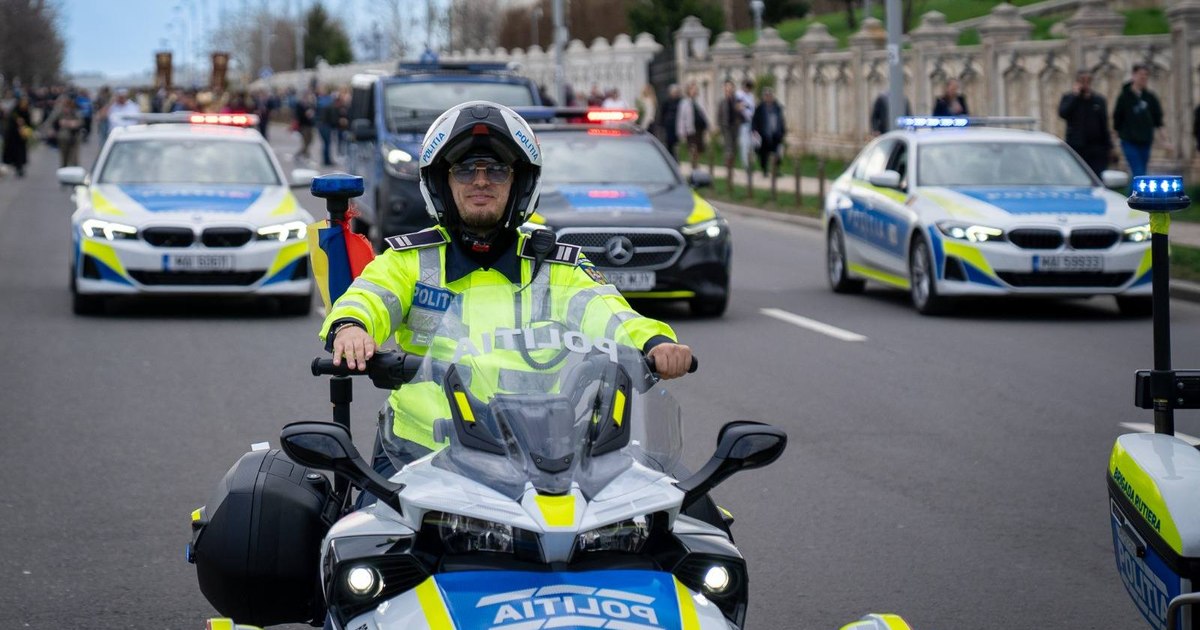
The average retirement age of police officers in 2025 was 50 years and three months. PHOTO: MAY
In March, the Bolojan government launched a draft law aimed at the pension system of the MAi, MApN and other national security structures. The central idea of the initiative was to increase the retirement age, because currently many employees of these structures retire between the ages of 47-53, and to change the way the pension is calculated.
“I believe that for all systems in which retirement is allowed at an age that means 50-51-52 years, when a man is in full physical and intellectual faculties, where the pension is as much as the last salary, things must be corrected (…)”declared, then, Ilie Bolojan.
Police unions protested against the circulated changes, pointing out that the retirement age has already been increased by the 2023 law, gradually rising to 65 until 2035.
The ban on combining the service pension with the state salary displeases the policemen
The new law on military pensions has not been adopted, but, the other day, the Government approved the ban on combining the service pension with the state salary, which will affect many former employees of the Ministry of Internal Affairs.
The Federation of National Unions of Policemen and Contractual Personnel from Romania sent, the other day, a statement in which it expresses its disagreement with the legislative proposals that limit the cumulation of the military pension with the salary, in particular the penalty of reducing the pension by 85% for those who continue to work for the state. Trade unionists consider the measure unfair and unconstitutional.
First, they say, it would violate the fundamental right to work guaranteed by the Constitution and European law, turning the freedom to work into a financially penalized option. Secondly, the military pension is an earned right, not a social aid, and its reduction contravenes the jurisprudence of the Constitutional Court.
The project is also criticized for discrimination, as it only affects public sector employees, not those in the private sector, and for the lack of proportionality of the sanction. It would also breach the principle of non-retroactivity, affecting people who have planned their incomes under the current legislation.
The unions also report discrimination between civilian and military retirees, the former being able to freely combine their pension with their salary, unlike reservists.
“The Romanian state acts as an employer in bad faith: it collects contributions from policemen and reservist soldiers, active and useful in the field of work, but refuses to recalculate their rights, and now, through this new project, it wants to confiscate their already acquired pension”, says the Federation of National Unions of Policemen and Contractual Personnel from Romania.
What the project provides
Prime Minister Ilie Bolojan announced that he will send the project to the Parliament and asks the elected to adopt it in an emergency procedure.
The special non-contributory pension will be reduced by 85% for pensioners who want to remain in the state, announced on Thursday, the interim Minister of Labour, Family, Youth and Social Solidarity, Dragoş Pîslaru.
The reform of military pensions divides Romania. Economist: “I'm not for 30 years of rest.” Cops reply
He specified that the draft law on the accumulation of pensions with salaries only concerns the public sector and only those with special pensions. In the private sector, the accumulation of the pension with the salary is still allowed for any kind of retirement category.
“It is, first of all, a problem of equity because it is no longer possible to collect a full special pension and a full salary at the same time, also from the state”he explained.
Those with special pensions and those with military service pensions if they wish to remain in the activity, will be able to do so, under the conditions that the non-contributory pension will be reduced by 85% during the period of activity.
The purpose of the decision is also to free the posts occupied by retirees to make room for newcomers, given that the public administration in Romania is “ossified”.
What pensions do police officers actually have? At what age do I retire?
“Adevărul” asked the MAI for information about the average retirement age of employees in the system, but also about the service pension received.
Thus, in 2024, the average age at which MAI employees retired was 50 years, and in 2025 it increased slightly to 50 years and 3 months, indicating a slow evolution in the direction of extending professional activity.
Regarding the level of pensions, the distribution of the approximately 90,000 beneficiaries shows that most people fall into medium income ranges. Thus, in October 2025, approximately 35,423 former police officers received pensions between 5,001 and 7,000 lei, representing the largest category.
Another 29,848 people received amounts between 3,001 and 5,000 lei.
A number of 11,932 beneficiaries were between 7,001 and 9,000 lei.
At the lower end, small pensions are relatively few: 407 people received less than 700 lei, and 925 beneficiaries between 701 and 1,500 lei.
At the top: 5,594 beneficiaries received pensions between 10,001 and 20,000 lei, and 2,905 people received between 9,001 and 10,000 lei.
Work after 50 years, acceptable only if the pension is combined with the state salary
The data confirm that, although there are high pensions in the system, most of the beneficiaries are in the average area, between 3,000 and 7,000 lei.
On the other hand, of the approximately 90,000 MAI pensioners, approximately 20,000 obtain salaries higher than 7,000 lei, and approximately 55,000 – i.e. 61% – obtain more than the median net salary estimated in Romania (4,500-5,000 lei). In February 2026, the average net salary in Romania was 5,557 lei, while the average gross salary reached 9,272 lei.
Retirement decision: How to challenge it and what steps to take for recalculation
Thus, the police unions claim that it is normal for a policeman to retire at 50 and the age increase should not be accelerated as the Bolojan Government demands, but when the government forbids them to combine their service pension with a state salary, they claim that their constitutional right to work is denied. In other words, work after 50 is acceptable only if the service pension is combined with a state salary.