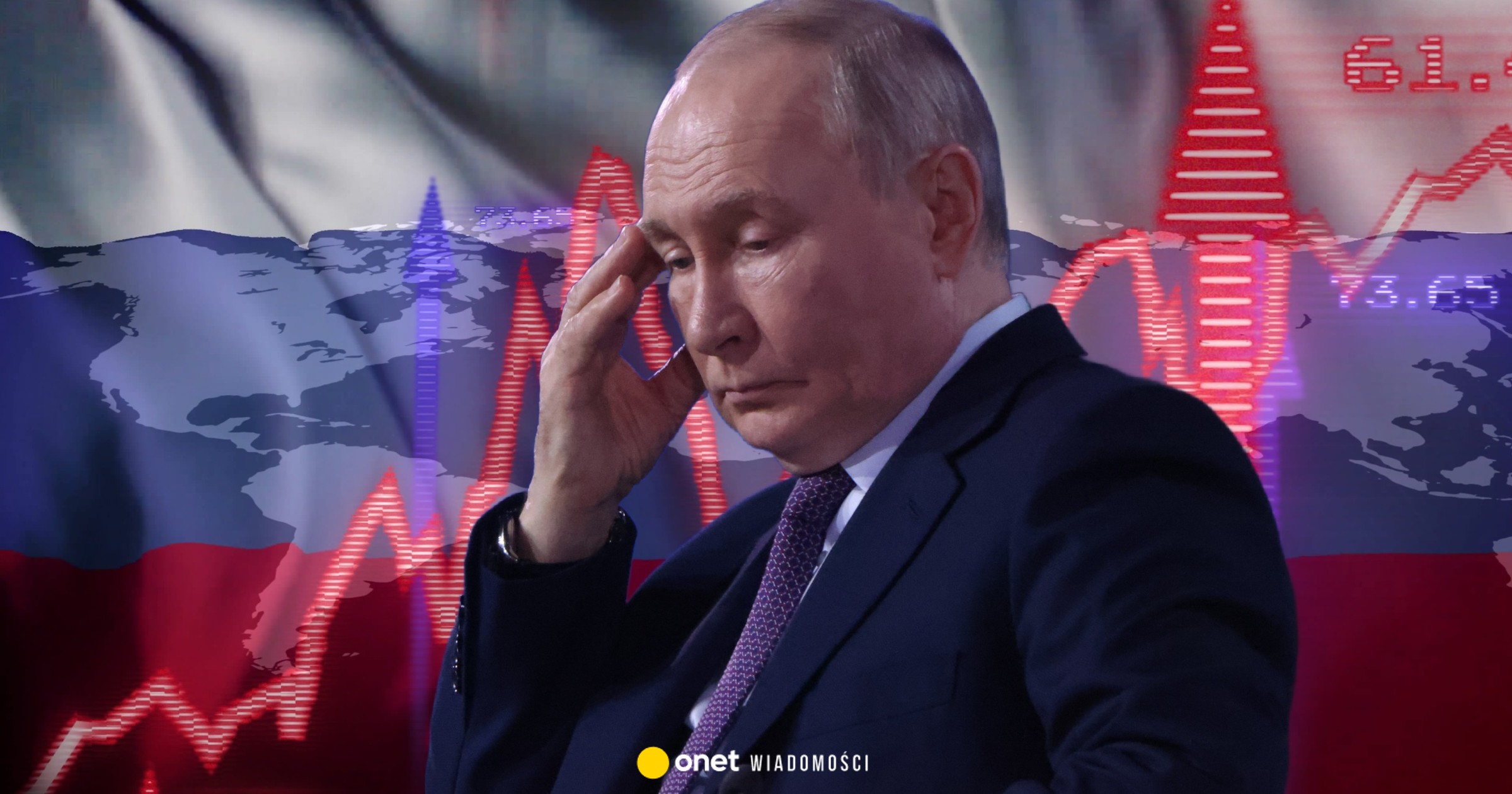
The financial situation of Russian enterprises is rapidly deteriorating. In January and February, they generated a total of 3 trillion 400 billion rubles (approx. PLN 153 billion), Rosstat reported. It is the difference between the results of profitable companies and the losses of unprofitable companies. That's as much as 33.1 percent. less than in the first two months of last year.
At this rate, company profits have not declined since 2022 – in the first year of the war, they decreased by 34.5%, according to Rosstat data.
The current decline is among the deepest in history.
Freedom Finance Global analyst Vladimir Chernov defines the so-called cumulative financial result as the final result of the entire economy – it reflects not only the dynamics of enterprises' income, but also the scale of problems in individual sectors.
Judging by the deterioration in results, difficulties are increasing in most industries not related to war or municipal economy:
profits in the processing industry fell by almost half (-45%),
in the mining sector by almost one third (-32%),
and in agriculture by 38.5 percent.
The share of profitable companies decreased in January and February to 63.1%, compared to 68.1%. a year earlier.
Companies in a bind
Businesses are under pressure from the economic slowdown, high interest rates and tax increases. In February, business activity in Russia stopped growing for the first time since 2022.
The business climate index, which the central bank calculates based on a survey of over 10,000 people. companies, amounted to 0.2 points (where zero separates growth from decline). At the beginning of the year, GDP decreased by 1.8% on an annual basis. in January and by 1.1 percent in February.
Russian women selling homemade preserves on a street in a town near Moscow, Russia, December 1, 2025 (illustrative photo)EPA/MAXIM SHIPENKOV / PAP
Many industries and companies are struggling with problems – weakening demand, rising tax burdens, rising costs, expensive loans and a shortage of working capital. Additionally, many service enterprises in large cities encountered problems related to Internet regulation for the first time this year, says Olga Bielieńkaja, head of the macroeconomic analysis department at Finam.
Oil and the ruble exchange rate worsen the picture
The situation was also worsened by low oil prices – at the beginning of the year they were at a very low level, while the ruble exchange rate was high.
Conditions on external markets were unfavorable, and – as analysts explain – the shipment of goods from the processing industry probably took place in November and December. (At the end of last year, profits were unnaturally high). Their calculations show that the trend of declining corporate profits in relation to GDP began to take shape in mid-2024, when the economy began to slow down.
The article continues below the video
The Institute of Economic Forecasts of the Russian Academy of Sciences indicated the decline in profits as one of the key threats to the economy this year. This is the basic source of financing for investments that have already entered a phase of decline: last year they amounted to minus 2.3%, and this year the Ministry of Economic Development expects further deterioration.
Companies affected by a decline in profits are increasingly unable to settle their liabilities to other entities. Overdue receivables increased by 3.3% in February and by 22.1% annually, reaching the level of 8 trillion rubles (approx. PLN 380 billion), i.e. almost 4%. GDP – according to Rosstat data. As of March 1, 6.7 percent was past due. all receivables.
Light at the end of the tunnel
Czernow admits that the decline in profits may slow down due to the increase in raw material prices.
Due to the conflict in Iran, the prices of Russian oil approached $100. per barrel (approx. PLN 400), metals and fertilizers are also becoming more expensive.
If this situation continues on the markets, profits in export sectors will begin to recover, and throughout the year the overall result may be even slightly better than last year.
I’m Ashley Davis as an editor, I’m committed to upholding the highest standards of integrity and accuracy in every piece we publish. My work is driven by curiosity, a passion for truth, and a belief that journalism plays a crucial role in shaping public discourse. I strive to tell stories that not only inform but also inspire action and conversation.