A new low-cost missile comes from the US and promises a range as great as the dreaded Tomahawk

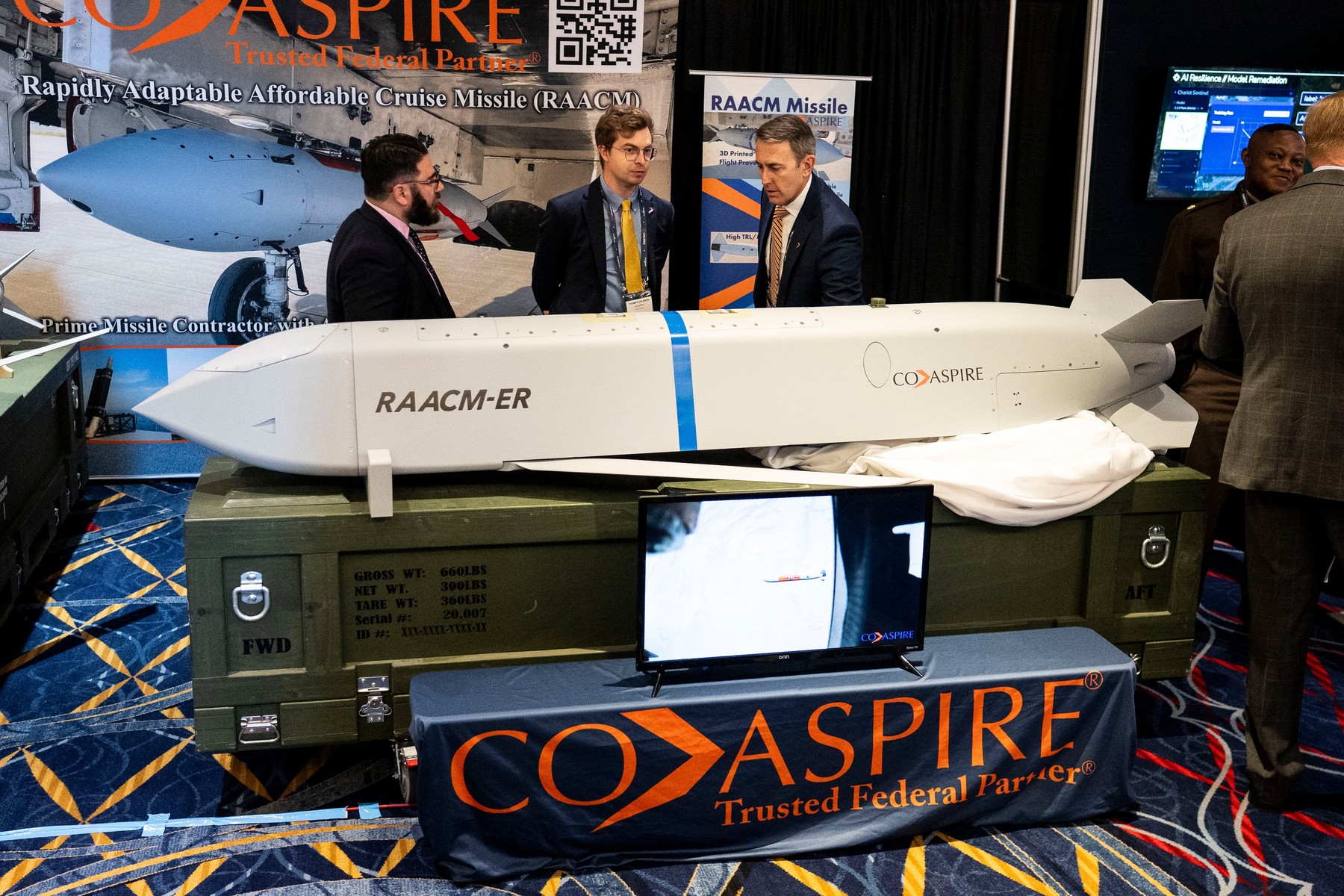
A new low-cost cruise missile that promises a range similar to the much better-known US Tomahawk missiles has been unveiled in the United States. The RAACM-ER promises to hit targets over 1,800 kilometers away, but at a much reduced cost.
The RAACM-ER is actually a longer-range version of the Rapidly Adaptable and Accessible Cruise Missile (RAACM), writes The War Zone. The new missile was presented by CoAspire at the Sea-Air-Space 2026 exhibition held in Washington DC
The featured product comes just days after the US Air Force launched market research for a new family of affordable mass missiles — Family of Affordable Mass Missiles — Beyond Adversary's Reach (FAMM-BAR). The desire of the US Air Force is to find new low-cost, long-range attack weapons specifically aimed at surface targets.
The original RAACM is a low-cost, modular cruise missile that uses 3D printing to reduce costs and allow for rapid ramp-up of production, says CoAspire founder and CEO Doug Denneny.
“When we designed the original RAACM, we knew it would be the size of a GBU-38 JDAM,” Denneny explained, referring to the 226 kg version of the Joint Direct Attack Munition (JDAM).
“When you go this size, the range isn't as great as a larger version. So we really wanted to put everything we've learned into practice and now we have an extended-range version,” says Denneny.
An anti-ship Tomahawk costs $3.6 million
According to the manufacturer, the new RAACM-ER has a range of more than 1,000 nautical miles, i.e. more than 1,800 km.
The War Zone writes that when it comes to anti-ship missiles, the only weapon in the US inventory that comes close to this range is the BGM-109 Block V Maritime Strike Tomahawk (MST), a cruise missile that can be launched from destroyers, submarines and the US Army's Typhon system. The problem is that a single MST missile costs $3.64 million, according to the Navy.
The RAACM-ER would have a similar combat range, but at a much reduced cost, the manufacturer says without giving exact figures. And, similar to the MST, the new missile can be launched from all platforms, including ground-based launchers if an additional booster is added.
Why does the RAACM-ER look just like another weapon already in the US inventory
Despite the name, the RAACM-ER is actually a new model of cruise missile, not a modification of the original RAACM.
“Our engineers came to us and said, 'Hey, if we're still going to make a bigger one, should we give it the same look?'
In design, the RAACM-ER is somewhat reminiscent of the AGM-158 Joint Air-To-Surface Standoff Missile (JASSM) already in operation by the US and other allied nations, in terms of appearance and capabilities, but the manufacturer says it avoids making a direct comparison, writes The War Zone.
“Physics is physics. When people look at the shapes, they look similar, but just like an Airbus is similar to a Boeing, what really matters is what's different inside, and so we differ in many ways,” says the CoAspire founder.
“The most important thing is mass production at affordable prices”
In terms of on-board sensors, the RAACM-ER is currently equipped with a GPS navigation system suitable for air, ground and surface launch.
“Both RAACM and RAACM-ER also have a long-wave infrared sensor on the front, so we have the ability to search and find targets,” explained Denneny,
The RAACM-ER, like the RAACM before it, is a missile optimized to be cheap, and this is its strong point. The manufacturer says that “the most important thing is mass production at affordable prices. That means keeping costs low so that our country and our allies can acquire these systems on a large scale.”
“The second thing is to use as many commercial parts available on the market so that we are not tied to one vendor for anything. The last thing is to have something that can survive enemy countermeasures and also hit the target whether it is stationary or moving. Those are the main requirements,” explained the CoAspire co-founder.
The company confirmed that it plans to test the RAACM-ER missile “very soon,” but did not give specific details.