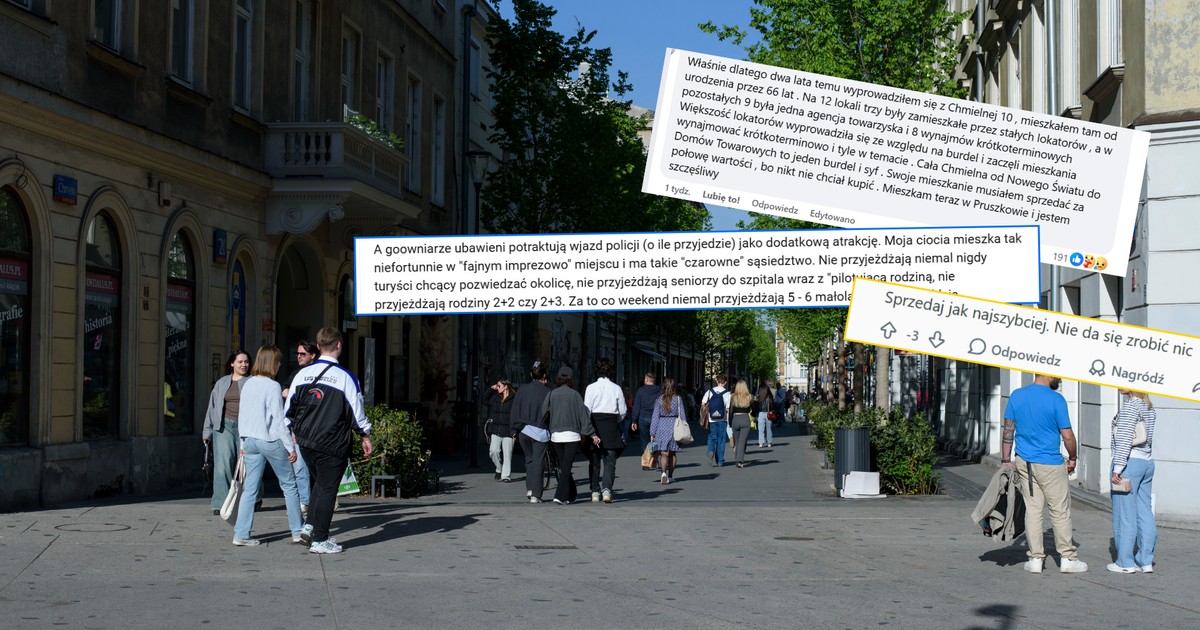
Just a few years ago, short-term rental was a way for many apartment owners to make quick and relatively easy profit. Today it is becoming more and more common a source of conflicts that spread throughout entire housing estates, tenement houses and resorts.
The scale of the phenomenon is growing, and with it the frustration of residents. Their stories show that the problem does not end with noise – it is about safety, standard of living and the feeling that one's own apartment is no longer “home”.
See also: Do old investment patterns still make sense in the era of crisis? “You have to hold on to the chair tightly”
Noise, rotation and lack of control. “Like we were staying in a hotel”
The most common scenario is similar – rotating guests changing every few days, suitcases being dragged down the staircases and parties lasting until the morning. In large cities such as Warsaw, Kraków or Gdańsk, the problem is especially concentrated in centers and new investment apartment buildings.
— We're here every weekend a nightclub instead of an apartment building. People change every few days and no one feels responsible for the silence at night, says Mrs. Anna, a resident of Warsaw, who asked not to be named.
– At two in the morning, screaming in the staircase, slamming doors and suitcases – this is the norm – adds Mr. Tomasz.
Over time, the problem ceases to be just an acoustic nuisance. Residents point to loss of sense of security. — I don't know who comes into my building every day. It is no longer a neighborhood, but a rotating hotel with no control, says Ms. Władysława.
In apartment buildings purchased wholesale for short-term rental, another phenomenon occurs – the disappearance of community. There are few permanent residents, and most establishments operate like mini-hotels.
— There are no neighbors you know anymore. I feel like I'm staying in an accommodation facility, not in my own home — we hear from the next interlocutor.
Read also: Sale of an apartment under the microscope of the tax office. New rules and more control
“The building is in terrible condition.” Story from Reddit
The scale of the problems is best seen in individual stories. One of them was described on the Reddit forum, in a thread about Krakow. The author of the entry reports on the situation in a building in Kazimierz, which was originally designed almost exclusively for short-term rentals.
“I am almost the only owner who lives permanently in this building (out of 72 apartments)” – writes the user.
It describes a number of problems: from dirt in staircases, through faulty installations, to sanitary hazards. “The entire floor is covered with dust, hair and dirt. The community pays over PLN 3,000 a month for cleaning, but the corridors are cleaned less than once a month,” we read.
They are even more disturbing security issues: “The underground parking lot has been used as a warehouse for flammable items. Things have been standing in dangerous places, e.g. a broken chair on the stairs for months.”
The author also points to insect problemswhich – in his opinion – may result from guest turnover and lack of hygiene in common areas. “I've found a lot of fleas and two bedbugs since January. I've never had problems like this before.”
The editorial team tried to contact the author of the entry, but by the time of publication we had not received a response.
See also: Why don't we control money in Poland? “The first barrier is cultural reluctance to this topic”
Destruction, parking lots and growing frustration of residents
The list of objections to short-term rentals is longer. Residents point to the devastation of common areas and organizational problems.
— The staircase is constantly dirty, someone leaves garbage or spills alcohol. Guests don't care about the space because it's not theirs – says one of our interlocutors. — Elevators and doors are damaged by the constant removal of tourists, he adds.
Another flashpoint is parking spaces. “Airbnb guests take up all the spaces and often park however they want,” we hear.
This is what happens frustration with apartment owners: — The owner makes money and we bear the costs and stress. It's unfair, emphasizes one of the residents.
Similar opinions dominate the Internet. Forums, discussion groups and social media pages are full of negative comments about the activities of platforms such as Airbnb or Booking.com. Users describe identical problems – noise, lack of control and a sense of chaos. Videos showing the destruction caused by users of such premises are increasingly being shared on Instagram or TikTok. What may seem surprising is that these recordings are sometimes published by the apartment owners themselves. There are a lot of comments under the videos that strike the tone: “you asked for it”.
See also: Short-term rental. The tax office is changing the rules, big changes are coming
The market is maturing. “This is the end of easy entry”
On the other hand, industry experts point out that the market is currently undergoing a phase of professionalization.
Ewa Rennack, general director of Lake Hill Mazury Radisson Individuals, notes that For years, short-term rentals operated outside the standards applicable to the hotel sector. Leveling up the rules changes the rules of the game.
In her opinion the market is shifting towards quality: — This is the moment of transition from the easy entry market to the professional market. In such an environment, entities that are prepared operationally and qualitatively win, he says.
Market data confirms this thesis. After a record year in 2025, when the number of tourists in Poland reached 58.9 million, the short-term rental sector generated 44.8 million overnight stays booked online.
In the first quarter of 2026, large cities show the greatest stability – Warsaw (53.3% occupancy) and Wrocław (52.5%). Resorts continue to struggle with seasonality.
As Kamil Gaszyński from Solarento emphasizes, today a good location is not enough. “The advantage is determined by management, technology and service quality,” he argues.
Experts also point to: changing customer expectations — the importance of the hotel standard and stay experience is growing.
Regulations are coming. What might change?
The growing scale of conflicts means that the topic has reached the legislative level. There are currently two key directions of change taking place in Poland.
The government project includes, among others: mandatory registration of apartments intended for short-term rental. Failure to enter the system will result in a fine of up to PLN 50,000. zloty. The regulation is intended to introduce greater market transparency, enable control of the number of such premises and limit the gray zone. In practice, this may mean the end of anonymous rentals and greater responsibility for owners towards their guests.
The Poland 2050 project goes a step further. It assumes, among others: the possibility of limiting short-term rentals by housing communities and introducing local limits. This solution could have a real impact on the situation in the most busy locations – e.g. city centers or resorts. Communities would gain tools to block activities that harm the comfort of residents.
Both directions of change can significantly transform the market. On the one hand, they will increase security and control, and on the other, they will raise the entry threshold for investors.
The market between profit and conflict
Short-term rental remains an attractive business, but its social costs are becoming more and more visible. Residents' stories show that the problem is not about individual incidents, but about the systemic tension between the residential and tourist functions.
The upcoming regulations may be an attempt to find a balance. The only question is whether it will happen quickly enough – before subsequent buildings turn into places that have less and less in common with home.