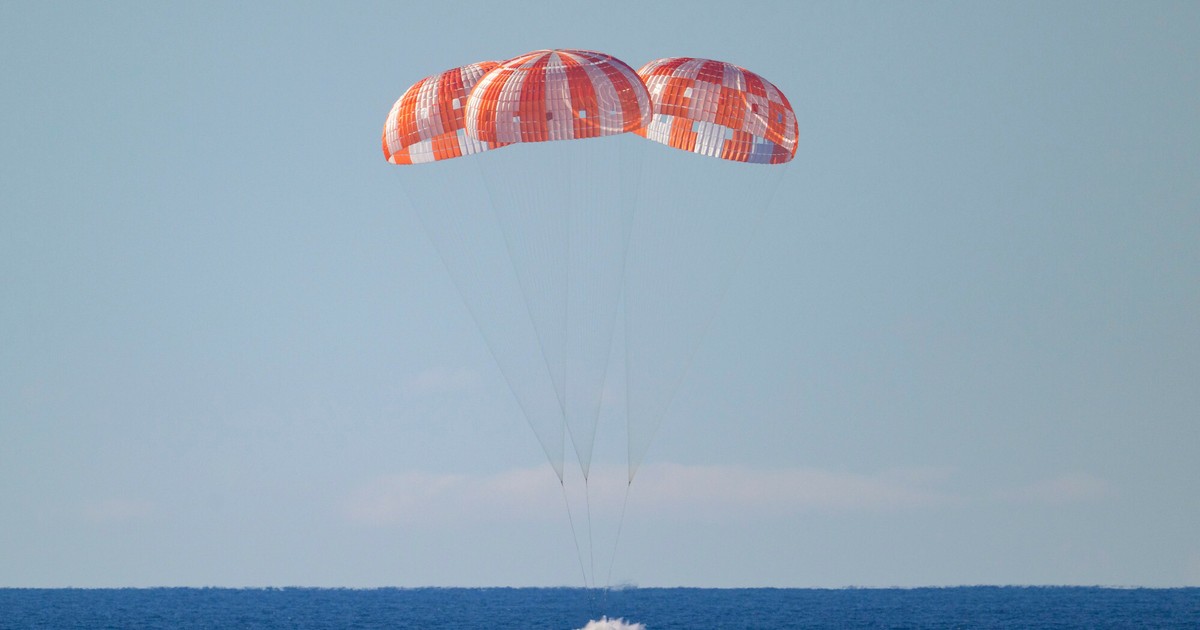
The Artemis II capsule with a four-person crew safely returned to Earth after almost 10 days in space, ending the first manned expedition to the Moon in over half a century. NASA's Orion spacecraft splashed down in the Pacific Ocean off the coast of southern California shortly after 1 p.m. on Friday. 17:07 local time.
Read also: The crew of Artemis II took photos with iPhones. A huge change since Apollo
The crew is feeling good
The landing was broadcast live by NASA. “Perfectly accurate splashdown of the Integrity capsule with four astronauts,” said agency commentator Rob Navias. Mission Commander Reid Wiseman radioed that the capsule was in a stable position and all crew were doing well.
It took NASA and US Navy rescue teams less than two hours to secure the capsule and extract the astronauts: Americans Reid Wiseman, Victor Glover and Christina Koch, and Canadian Jeremy Hansen. The crew was then transported by helicopter to the USNS ship John P. Murthawhere preliminary medical tests were carried out.
The return to Earth was the riskiest stage of the mission and a key test of the Orion capsule, built by Lockheed Martin. The craft entered the atmosphere at about 32 times the speed of sound, and the temperature at the heat shield reached about 2,760 degrees Celsius. During the entry, there was a planned break in radio communication that lasted several minutes.
Artemis II landing
|
ASSOCIATED PRESS/East News/East News
First test flight with crew
After re-establishing contact, the capsule deployed parachutes that slowed its descent to approximately 25 km per hour, allowing for a gentle landing. The successful reentry confirmed the effectiveness of the modified re-entry trajectory introduced after problems observed during the unmanned Artemis I mission in 2022.
The Artemis II mission was the first manned test flight of the Artemis program, which aims to return humans to the lunar surface by the end of this decade. In total, the astronauts covered over 1 million 100 thousand kilometers. km, circled the Earth twice and flew past the Moon at a distance of approximately 6,400 km from its surface.
The crew reached a maximum distance of 252,756 miles from Earth, breaking the record set in 1970 by the Apollo 13 mission. Glover, Koch and Hansen also made history as the first black astronaut, the first woman and the first non-U.S. citizen on a lunar mission.
Priority despite cuts
NASA emphasizes that the mission was a key step before the planned next stages of the program. The agency wants to return to the Moon before China, which announces its own manned mission around 2030, and in the longer term, use the Moon as a starting point for manned exploration of Mars.
Read also: The rocket has already left Earth, but who is paying for it? NASA space bill
Artemis II's success, however, came at a time of budgetary challenges. President Donald Trump's administration has proposed cutting NASA funding, including cuts to science programs and job cuts. Nevertheless, the agency emphasizes that the Artemis program remains a priority and is a broad international and commercial cooperation, with the participation of, among others, SpaceX, Blue Origin and space agencies from Europe, Canada and Japan.
NASA said it will soon announce the crew of the Artemis III mission. However, work on the lunar landers is facing delays, which may postpone the schedule of subsequent flights.