At the end of March this year Digital game distribution giant Steam has updated its currency conversion tools, introducing two new variants for publishers. The decision aroused the enthusiasm of users from Poland, who had been complaining for months about highly inflated rates in PLN, but it turns out that the new price conversion rules are only seemingly beneficial for our players. The default algorithm still increases game prices in Polish zlotys, and the users themselves do not intend to give up and are still fighting for a better pricing system.
Already since 2023, users from Poland have been drawing attention to the extremely unfavorable price conversion rate for games on the Steam platform, which resulted in the Polish Our Prices initiative and activities motivating developers to use rates that take into account current market conditions. On March 27, 2026, Valve, the platform operator, announced two additional variants of game price conversion to publishers, which did not necessarily mean good news for users.
Three variants of price conversion on Steam
Content creators on Steam have previously been able to convert prices in a specific country using the default exchange rate, which in the case of Poland has not been updated for several years. As part of the latest policy update, the platform offered developers as many as: three different value conversion models games to local markets, which theoretically was a step in the right direction, because the prices were more realistic and adjusted to market conditions. The price conversion variants proposed by Steam are
- Exchange rate conversion, which is based on a simple, direct currency conversion based on current market data.
- Conversion based on purchasing power, taking into account the real financial and earning potential of the inhabitants of a given territory.
- Multivariable conversion, a market default option that actively combines the exchange rate, local purchasing power, and projected costs of other comparable entertainment goods.
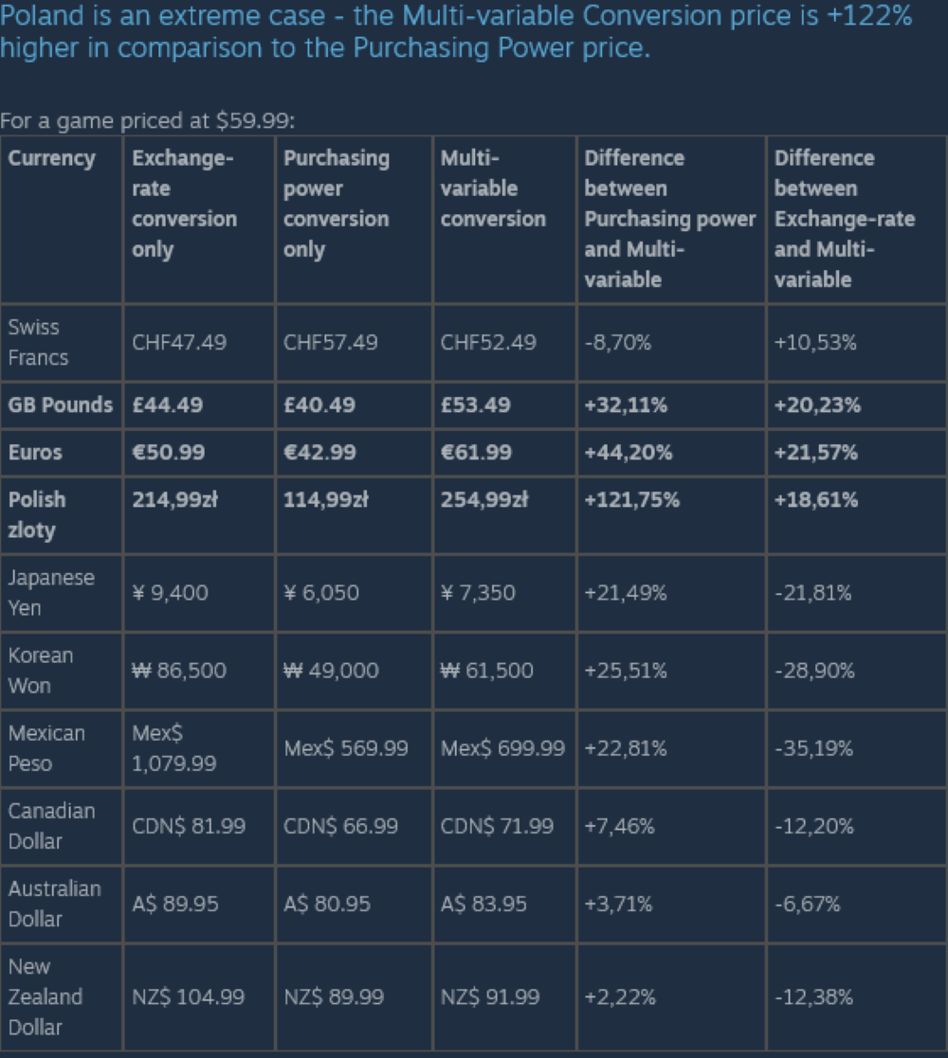
In the case of a game for USD 59.99, which would previously cost PLN 274.99 in Poland, the price taking into account only the exchange rate would be PLN 214.99, while the rate according to purchasing power would be PLN 114.99. The price according to multivariable conversion is the closest to the current valuation methods – it is PLN 254.99.
Game prices are lower, but is it really?
The creators of the Polish Our Prices initiative welcomed the changes presented on Steam, noting the lower prices in each variant:
Hell has frozen over! Steam has updated developer tools for setting regional prices.
Price conversion data has been updated in line with the current economic situation and two new price conversion methods have been added.
Steam now offers three different… pic.twitter.com/q7vfHFA3Nh
— Polish Our Prices (@PolishOurPrices) March 28, 2026
It turns out, however, that it is the last, theoretically most comprehensive model that causes the greatest and fully justified controversy among Polish players. An analysis conducted by one of the users proves that the default mechanism treats Poland unfairly: suggested the price of a game with a base price of $59.99 on Steam, according to multivariable conversion, is as much as PLN 254.99 and is over 120 percent higher than if the algorithm based its estimates solely on the actual purchasing power Polish citizens. Moreover, the value determined by the system is up to nearly 19 percent higher than a simple, direct conversion of the current exchange rate, which is also the case with euro and British pounds.
Entertainment goods – what are they?
Industry experts and Steam users themselves quickly began to analyze the mechanisms behind such drastic discrepancies. The platform officially explains that the multivariable algorithm takes into account, among others, local conditions costs of comparable entertainment goodshowever, does not explain what exactly this term means. Even if we accept the price lists of streaming platforms such as Netflix, Amazon Prime or Disney+, when we compare them with the costs of services in the USA or Western Europe, it turns out that Poles pay much less for entertainment services, e.g.
- Netflix – in the USA USD 15.49, in Poland USD 10.68, in Germany USD 14,
- Amazon Prime (annually) – in the USA USD 139, in Poland USD 18.53, in Germany USD 104,
- Disney+ (no ads) – in the USA USD 18.99, in Poland USD 9.40, in Germany USD 12.69,
The players half-jokingly, half-seriously suggest that someone at Steam responsible for entering data into the spreadsheet simply made a mistake by one order of magnitude and instead of adding a reasonable mark-up of 22 percent, he mistakenly entered a value of 122 percent. However, this does not change the fact that although the conversion may be based on the exchange rate or purchasing power itself, the default, recommended method for developers will be the one based on several factors. Polish players benefited only theoretically from the new rules, because comparison with other currencies leaves no doubt which variant of price conversion is beneficial for them and which for publishers.
Social pressure as a chance to change prices?
Information provided by the gaming community shows that prices on Steam have been reduced or correctly adjusted to Polish realities for up to 1,000 to 1,355 games, which is largely due to the Polish Our Prices campaign. Rational, reduced rates have been introduced in many indie games and such famous titles as Death Stranding 2, Europa Universalis V, Star Wars Outlaws, The Outer Worlds 2, Starfield and Doom: The Dark Ages. It is worth noting that in the case of games that have already had their premiere, the price change depends solely on the decision of a specific publisher or developer, which is why players are afraid that large studios will ignore lower conversion rates, relying on the new, default multivariable conversion, which is still unfavorable for Polish customers.
Experts and users indicate that there are ways to put pressure on developers and Steam itself regarding price conversions. The first is to publish substantive opinions on the platform's official forums, with a clear description of irregularities in valuations relative to Polish purchasing power, the second is to encourage local developers to report algorithm errors via an internal panel in the system.