The crew of the Artemis II mission makes history: The record for the distance traveled by humans in space has been broken

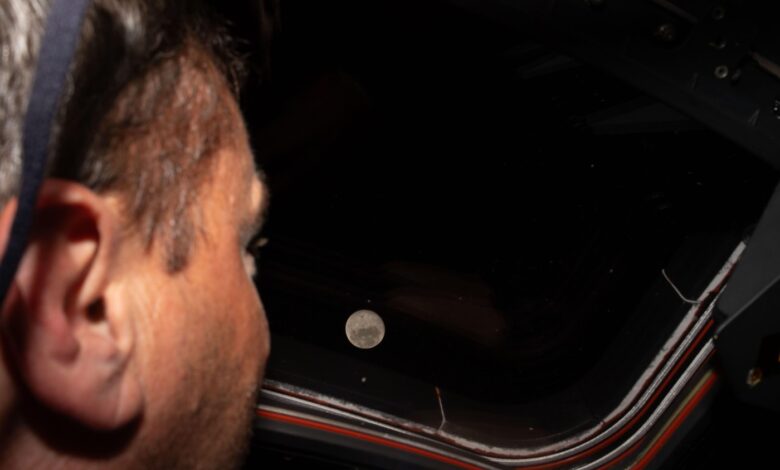
Astronauts on the Artemis II mission became the farthest humans have ventured from Earth on Monday, reaching more than 250,000 miles in space, NASA announced.
The three Americans Christina Koch, Victor Glover and Reid Wiseman, together with the Canadian Jeremy Hansen, thus surpass the record of the Apollo 13 mission, which in 1970 had reached the farthest distance from Earth after it had to change its trajectory following the explosion of an oxygen tank in flight – the famous situation “Houston, we have a problem”, reports AFP.
The Artemis II crew will continue to move further away, reaching a distance of 406,778 km from Earth.
NASA's Artemis II mission has reached the moon
The four astronauts of NASA's Artemis II mission aboard the Orion capsule launched from Florida last week are on their sixth day of flight on Monday. They entered the Moon's sphere of gravitational influence during this day as they moved on a trajectory that would take them above the far, hidden side of the Moon.
They thus became the people who flew the greatest distance from Earth in history.
Mankind, again close to the moon
This moment is the culmination of the Artemis II mission, which will last nearly 10 days and is the first manned test flight of NASA's Artemis program.
The series of multibillion-dollar missions aims to return astronauts to the moon by 2028, ahead of China, and establish a long-term American presence there over the next decade by building a lunar base to serve as a testing ground for possible future missions to Mars.
The flyby of the far side of the Moon will plunge the crew into darkness and cause brief communications disruptions as Earth's natural satellite blocks their connection to NASA's Deep Space Network, a large global array of radio antennas that the agency uses to communicate with the crew.
How long will the astronauts stay on the far side of the moon
The flyby will last about six hours, during which time the astronauts will use professional cameras to take detailed pictures through the window of the Orion capsule, providing a rare and scientifically valuable angle on how sunlight filters around the edges of the Moon, in a phenomenon that is practically equivalent to a lunar eclipse.
They will also have the opportunity to photograph a rare moment when their home planet, dwarfed by its record-breaking distance in space, will rise from the lunar horizon as their capsule emerges from behind the Moon – a spectacular, cosmic-scale reinterpretation of a moonrise seen from Earth.
A team of dozens of lunar scientists at NASA's Johnson Space Center in Houston will take notes as the astronauts — who studied a wide range of lunar phenomena in preparation for the mission — describe their observations as they re