Did Kopic make the wrong starting team with Argeș? What was the moment that changed the game at Mioveni


Article by Cezar Titor – Published on Sunday, 05 April 2026, 11:24 / Updated on Sunday, 05 April 2026 11:31
Last night, in Mioveni, FC Argeș and Dinamo kicked off round #3 of the play-off with a tie, 1-1, in a match that, beyond the result, reveals a clear contrast between the control of the game and the efficiency in front of the goal. GSP consulted the Wyscout report, and the conclusions can be consulted in the following lines.
The “Dogs” were the dominant team in almost all statistical chapters, but they were unable to turn their superiority into victory.
Dynamo, total control on paper
With a possession of 63% and no less than 472 passes, compared to only 228 of the hosts, Dinamo controlled the pace of the game, but without creating a decisive difference on the table.
Moreover, the accuracy of the passes was clearly superior for the Bucharesters, 83% compared to 67%, a sign of an elaborate but predictable construction. In fact, Dinamo's playing style was based on short passes, to the side or behind (average length of only 15.5 meters), in contrast to Argeș. The “Purple Eagles” relied on verticality (22.6 meters) and a much higher percentage of long balls (24% vs only 6%).
Share of long passes, in FC Argeș – Dinamo 1-1 // photo: wyscout
Dinamo was also better in the pressing chapter, with a PPDA of 5.7, compared to the hosts' 8.8which indicates more aggressive pressure and faster balloon recovery.
-
PPDA is a metric that measures pressure intensity. Simply put, how many passes a team allows the opponent before attempting to recover the ball. A small PPDA indicates aggressive and effective pressing, while a high PPDA reflects weak, withdrawn pressing. The acronym PPDA comes from “Passes Allowed Per Defensive Action”.
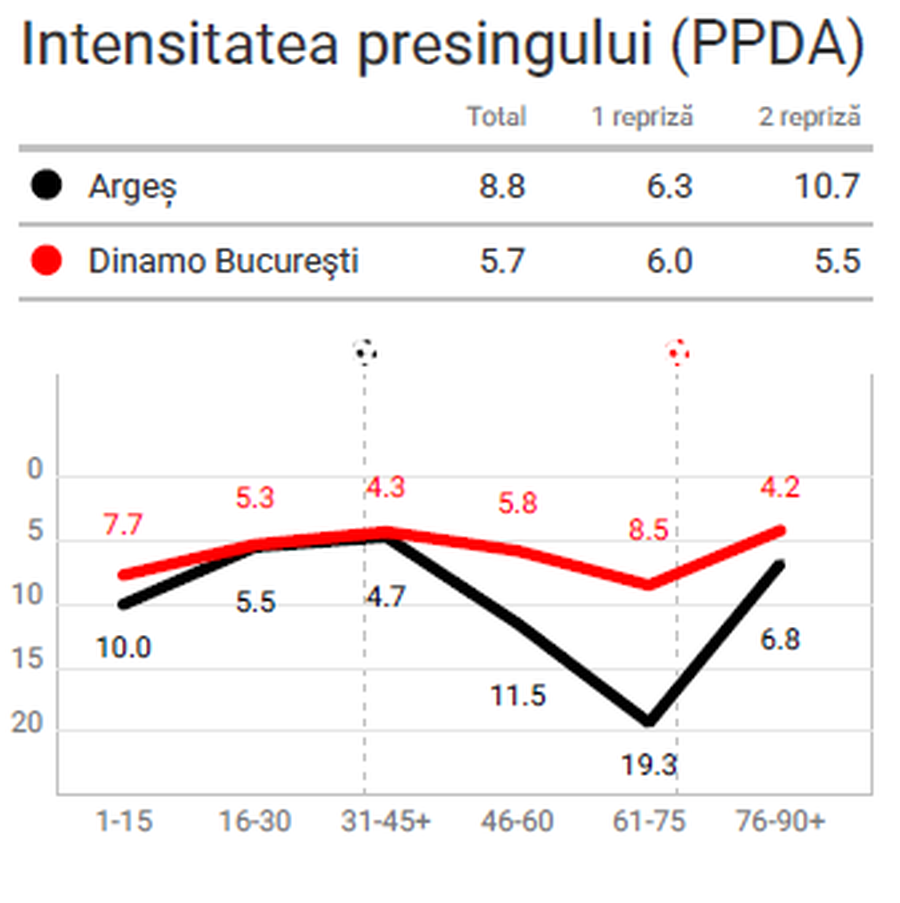
PPDA, in FC Argeș – Dinamo 1-1 // photo: wyscout
However, the balance was kept in terms of opportunities: the cumulative xG was almost identical (2.26 for Dinamo and 2.40 for Argeș), and both teams had 5 shots on goal.
Eddy Gnahore changed the game from the bench
The key moment came in the 57th minute, with the introduction of Eddy Gnahore.
The midfielder fortunately equalized in the 76th minute and was Dinamo's most dangerous player, with an xG of 0.71, the highest in the visitors' camp, taking into account another important chance, a few minutes before he put the ball in the net.
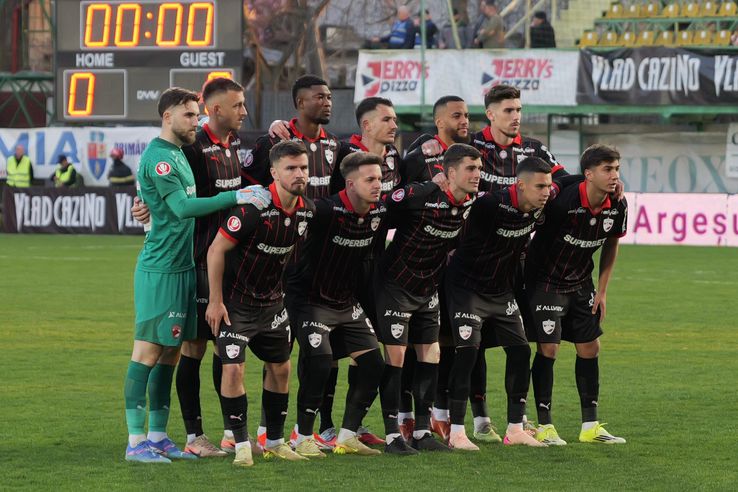
His impact was not limited to the goal. After his entry, Dinamo increased the intensity of the game: the team reached 69% possession in the second half and saw a significant increase in rebounds, from 0.17 per minute in the first half to 0.27 after the break. Basically, Gnahore moved the center of gravity of the game to the opposing half.
Regarding Gnahore, it was my decision. I knew that Mărginean is better in duels.
– Zeljko Kopic, after the matchexplaining the decision not to start the French midfielder
7was the grade awarded by GSP to Eddy Gnahore, after the match in Mioveni.
Another interesting detail comes from the evolution of Maxime Sivis. Dinamo's right-back was surprisingly one of the most dangerous men on the pitch, posting an xG of 0.68, a huge value for a defensive player who fails to score.
His constant presence in offensive phases confirms the increasingly offensive role of full-backs in Dinamo's system, Sivis having no less than 92 actions, of which 57 were successfulbeing extremely involved in construction and completion, albeit chaotic at some points in the game. Got 6 from GSP.