Sweden “cuts” the price at the pump. What are the rest of the European countries doing and where is Romania?


Sweden's government plans to compensate households for higher electricity costs and cut taxes on petrol and diesel amid rising oil prices following the Iran war, Prime Minister Ulf Kristersson said on Monday.
Sweden reduces tax on petrol and diesel. Photo by Shutterstock
The changes will be included in an amendment to the budget law, which the Executive will submit to Parliament on April 13, and which, Finance Minister Elisabeth Svantesson announced last week, includes new expenses worth 7.7 billion Swedish crowns ($812 million).
“Oil prices have risen significantly. All these developments are currently affecting and may continue to affect Sweden's economy.”Kristersson said at a press conference.
Hostilities launched by the United States and Israel against Iran since February 28 have raised concerns about the rise in global prices, especially due to the increase in the cost of hydrocarbons as a result of the closure of the Strait of Hormuz, through which a large part of the Persian Gulf countries' oil and gas exports pass.
In this context, several European states adopted measures to mitigate the impact of fuel price increases on the population and the economy, while international organizations in the energy sector issued recommendations to reduce oil consumption.
On the ICE Futures exchange, the price of a barrel of Brent oil from the North Sea fell by 7%, to approximately 103 dollars, against the background of optimism on the markets, after it had risen to 119 dollars on Friday.
US President Donald Trump threatened on Friday to destroy Iran's power plants if Tehran does not reopen the Strait of Hormuz by Monday evening. On Monday, however, he assured that in the last two days he held “very good and productive discussions” with Tehran regarding a “complete and total cessation of hostilities” and specified that the discussions “will continue this week.”
What measures have other European states taken?
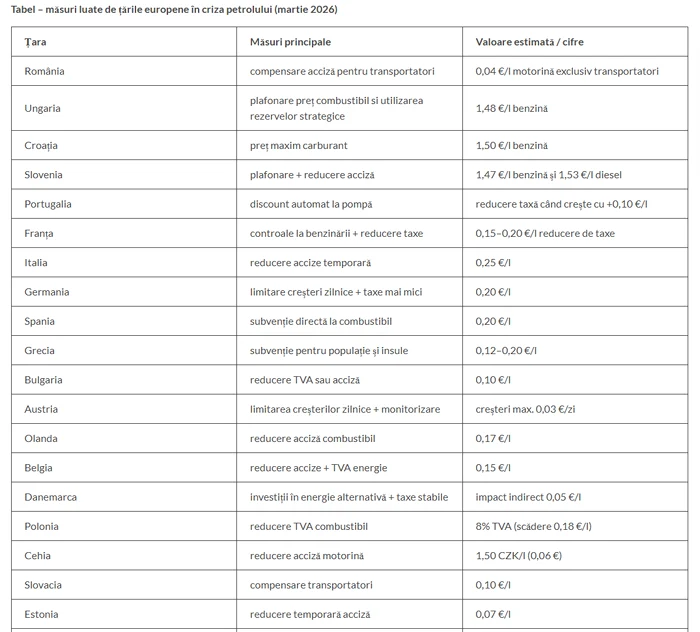
A recent analysis by Dumitru Chisăliță, president of the Intelligent Energy Association (AEI) shows that Hungary has capped the price at around 1.48 euros/l and used strategic reserves, and Croatia imposed a maximum price of around 1.50 euro/l for petrol. Slovenia combined the capping with the reduction of excise duties, reaching around 1.47 euro/l for petrol and 1.53 euro/l for diesel.
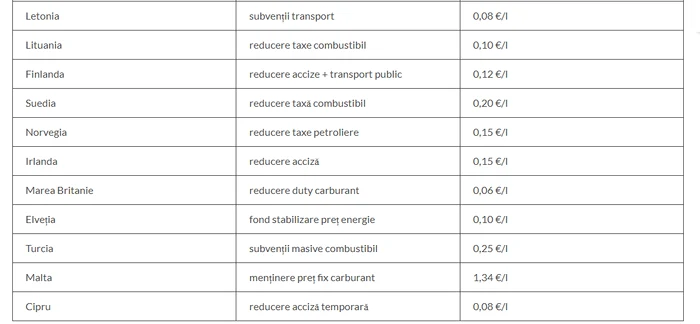
Poland reduced the VAT to 8%, which led to a decrease of approximately 0.18 euro/l, and Bulgaria operated tax reductions of around 0.10 euro/l. Czechia reduced the excise duty on diesel fuel by approximately 0.06 euro/l, Slovakia granted compensations of around 0.10 euro/l, and the Baltic States — Estonia, Latvia and Lithuania — applied discounts and subsidies between 0.07 and 0.10 euro/l.
In Western Europe, Germany reduced taxes with an impact of around €0.20/l and limited daily price increases, while France granted reductions of €0.15–0.20/l and stepped up controls at petrol stations. Italy reduced excise duties by approximately 0.25 euro/l, and Spain introduced a direct subsidy of 0.20 euro/l.
How much does petrol and diesel cost on Monday? Head of the International Energy Agency: The world is facing the worst energy crisis in recent decades
Portugal implemented an automatic compensation mechanism for increases above 0.10 euro/l, Greece provided support between 0.12 and 0.20 euro/l, especially for island areas, and Austria limited daily increases to around 0.03 euro.
Belgium combined the reduction of excise duties with the reduction of VAT, with an impact of approximately 0.15 euro/l, and Netherlands reduced excise duties by around 0.17 euro/l. Ireland applied a discount of 0.15 euro/l, Denmark had an indirect impact of about 0.05 euro/l through energy policies, and Finland and Sweden they reduced excise duties by approximately 0.12 euro/l, respectively 0.20 euro/l.
Outside the EU core, but included in the analysis, Norway reduced taxes by approximately 0.15 euro/l, Great Britain reduced the duty by 0.06 euro/l, and Switzerland used stabilization mechanisms with an impact of around 0.10 euro/l.
In southern Europe, Malta maintained a fixed price of around 1.34 euro/l, CYPRUS reduced excise duties by about 0.08 euro/l, and Turkey granted subsidies of about 0.25 euro/l.
Regarding Romaniain addition to the compensation granted to transporters for diesel fuel of approximately 0.04 euro/l, the Government announced that it will declare, on Tuesday, March 24, a crisis situation on the fuel market. The decision will be taken by Emergency Ordinance, for a period of 6 months, with the possibility of successive extensions for intervals of no more than 3 months, as long as the circumstances that determined the establishment of the crisis situation persist.
Also by ordinance, the commercial surcharge for gasoline, diesel and the raw materials used to obtain them will be limited on the entire chain of economic activity.
The export and/or intra-Community deliveries of petrol and diesel can be carried out by economic operators exclusively with the prior written consent of the Ministry of Economy, Digitalisation, Entrepreneurship and Tourism and the Ministry of Energy.
During the crisis, the amount of biofuel in gasoline is reduced to lower the final price.