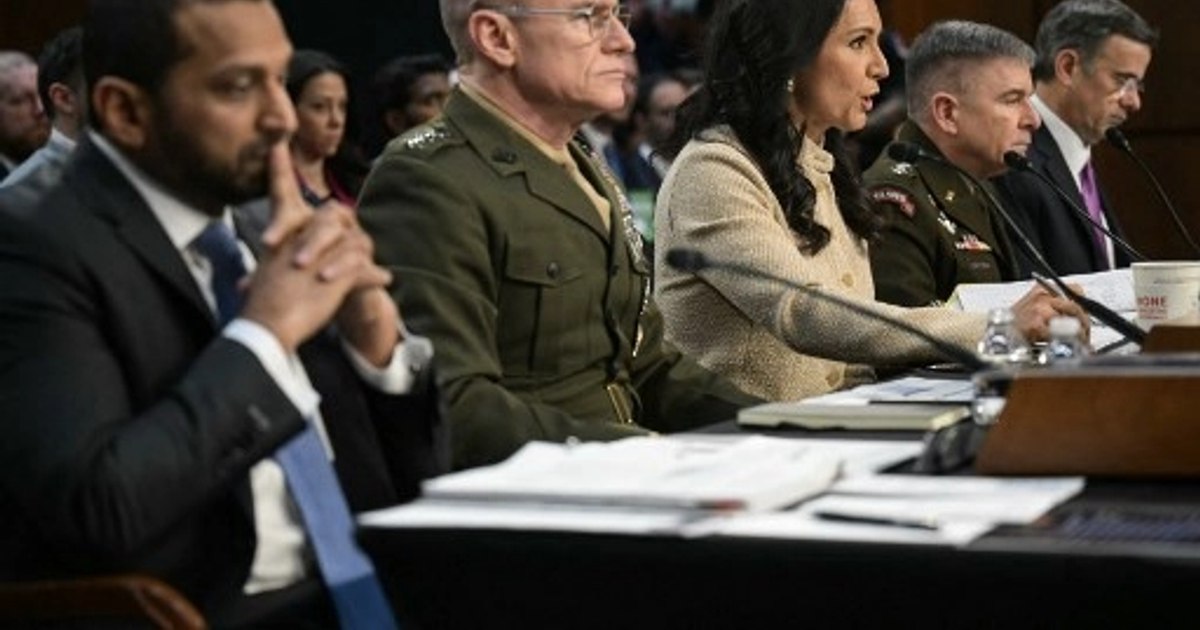
US intelligence officials were questioned by Congress about support for Ukraine and Russia's possible involvement in supporting Iran as part of the Senate Intelligence Committee's annual global threats hearing.
US intelligence chiefs/PHOTO: AFP
Discussions have focused mainly on the conflict in the Middle East and the military operation against Iran, but questions about Ukraine have constantly returned — especially amid concerns that Washington may struggle to maintain two fronts simultaneously.
Officials acknowledged that a prolonged conflict with Iran could put pressure on supply chains and ammunition stocks needed to support Kiev.
A notable moment of the hearing was the exchange of lines regarding the possible provision of information by Russia to Iran. CIA Director John Ratcliffe strongly rejected the idea of trusting Moscow's statements.
“I don't take Vladimir Putin at his word”, he said, when asked if Russia was providing intelligence support to Tehran.
He confirmed that Iran is seeking assistance from Russia, China and other states seen as adversaries of the United States, but avoided giving a clear public answer on whether that assistance is being provided, saying details could only be discussed in classified sessions.
Asked about media reports of possible cooperation between Russia, China and Iran, Ratcliffe said such information could not be publicly confirmed, but added that such behavior “would not be surprising”.
Iran, still capable of attacking American interests in the region
At the same hearing, Director of National Intelligence Tulsi Gabbard said the regime in Tehran has been weakened by recent military operations, but remains capable of attacking US and allied interests in the region.
She warned that if the regime survives, Iran may seek, in the long term, to rebuild its military capabilities, including its missile and drone programs.
American officials also emphasized the risks of expanding the conflict. According to the annual threat assessment for 2026, Russia believes that it has the upper hand in the war in Ukraine and has no reason to stop the offensive.
Moscow is confident that it can win the war
The report shows that Moscow is confident it can win the war and could force a deal on its terms.
But intelligence services warn that prolonging the conflict increases the risk of escalation, including a direct confrontation between Russia and NATO.
The document notes that Russia has already resorted to acts of sabotage against Western allies, and repeated signals of the use of nuclear weapons are raising concerns about the widening of the conflict.
At the same time, China's economic and technological support is seen as essential to maintaining Russia's war effort, reducing pressure on Moscow to accept a truce.
Despite losses at the front, the Russian army remains functional, and some military capabilities have even been strengthened during the conflict.
In Congress, the central question was whether the United States could simultaneously support Ukraine and operations in the Middle East. Officials admitted that there are real pressures, particularly around the rapid consumption of advanced munitions.
However, they argued that Washington is capable of handling both crises.
“We can do both at the same time”Ratcliffe said, referring to support for Ukraine and targets in the Middle East.
Assessments presented to Congress indicate that the war in Ukraine remains one of attrition, in which Russia currently holds the advantage on the ground and is unlikely to relent in the absence of a formal agreement.
The deployment of Marines to the Middle East raises fears of a possible ground intervention in Iran. Variants of military scenarios
At the same time, the conflict continues to have global effects—from the indirect involvement of other states to changes in the way modern wars are fought.
At the same time, American intelligence services warn that prolonging the war increases the risk of an escalation, including a direct conflict between Russia and NATO.
War has global effects
The report notes that Russia has already demonstrated a willingness to carry out acts of sabotage against Western allies in order to disrupt support for Ukraine. An incident in November 2025, when an explosion affected a railway line in Poland, is cited in this regard.
The document also draws attention to repeated signals about the use of nuclear weapons, as well as the use of dual-capable missile systems in Ukraine, which amplifies the risk of the conflict expanding.
Since the start of the full-scale invasion, Russia has issued nuclear threats, deployed nuclear weapons to Belarus, and suspended participation in major arms control agreements.
War also has global effects. According to the report, North Korean troops participated in combat operations, gaining military experience and access to Russian technology.
China's economic and technological support helps support Russia's war effort. Chinese imports of Russian oil and gas provide Moscow with important sources of income, while exports of dual-use goods and technologies support military production and reduce pressure for a ceasefire.
Despite the losses suffered on the front, the Russian army remains functional
Ground forces have expanded during the conflict, and air and naval forces are in some cases more capable than before the invasion.
The report warns that the greatest threat to the United States is a possible escalation of the conflict — either in Ukraine or in another theater — that could lead to direct confrontation, including the use of nuclear weapons.
Oman's foreign minister calls for end to Iran war: 'There is no scenario in which the US gets what it wants'
Russia continues to develop advanced weapons systems, including hypersonic missiles, anti-satellite capabilities and new nuclear platforms.
The conflict in Ukraine is also changing the way modern wars are fought. The widespread use of drones and autonomous systems has accelerated the adaptation of tactics on the battlefield.
Russia has shown some resilience in the face of Western sanctions
The report also highlights the increasingly important role of space services. Ukraine has demonstrated that a country without its own space infrastructure can integrate commercial and partner services to defend against an adversary with enhanced space capabilities.
US intelligence services also claim that Russia has used chemical weapons in Ukraine and that its actions are contributing to the weakening of international arms control mechanisms. However, it is considered unlikely that Moscow will resort to the large-scale use of weapons of mass destruction in the absence of a major change in the conflict.
Economically, Russia has shown some resilience in the face of Western sanctions, developing alternative financial systems and strengthening relations with other states.
But this adaptation comes with costs, including growing budget deficits, reduced investment in civilian sectors and a growing dependence on China.