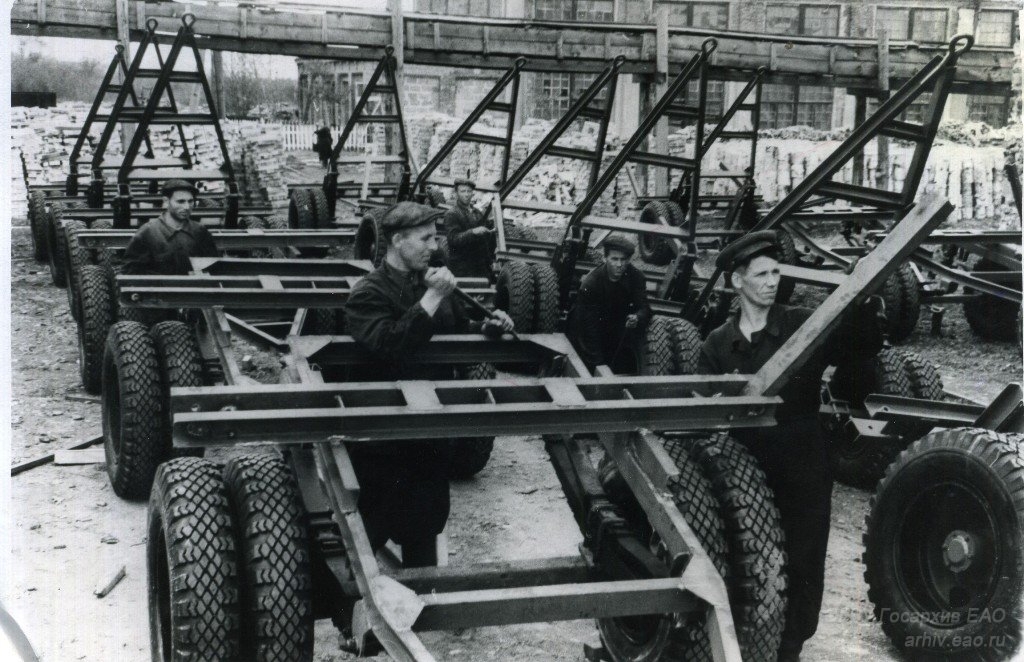
Birobidzhan convoy-building plant. 1954
Photo: State Archive of the Jewish Autonomous Region
March 19, 1957
A meeting of the active members of the regional and Birobidzhan city party organizations was held, at which the Resolution of the February (1957) Plenum of the CPSU Central Committee “On further improvement of the organization of industry and construction management” and the tasks of the regional and city party organizations were discussed. The adopted resolution defines specific measures to implement the resolution of the CPSU Central Committee.
March 19, 1974

Clippings from the newspaper “Birobidzhan Star”. Photo: Photo: Regional Library
In the newspaper “Birobidzhan Star” (12+), on the first page there is an article “With the award of the Motherland, dear comrades!” It talks about awarding orders and medals to residents of the region for their labor achievements. Here is how it is said in the newspaper material: “For success in fulfilling and exceeding the plans of 1973 and accepted socialist obligations, the Presidium of the Supreme Soviet of the USSR awarded orders and medals of the USSR to workers and engineering workers of enterprises and organizations of the Ministry of Meat and Dairy Industry of the USSR. Including in the Jewish Autonomous Region:
ORDER OF THE RED BANNER OF LABOR
Gladkikh Ekaterina Ignatievna – operator of the Birobidzhan dairy plant.
Gomzyakova Maria Georgievna – worker at the Birobidzhan meat processing plant.
MEDAL “FOR LABOR EXCELLENCE”
Karpenko Valentina Vladimirovna – master of the Smidovichi dairy plant.
Tyukavkina Elena Petrovna – worker of the Birobidzhan meat processing plant.”
March 19, 1979
On this day, a ceremonial meeting of the management team at the regional executive committee was held in Khabarovsk with the participation of representatives of state industrial enterprises and State Hunting Supervision services. It was dedicated to presenting the management with the rolling Red Banner of the Council of Ministers of the RSFSR and the All-Russian Central Council of Trade Unions for achieving the highest results in the All-Russian Socialist Competition for increasing production efficiency and quality of work, and the successful implementation of the plan for 1978.
Among the awarded teams was the Obluchensky State Industrial Enterprise, which was part of the regional hunting and fishing department.
“The challenging Red Banner was awarded to the management for significantly exceeding the annual plan for production and sales of products. “98 thousand rubles of over-plan profit were received. The annual plan for the procurement of furs, including sable, squirrel and mink, has been exceeded by more than 26%. Over the three years of the five-year plan, fishermen have prepared, in addition to the program, over 550 tons of mushrooms and berries, 263 tons of ferns, and a lot of fish.”
March 19, 1955

Workers of the Birobidzhan convoy plant Volynsky V. Sh., Burd S. M., fulfilling more than two standards daily. 1941. Photo: State Archives of the Jewish Autonomous Region

Birobidzhan convoy plant. Assembly shop. 1950s. Photo: State Archive of the Jewish Autonomous Region
“Exhibits for the All-Union Agricultural Exhibition” is the title of a small article in the newspaper “Birobidzhanskaya Zvezda” on March 19, 1955. It reports the following: “The Obozostroitelny Plant is presenting at the All-Union Agricultural Exhibition of 1955 samples of its products manufactured for agriculture: a cart of the P-49 brand and a steam-horse move. A machine made at the plant will also be sent to the exhibition for testing axial and radial runout of wheels”.
Since 1939, leading agricultural workers in the region have taken part in the All-Union Agricultural Exhibitions.
Brief historical background. Agricultural exhibitions taking place in Russia and the USSR are public displays of the achievements of agricultural production and science for the purpose of exchanging economic experience and disseminating new agricultural techniques.
In the Russian Empire, similar exhibitions were organized both general and special. The largest general exhibitions were held in St. Petersburg and Moscow. At these exhibitions, entrepreneurs entered into trade deals, and exhibits, especially farm animals, were sold at auction.
In Soviet Russia, the first All-Russian Agricultural and Handicraft Exhibition was opened on the initiative of V.I. Lenin on August 19, 1923 in Moscow.
The permanent All-Union Agricultural Exhibition (VSKhV) began to be held in 1939. On an area of over 140 hectares, more than 250 buildings (pavilions, greenhouses) were built, a large number of fruit and ornamental trees were planted, flower beds were planted, and exhibit crops were planted. The exhibition at the All-Union Agricultural Exhibition was built on a sectoral and territorial principle – by union and autonomous republics and individual natural zones.
In accordance with the resolution of the Council of Ministers of the USSR dated May 28, 1958, the Exhibition of Achievements of the National Economy of the USSR (VDNKh) was created on the basis of the All-Russian Agricultural Exhibition. VDNKh existed until 1992.