

[Aktualizacja godz. 10.05 — komentarz Agory]
Artificial intelligence is developing at an incredible pace. It carries great opportunities and equally great threats. The Internet is increasingly flooded with fake news. Some are relatively harmless, focused on cheap sensation.
Unfortunately, there is also content that is not only misleading and harms people's good name, but also they encourage activities that may result in loss of money.
See also: Poles are being robbed massively. A new team of two state institutions is intended to help with protection
The rest of the article is below the video
“You are robbing millions of Poles” – fake news from an imaginary interview with the president of the National Bank of Poland
An article with a sensational title appeared on the Internet: “'You are robbing millions of Poles': how Monika Olejnik crushed the president of the NBP live.” It looks as if it was published on the Gazeta.pl website, published by Agora (its group includes Gazeta Wyborcza and Radio Zet). However, this is just fake news that impersonates a well-known news portal. It must be admitted that he does it quite reliably.
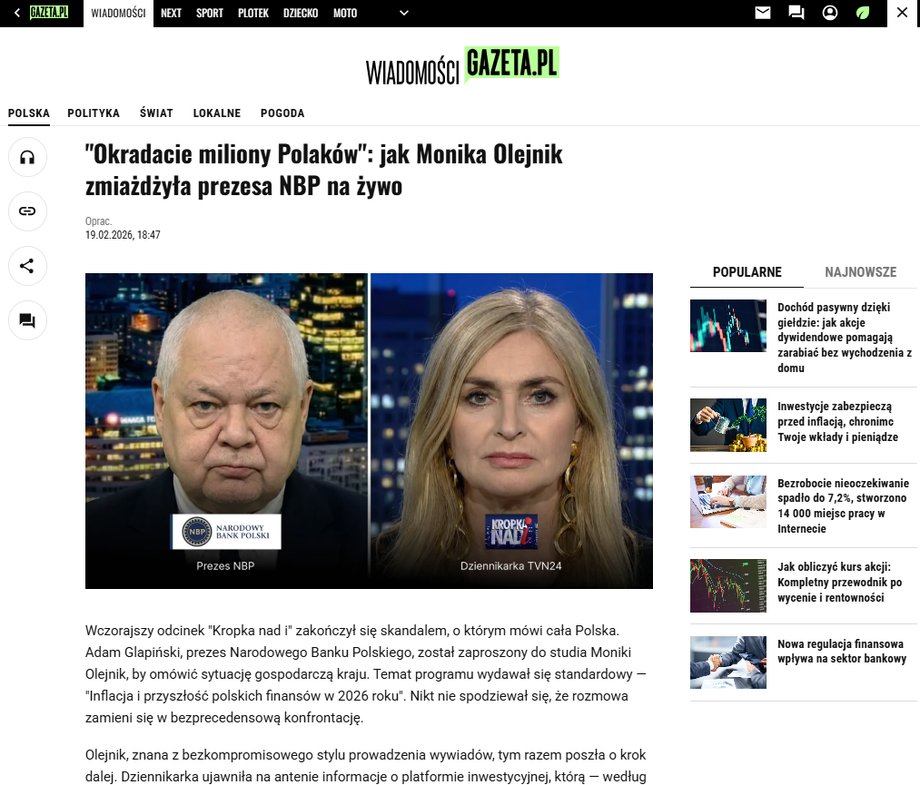
Fake news pretending to be published on Gazeta.pl
The article describes a fictitious interview by Monika Olejnik in the TVN program “Kropka nad i”. The reader learns from it that “a famous journalist revealed on air information about an investment platform which – according to her – the financial elites hide from ordinary Poles. Glapiński couldn't stand the confrontation. He ripped off the microphone and literally ran away from the studio to the applause of the audience. There was no such interview at all.
See also: “We have to fight to get our money back.” Banks are suing customers for fraudulent transactions
“Over PLN 7 billion of net profit. The average user earns from PLN 11,000. up to 23 thousand PLN per month. No credits. No commission for banks. And what is most interesting – we have information that NBP employees use this platform themselves,” Monika Olejnik was said to have said to the President of NBP, which of course did not happen.
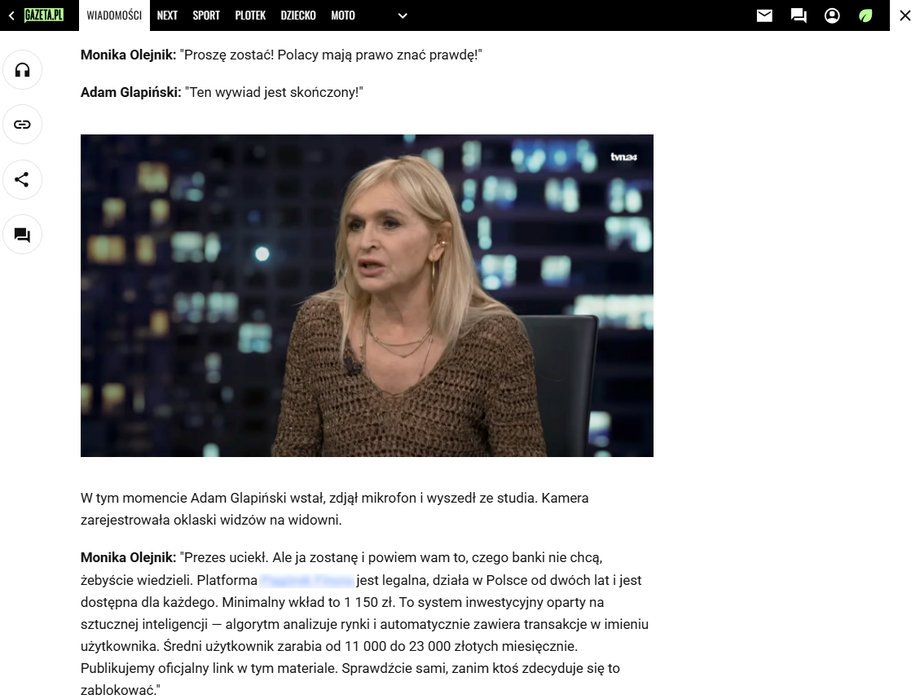
A fragment of a fake interview intended to imitate a publication in Gazeta.pl
|
Press materials
A fictitious article disguised as an interview between a journalist and a key figure in the Polish economy smuggles in advertising an investment platformpromising its users golden mountains. There are imaginary examples of people who were supposed to make a fortune from it.
In addition to anonymous people, the following people are also quoted by name: former director of PKO BP and an economist from the Warsaw School of Economics. This non-existent peoplewhich are intended to authenticate the message of fake news.
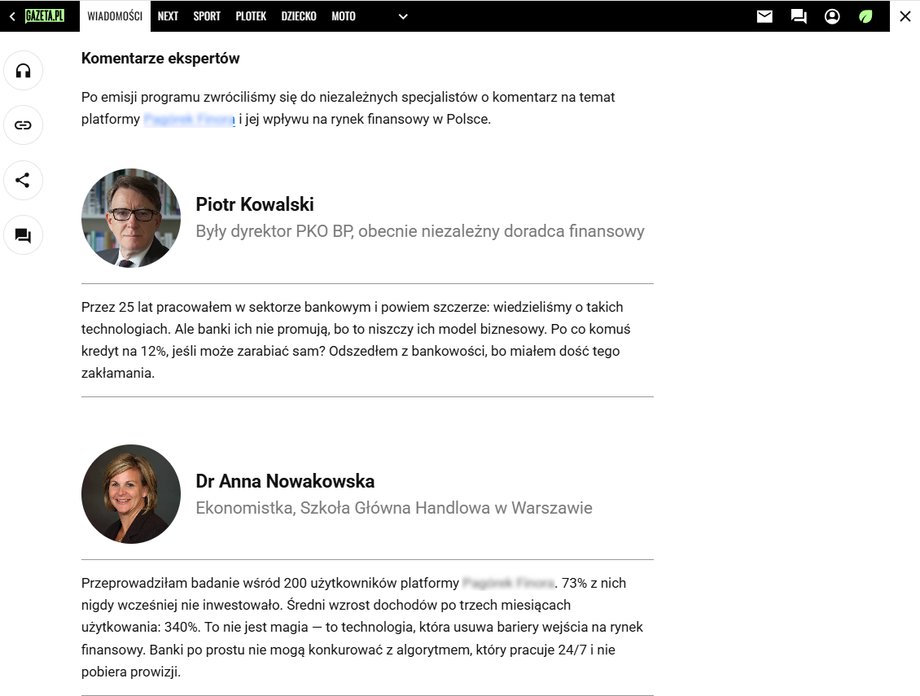
Made-up comments in fake news about an interview with the president of the National Bank of Poland
|
Press materials
Interestingly, you can go straight from this made-up article to the investment platform's registration form. At the same time, a mechanism involving pressure was used pressure on the readersuggesting that registration is only possible until the end of the day.
Fake news with the president of the National Bank of Poland. Bank, Agora and TVN comment
We asked, among others, for a comment on the matter: representatives of the TVN station.
“We monitor fake news using the image of presenters and journalists associated with us and counteract this phenomenon on many fronts, including by summonses to social media administrators and internet service providers or through criminal proceedings. We strive to remove fabricated materials as quickly as possible” – we read in a statement from the TVN Warner Bros. Discovery press office sent to Business Insider.
In turn, the National Bank of Poland told our editorial office that “monitors and responds to cybersecurity threats and disinformation regarding the NBP on an ongoing basis and its bodies, including attempts to impersonate the bank and unauthorized use of its image and good name.
“NBP cooperates with the relevant state authorities in order to identify and neutralize this type of activities and to take care of the image of NBP and its security. Each time it takes and will continue to take legal actions in the event of unauthorized use of the image of the President of NBP or the NBP logo and any fraud attempts related to it,” we read in the sent statement.
What does Agora say about this? “We most often receive information about false content impersonating our brands from Gazeta.pl users, such cases are reported by Wyborcza.pl readers. Each time we report the website to be blocked at CERT.pl, and if the matter concerns social media, we contact the given platform and demand that the false content be removed. Additionally, we inform users of our websites how to act in such situations and operate based on internal procedures” – comments the publisher's press office in response to Business Insider's questions.
However, he adds that “identifying people responsible for spreading false content is very difficult in practice.” It doesn't change the fact that Agora filed reports on suspicion of committing a crime. Proceedings are ongoing.
The Polish Financial Supervision Authority intervenes. Blocked tens of thousands of websites per year
We asked the Polish Financial Supervision Authority, which supervises, among others, over the financial market.
— The link to the fake article has already been reported by us – says Jacek Barszczewski, spokesman for the Polish Financial Supervision Authority.
— Thanks to cooperation between CSIRT NASK and sector CSIRTs the domain in question was added to the Warning List on February 19 at 10:22 a.m. and is no longer available – adds Katarzyna Szumotalska-Samorek from the communications office of the Ministry of Digitization in an interview with Business Insider.
In an interview with Business Insider, Jacek Barszczewski points out that “a made-up article is one of the stages of the so-called investment fraud in which a potential victim is manipulated to extort funds“.
See also: The Polish Financial Supervision Authority denies reports regarding payment transactions in banks
“Such content is created by organized groups of cybercriminals extorting funds from Internet users,” warns the KNF spokesman.
We asked the Polish Financial Supervision Authority whether the office has tools to combat this type of harmful content and what steps it is taking. In response we heard that There is a KNF CSIRT team within the structures of the Polish Financial Supervision Authority, which monitors the described phenomenon and takes actions aimed at limiting it..
As part of the tasks implemented in 2024, the following were identified: 45985 websites blocked related to this practice. Data for 2025 will be published in March.
How to identify investment fraud?
The main categories of attacks identified by the Polish Financial Supervision Authority in 2024 are:
- Fake investments: 45,985 domains (89.4%)
- Fake surveys: 4030 domains
- Courier/postal services: 521 domains
- Social networking sites: 166 domains
- Fake payment gateways: 125 domains
Images of the following groups were used in the identified attacks:
- Politicians: 26 percent
- Other: 19 percent
- Celebrities: 14 percent
- Recovery of funds: 11 percent.
- State Treasury companies: 11 percent
- Baltic Pipe: 7 percent
- Entrepreneurs: 6 percent
- Influencers: 4 percent
- Bank: 1 percent
- Tesla: 1 percent
An example of a fictitious interview disguised as an article on a well-known portal is only the first stage of a larger fraud. As indicated by the Polish Financial Supervision Authority, this is the persuasion stage consisting of:
- Presenting invented investment success stories, often with the participation of supposed “experts”
- Simulating profits that encourage users to deposit more
- Using pressure, such as limited promotional offers, to force the victim to act quickly
- Using fake investment advisors who contact victims directly
The next stage is fraud:
- Requiring a minimum deposit as a condition for participation in the investment platform
- Encouraging further payments, allegedly increasing potential profits
- Blocking withdrawals and forcing additional fees, e.g. for “account verification” or “refund”
The scheme of the investment fraud itself can be illustrated as follows:
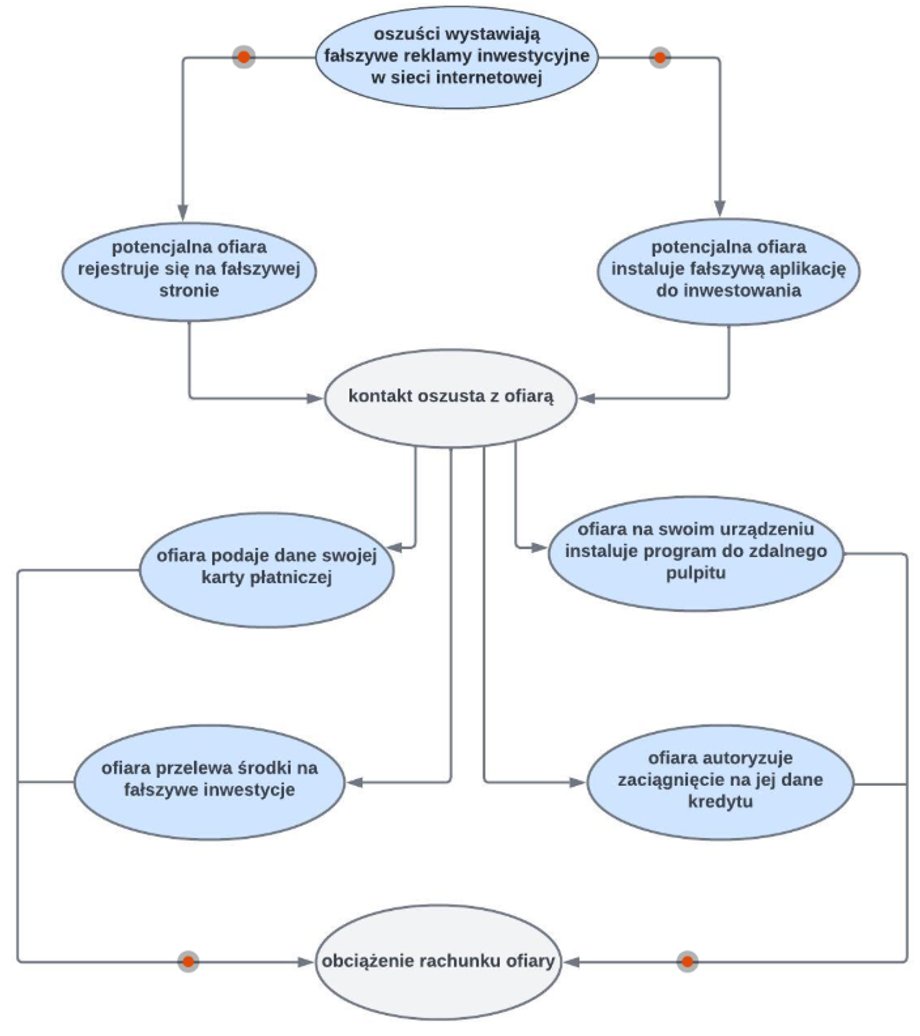
Fraud scheme for “fake investments”
|
KNF CSIRT
Investment fraud on the Internet. It is worth checking suspicious links there
CSIRT KNF carries out activities mainly based on the “Act on Combating Abuse in Electronic Communications” and the CERT Polska Warning List. All blocked domains are available on the public list HERE. There are almost 150,000 of them.
“Warnings about new methods of cybercriminals' operations, as well as detected malicious websites, are available on the CSIRT KNF social media (https://x.com/CSIRT_KNF), as well as on the educational website https://cebrf.knf.gov.pl/,” informs the KNF spokesman.
Fake campaigns are appearing more and more often. The Ministry of Digitization indicates special techniques
What does the Ministry of Digitization say about all this? “We have been monitoring similar cases for a long time. Since October 2025, we have observed an intensification of such activities“- admits the ministry's press office.
“We are currently at the stage of research, analysis of the network of connections and piloting tools for classifying and searching the space of social networking sites for this type of campaigns.. Thanks to such activities, we are able to identify repetitive patterns as well as tools and infrastructure used by fraudsters,” says the ministry in a response to Business Insider.
He adds that research and analytical activities aimed at developing detection methods are carried out in parallel. “Such campaigns are, unfortunately, a well-known and repeatable fraud pattern,” the ministry admits. Indicates that repeating the same patterns over and over again suggests operation of organized criminal groupswhich use ready-made narrative templates and infrastructure that allows you to quickly create subsequent versions of the same operation.
The Ministry of Digitization draws attention to an interesting aspect of investment fraud. “In this type of campaigns, the so-called cloaking, i.e. a technique of hiding the actual content from moderation systems and outsiders. Fake advertisements leading to such websites are displayed to selected, previously profiled groups of users, e.g. people who have previously interacted with investment or financial content,” explains the ministry.
In practice, a link opened from an advertisement leads to a malicious website, while the same address visited by analytical tools may display neutral, noisy or completely different content.
The ministry emphasizes that the infrastructure of such campaigns is very dynamic – domains and ads rotate quickly or are deactivated, and content is moved to new addresses. This process makes it significantly difficult to document incidents, quickly report or block them, as well as monitor the scale and scope of the campaign.
The president vetoed a bill that supported the elimination of illegal content
As the Ministry of Digitization emphasizes, “the elimination of illegal content on online platforms would be facilitated by the entry into force of the provisions of the EU Digital Services Act (DSA). Unfortunately, the act implementing these provisions into the Polish legal order was vetoed by the president“.
The Ministry of Digitization informs that it has prepared new draft laws. The regulations have been included in two drafts to speed up implementation. The draft laws have already been submitted to the list of legislative and program works of the Council of Ministers.
“Currently, the Minister of Digitization is the Government Plenipotentiary for Cybersecurity. He is responsible for three CSIRTs at the national level – CSIRT GOV, CSIRT MON and CSIRT NASK, each of which is assigned its own areas of operation. Cooperation is paying off, and the protection of the Polish Internet will be more and more tight – new sector CSIRTs are already being created, thanks to which the prevention of the activities of cybercriminals will be even more effective,” the ministry argues.
Author: Damian Słomski, journalist of Business Insider Polska


