Iran's new tactics. It turned the Strait of Hormuz into a death trap


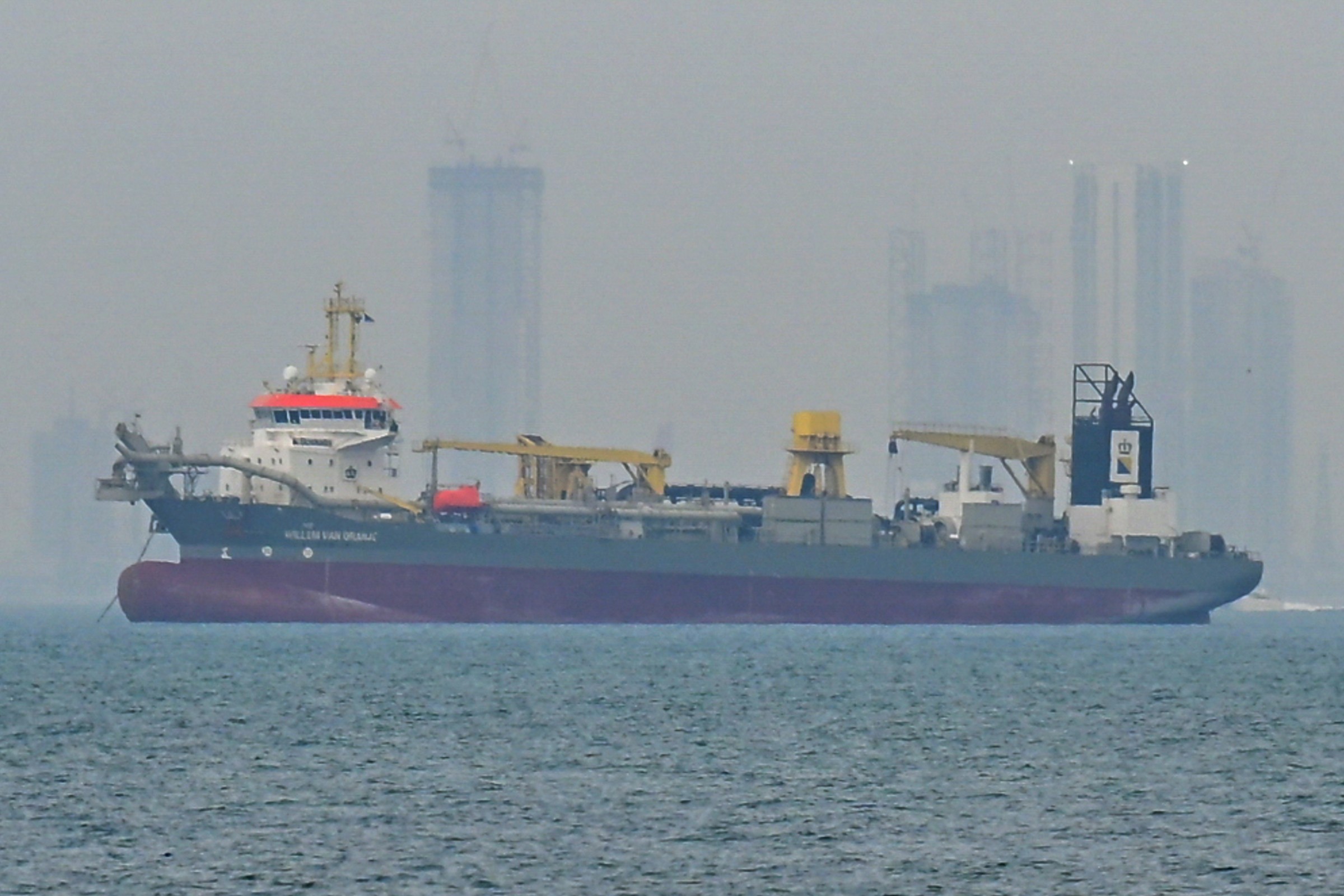
The Safesea Vishnu itself – an oil tanker carrying the flag of the Marshall Islands – has a deadweight tonnage of approximately 73,000 tonnes. 900 tons, which corresponds to a capacity of approximately half a million barrels of oil. If the tankers sink, there will be a risk of a huge ecological disaster. The last data on the position of both ships is from 13 hours ago. After this, the signal about their position was lost.
Thus, US President Donald Trump's claim that the US Navy can secure commercial traffic through the Strait of Hormuz and the Persian Gulf turns out to be baseless.
Iran does not focus on a classic naval war – uses the experience that the Russians must have gained in the Black Sea and which they most likely passed on to the Iranians. These make surface vessels and merchant ships highly vulnerable to attacks by slow and low-flying drones and remotely operated overwater and underwater vehicles carrying explosives. Modern mines also resemble underwater drones more than the explosive shells known from World War II films. They can independently track and attack detected targets.
The Strait of Hormuz is particularly suitable for this type of warfare. The narrowest point of the isthmus between Iran's Larak Island and Oman's Great Quoin Island is only 38 km wide, and the waterway is limited to 3 km. Iran's coast rises steeply there, and the coastal mountains behind the port city of Bandar Abbas are perfect for launching stealth flying drones from there.
According to its own propaganda, in the years leading up to the war, Iran had dug dozens of tunnels near the coastline from which remote-controlled boats could launch. Already in 2025, he published propaganda videos showing such boats – each carrying one or two mines. It is doubtful whether Iran's reported numbers of hundreds of units are true. It is also unknown how many of their tunnels have already been detected and destroyed. Just a few hits on a mine can interrupt ship traffic for weeks or months.
Difficult to detect
Famous photos of Iranian surface drones show small motorboats, only 7 meters long, with fiberglass hulls, unmanned and with the lowest possible superstructure. Such vehicles are difficult to detect on radar, especially in small waves, and can easily carry half a ton of explosives at speeds in excess of 40 knots (or over 74 km per hour).
How difficult it is for even armed naval vessels to defend against these boats is shown by Ukraine's successful attacks using almost identical overwater drones on Russian vessels in the Black Sea. NATO frigates and corvettes use rapid-firing light naval guns to defend against such attacks, but merchant ships are completely helpless.
Defense becomes even more difficult when drones are used to autonomously lay sea mines in the strait. According to American reports, the most dangerous mine in Iran's arsenal is the Chinese EM52 mine. It can be located at a depth of up to 200 m. If it detects a target within the range of its acoustic and magnetic sensors, it can fire an explosive charge using an underwater rocket at a speed of over 100 knots (about 185 km per hour), and its range is 3 km. A single such mine can block the entire waterway.
In addition to the Chinese models, Iran may also use Russian UDM sea mines and its own equivalents. They are intended for use in shallower waters and are specially protected against modern mine clearing methods. They can be dropped from the air by small craft or even large drones, after which they settle to the bottom and are almost invisible to sonars.
They are equipped with magnetic field sensors and computer control that, depending on the software, is activated only after several ships have passed. This makes them somewhat resistant to modern demining methods, in which remotely operated so-called stick boats simulate the magnetic field of a larger craft to cause mines to prematurely detonate.
Limited possibilities
The United States has relatively few tools to counter this. The last wooden-hulled Avenger-class minehunters, stationed in the Persian Gulf for decades, were decommissioned last September and sent to the scrapyard.
This leaves the newer multi-role Littoral Combat Ship (LCS) type. Unlike old specialist boats, they do not enter the minefield themselves, but use unmanned boats, underwater drones and helicopters with mine detection devices. This concept is considered modern, but prone to failure. In the 2024 tests, the Directorate of Operational Test and Evaluation (DOT&E) — the U.S. Department of Defense's independent watchdog responsible for assessing the operational readiness of new weapons systems — repeatedly criticized the high failure rates and technical shortcomings of the drones in use.
Particularly problematic are the stern lifting devices used to launch the drones. If this mechanism fails, the ship will not be able to conduct mine countermeasures operations. There have also been documented cases of damaged towbars, loss of remote control connection, and sonar problems in turbid, shallow waters – exactly the conditions found in the Persian Gulf. Moreover, these ships have a stronger magnetic signature than earlier wooden boats.
The US Navy therefore relies entirely on technically complex remote control systems – if one of them does not work, all mine defense is stopped.
During NATO operations during the Cold War, the United States traditionally relied on the demining capabilities of European allies – they had much greater experience in clearing mines left in the North and Baltic Seas after World War II. One of the first missions of the German Navy outside the NATO area was the removal of Iraqi mines in the Persian Gulf in 1991. The mission lasted several weeks and already showed how time-consuming this task was.
In this context, Donald Trump's promise to keep the Strait of Hormuz open to international maritime traffic seems increasingly nonsensical. The narrow passage, protected by technically failure-prone mine protection systems, threatened by difficult-to-detect drones, Shahids and modern sea mines, cannot be controlled solely by political determination. A few targeted attacks or undetected mine hits are enough to force insurers to cancel their policies and, consequently, shipping companies to withdraw from the contract.